Part VI of our series on Preparation
 As we talked about in our previous post, we need a discipleship strategy that links the hearing and the doing of the word. The good news is, we don’t need to develop anything new because this goal of linking the hearing and the doing of the word has been the basic approach to discipleship through most of Christian history.
We can look at many great Christian teachers to learn how they linked the hearing and doing of the word. In the ancient church there were those like Origen, Tertullian, and Augustine. And then the Protestant reformers: Luther, Calvin, and Simons all wrote about this question. As did John Wesley in the 1700s , and so on.
In other words, it’s not a denominational question.
It is a question that all Christians must deal with regardless of whether we come from Presbyterian, Methodist, Baptist or any other background.
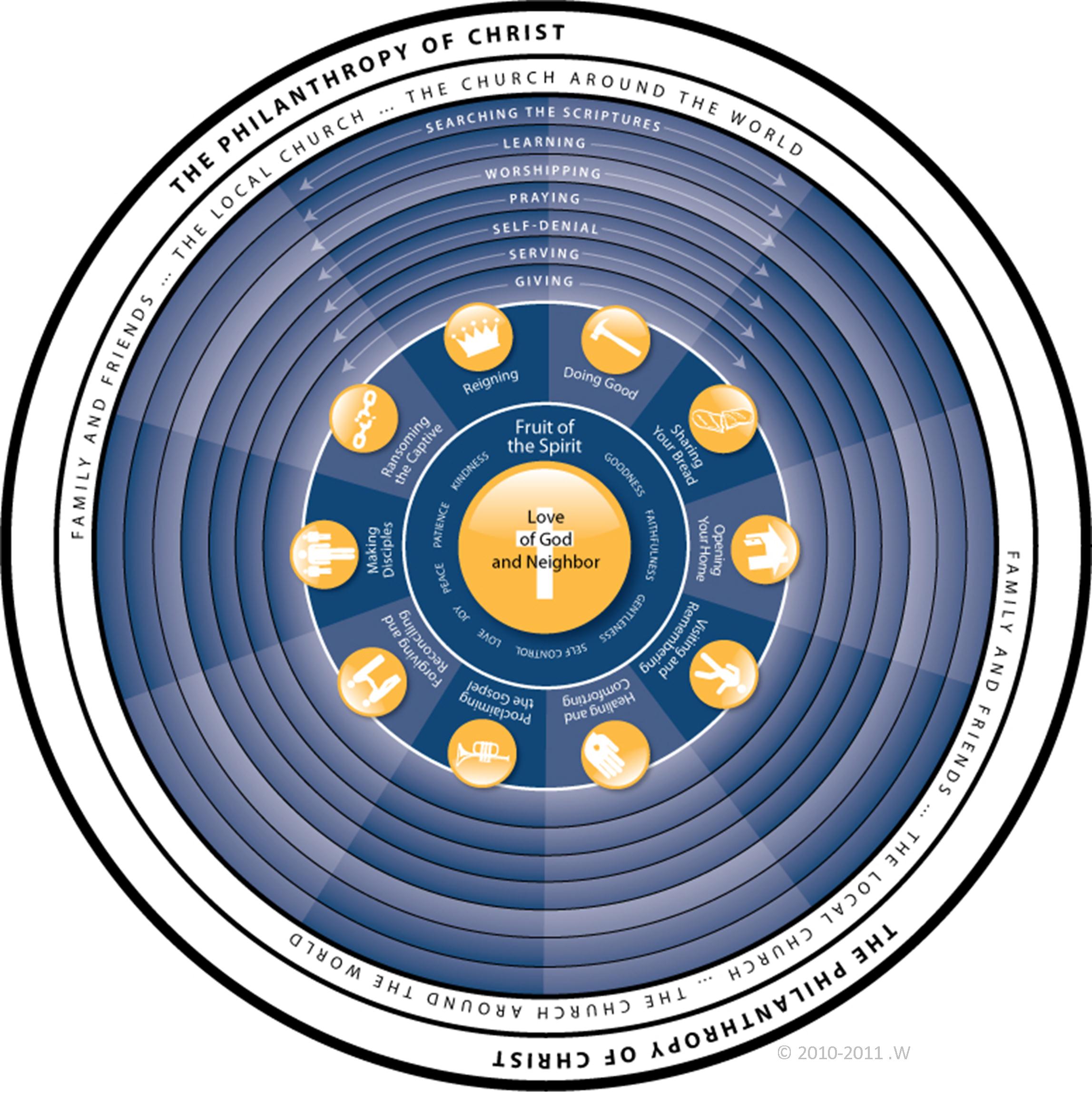
The model I want to show you today comes from a book that I wrote called The Whole Life Offering (click the image to view a larger version).
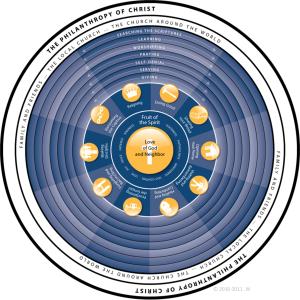
In Romans 12 Paul says, “Present your bodies as a living sacrifice.” That is a whole life offering. That’s what is being represented in this diagram.
It is a practical strategy for comprehensive discipleship. It may look very complicated but it’s not hard to understand.
By using a diagram like this, we can make sure that we are helping our disciples to grow in all of the areas God calls us to. With a tool like this we can make sure that the hearing of the word and the doing of the word stay joined at the hip.
For the better part of 2000 years in the church, that internal spiritual development part of discipleship has been called “Works of Piety” and you can see those represented on the diagram as Searching Scripture, Learning, Worshipping, Praying, Self-Denial, Serving, and Giving.
Let’s look at Ephesians 2:10:
For we are God’s handiwork, created in Christ Jesus to do good works, which God prepared in advance for us to do.
According to this verse, we were created for works that he prepared for us to do beforehand. So on the one hand we have Works of Piety, and on the other hand we have these good works, which the church has typically referred to as “Works of Mercy”.
The Works of Piety are internal, while the Works of Mercy are external.
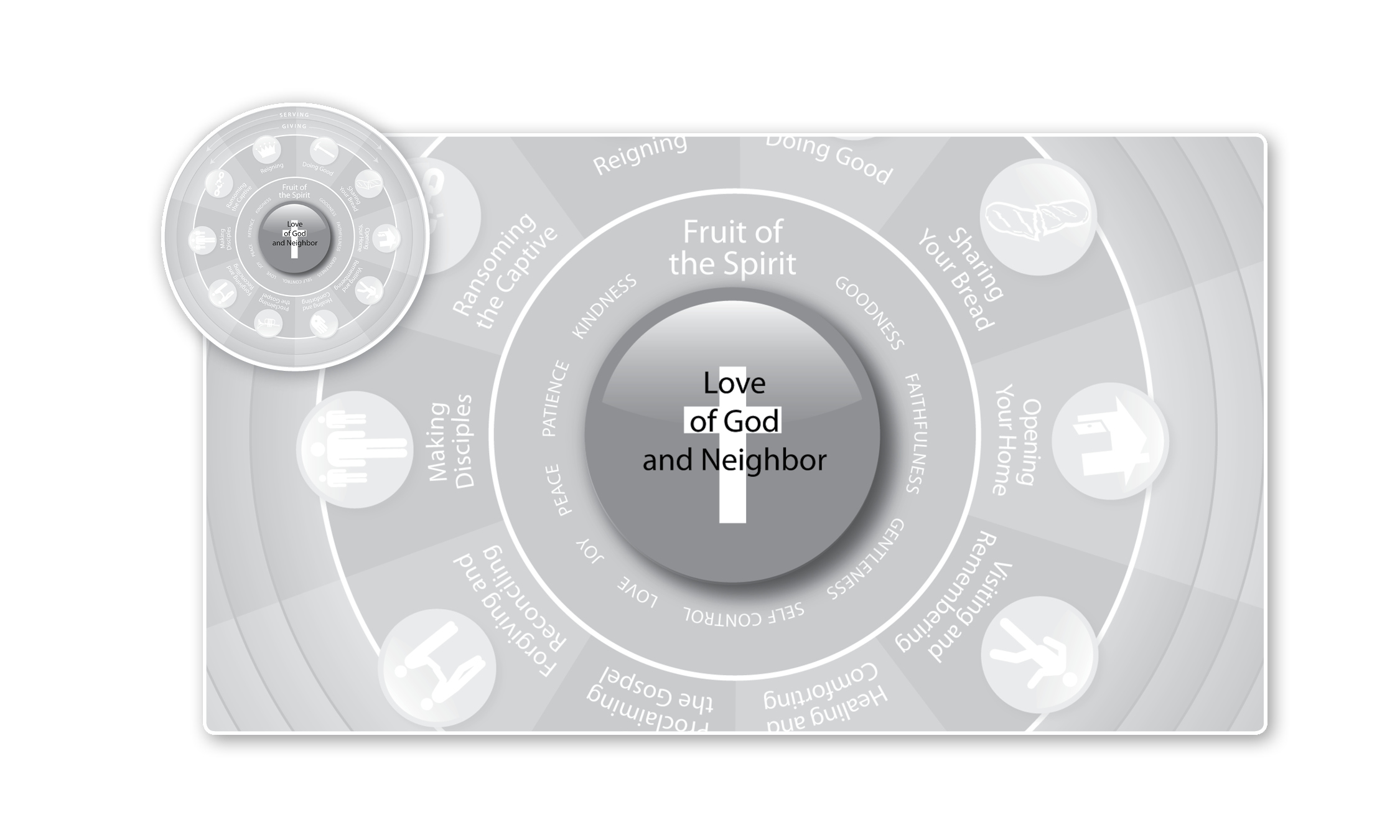
Now look at the center of the circle. There are two commandments there: love God and love neighbor.
Jesus says these are the great commandments. At the heart of the Christian life, we link those together: loving God, loving neighbor; hearing the word, doing the word.
Internal development/external ministry, the works of piety/and the works of mercy – these things are always joined together at the center of the Christian life.
Now, look at the outside of the circle. The outside of the circle says, “the philanthropy of Christ.”
Philanthropy is usually used to indicate the giving away of money but it is actually a biblical word from Titus 3:4. It says, “When the goodness and loving-kindness of God appeared.” In Greek the word for “loving-kindness” is “phil-anthropy.”
In Greek “phil” means love and “anthropos” is people.
But it is not our love for others. Everything that’s inside of this diagram is about God’s grace–his philanthropy. You’ll see in verse 5 of Titus 3 that God saved us not because of works done in righteousness, but according to his own mercy. Everything that happens inside this circle is God’s love to us—including the Works of Mercy we perform on other people.
Christ’s love forms the outside of the circle because everything that happens inside of the circle is God’s work; it is God’s doing; it is God’s activity in our lives. It’s not something we do in our own power, it is God’s work in us.
The next circle in—the one that says “Family, Local Church, Church Around the World” reminds us that this activity of God is not something that’s just between he and us.
Discipleship in the Christian church and grace from the living God has never been just an individual experience. It is always pictured in Scripture as a group activity.
Wow, does the church fail to see that today.
“Yeah, I don’t go to church but I’m spiritual.” Huh? But God shares his grace collectively with his children; what are you doing over in the corner by yourself being spiritual?
Jesus always taught people in groups. When Jesus taught evangelism in Luke 10, he taught 72 disciples at the same time. Each of us belongs to three different communities.
At its base, discipleship takes place in the family, meaning discipleship is not simply the pastor working with each individual Christian. Parents have the primary responsibility to disciple their own children. That’s the first community of which we each are a part.
The second is the local church. Here we’re reminded that discipleship does not only happen in the family but it happens as we come together in God’s wider family.
Third is the church around the world. Each of us belongs not only to our own local fellowship but to all of God’s people. The body of Christ only grows to fullness if the whole church around the world is working together and sharing with each other.
Now, here’s a key principle that’s fallen by the wayside today:
Missionary service always begins locally before it goes global.
Jesus says to his disciples in Acts 1:8, “You will be my disciples in Jerusalem, Judea, Samaria and the ends of the earth.”
So, if a person is not faithful to disciple their own children, they cannot disciple others in the local church. This is Paul’s message to Timothy in 1 Timothy 3:1-5:
The saying is trustworthy: If anyone aspires to the office of overseer, he desires a noble task. Therefore an overseer must be above reproach, the husband of one wife, sober-minded, self-controlled, respectable, hospitable, able to teach, not a drunkard, not violent but gentle, not quarrelsome, not a lover of money. He must manage his own household well, with all dignity keeping his children submissive, for if someone does not know how to manage his own household, how will he care for God’s church?
The same applies to us: in order to be able to minister to the church around the world, we have to first be faithful in our local church. The early missionaries would travel with a letter from their church authorizing them as good ministers in their local context.
So, when someone is faithful here, God will raise them up there. But we have too many church missionaries that were not faithful in their local church (the local church doesn’t even know who they are) who are ministering abroad and causing many problems; they don’t disciple well—they never learned how to disciple others (or even be discipled by others) at home.
In our next post, we’ll go into more depth about the Works of Mercy.
What else might be helpful to know about The Whole Life Offering Diagram? What do you need to be able to explain it to others?








 Do the Word