
How Trying to Do Good Can Result in Bad

Part XI of our series on Preparation
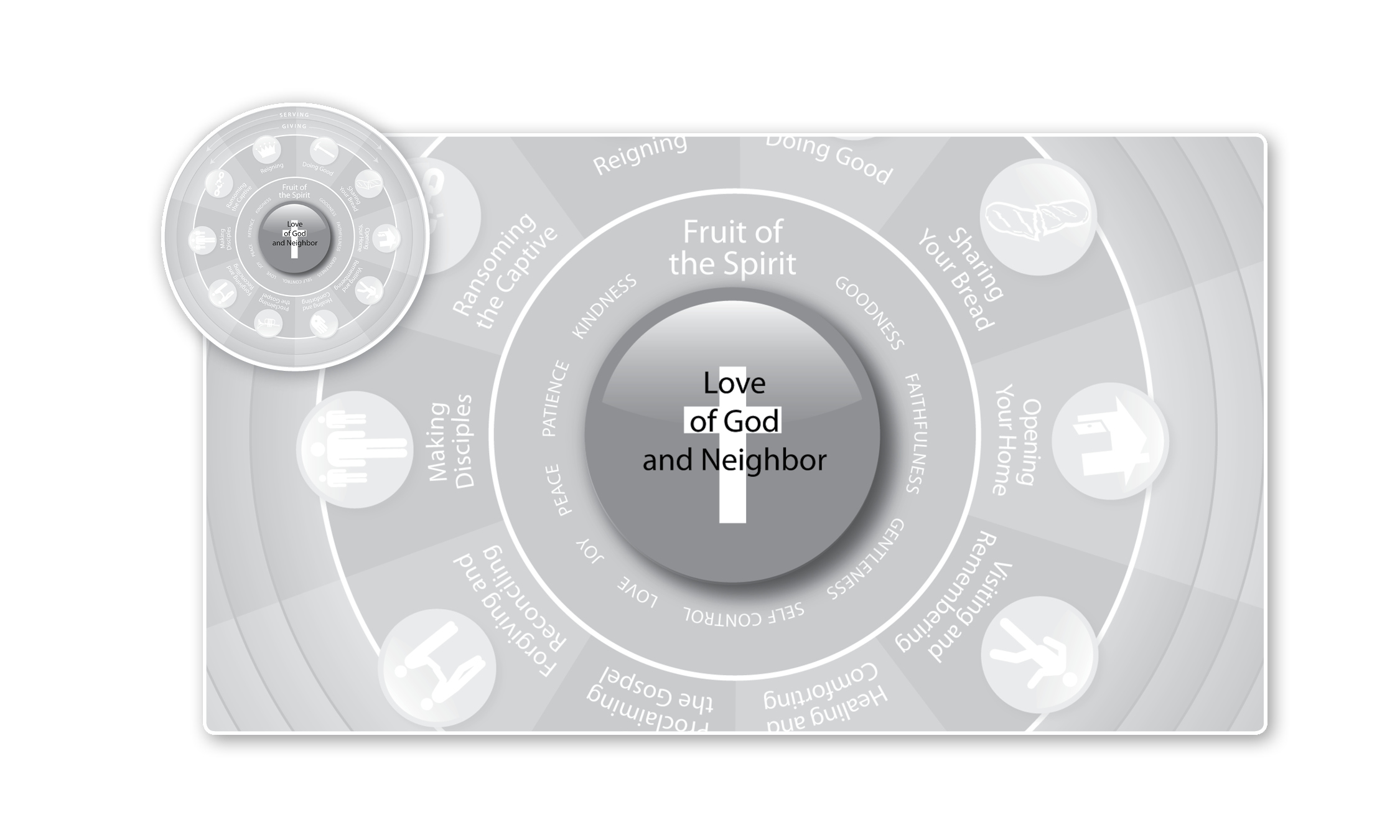
We concluded our last post by noting the importance of the Works of Mercy in training our body.

But before we continue, we need to make one thing clear that so often gets muddied in today’s change-the-world Christian climate.

We are not called to originate the Works of Mercy. That would yield what Paul in Galatians 5:19-21, NIV, calls “the acts of the flesh”:

“The acts of the flesh are obvious: sexual immorality, impurity and debauchery;  idolatry and witchcraft; hatred, discord, jealousy, fits of rage, selfish ambition, dissensions, factions and envy; drunkenness, orgies, and the like. I warn you, as I did before, that those who live like this will not inherit the kingdom of God.”

Initially it is hard to imagine how focusing on trying to do good could lead to all these bad things.

But James 1:17, NIV, says, “Every good and perfect gift is from above, coming down from the Father of the heavenly lights, who does not change like shifting shadows.”

The root of trying to originate Works of Mercy (rather than pass on the ones we have received from Christ) is the Original Sin of Genesis 3:4: trying to be like God rather than carrying out our purpose of glorifying God by passing on what we have received from him.

We need to retrain our souls and spirits to receive and pass on good gifts, not to generate them. This is counterintuitive to the degenerate human mind.

When we “seek first his Kingdom and his righteousness” (that’s Matthew 6:33, NIV, which shows the body receiving from the soul and the soul receiving from the spirit, by the way), then our bodies receive all the good gifts they need. And our hearts are retrained to desire the good things God wants, and to desire to pass them to others in the way we have received them.

That means the body is the indispensable third part of the tripartite human form that mirrors God’s Trinitarian being:
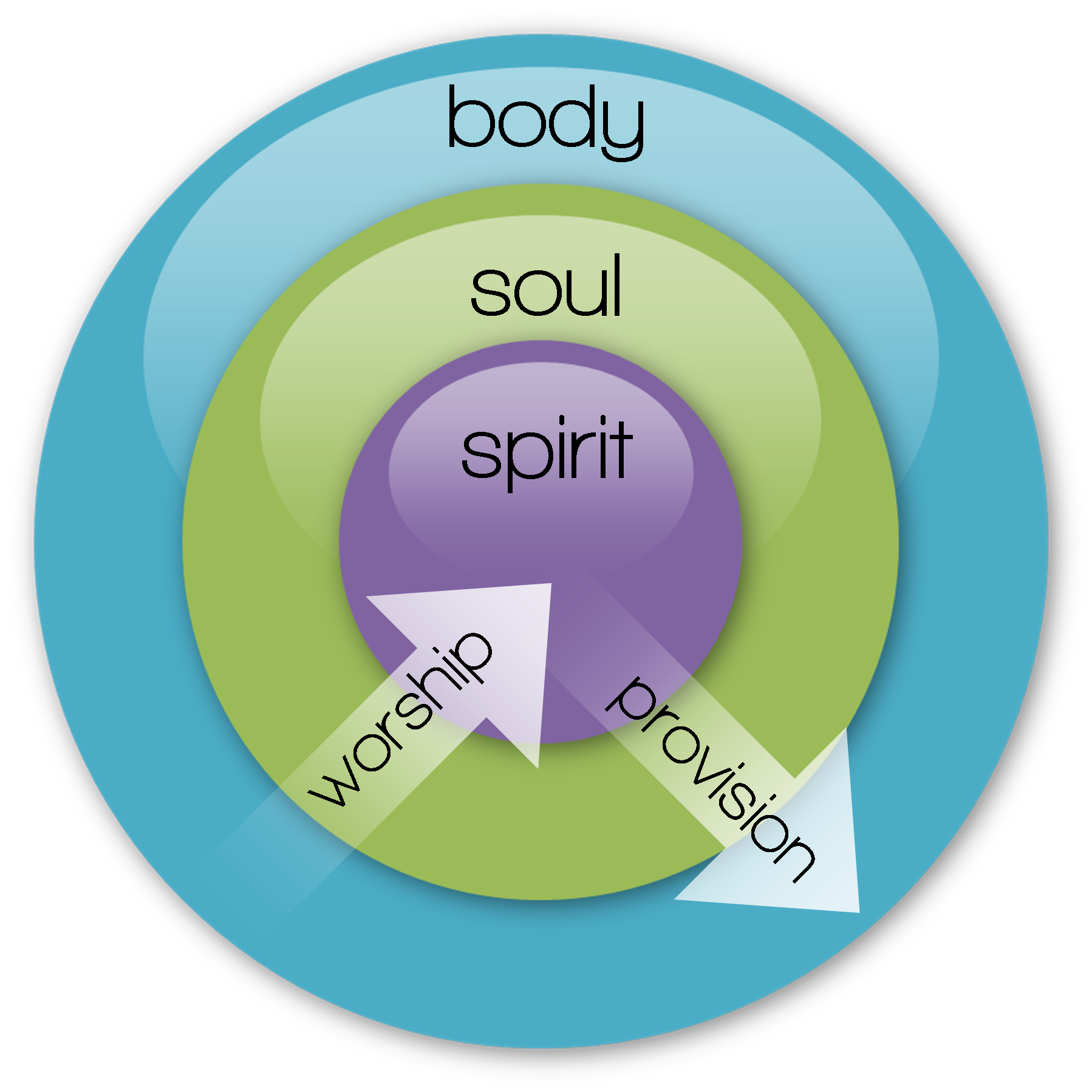
  • body  – Christ, the visible image of the invisible God
  • soul – mind, will, and emotion in alignment with God’s will, passing things from spirit to body and from body to spirit, which corresponds with the Holy Spirit
  • spirit – the seat of the divine life unique to the human being, which corresponds to the Father

Notice how the proper relationship is for spirit to pass on to soul and soul to pass on to body (that’s our provision), and then for body to offer to soul and soul to offer to spirit (which is our worship). One is not above the other, contrary to the way we Greek-influenced Western types usually think about it, where we see body as lower and spirit as higher. But we’re modeled after the Trinity, so we need to derive our thinking about body, soul, and spirit from the relationships in the Trinity, not the other way around.

The Scripture makes clear that we are not to hurt ourselves or neglect our bodies, minds, will, or emotions. Instead, we are to receive and pass on the gifts for the soul and the body that God provides to us through the Holy Spirit. We’re to care equally for each of the three parts that compose us. That’s a message the church doesn’t share very often, unfortunately.

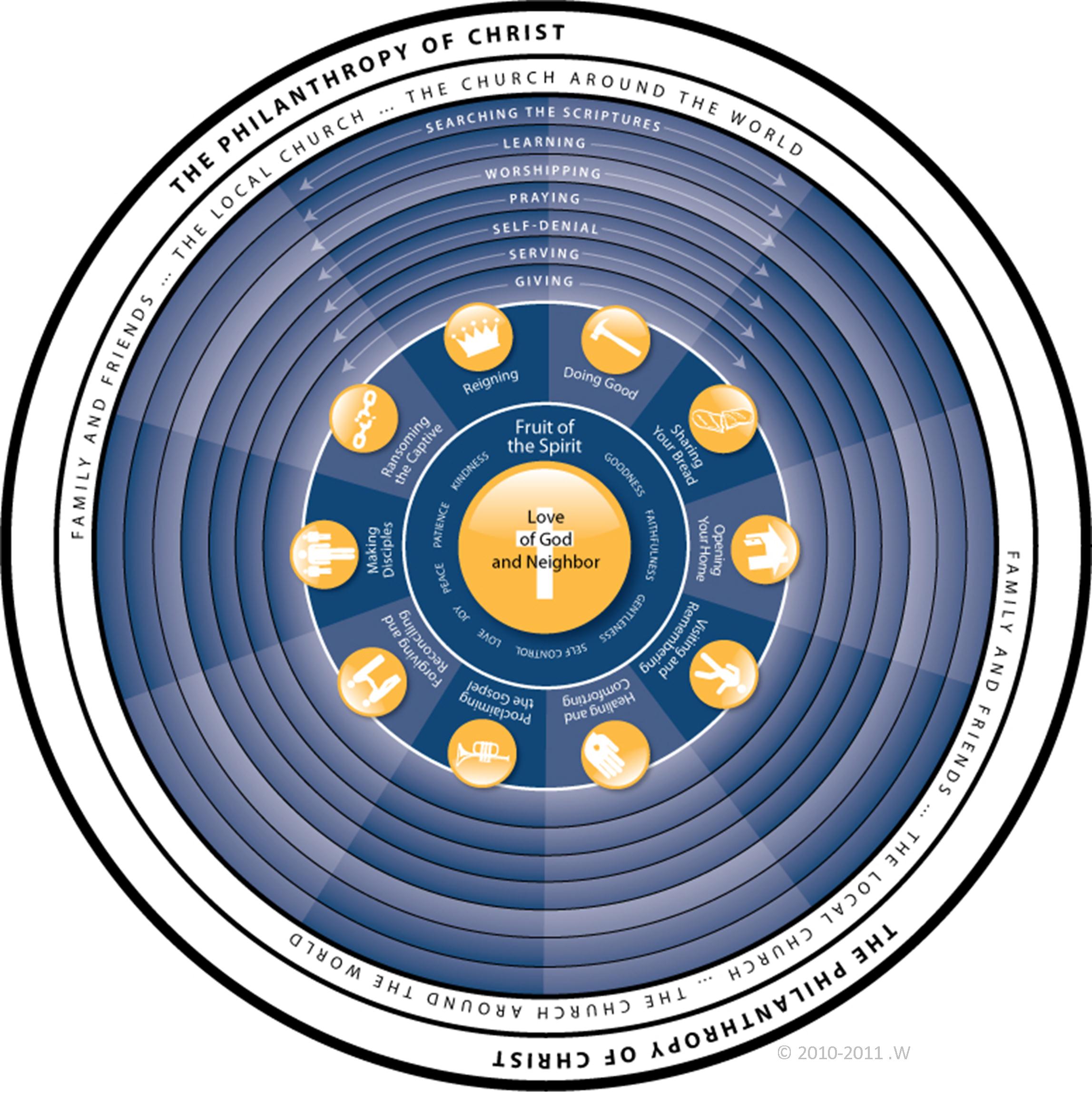
The Works of Piety are the good gifts for our soul that keep our mind, will, and emotions in proper relationship to our spirit (“hearing the Word”):

  • Searching the Scripture
  • Learning
  • Worshiping
  • Praying
  • Self-denial
  • Serving
  • Giving

The Works of Mercy are the good gifts for our body that keep it in proper relationship to our soul and spirit (“doing the Word”):

  • Doing good to your enemies
  • Sharing your bread
  • Opening your home
  • Visiting and remembering
  • Healing and comforting
  • Proclaiming the Gospel
  • Forgiving and reconciling
  • Making disciples
  • Ransoming the captive
  • Reigning

The Works of Piety and The Works of Mercy remind us that God’s grace is even greater than forgiveness—forgiveness is just one of many precious gifts he gives us so that we can accomplish our purpose of receiving and handing on to the visible realm all that he is and does in the invisible realm.

How does this shift in thinking keep good works from resulting in bad things?
Posted in Uncategorized | Tagged , , , , , , , , | 5 Comments

The Role of the Body in Christian Discipleship

Part X of our series on Preparation

Christianity is a religion of incarnation. Jesus came in the flesh to the world God created. and we are bound for a new heavens and a new earth, where we will live in new bodies. Ours is not a religion of escaping or denying our bodies but rather a religion of our bodies achieving the purpose for which they were intended: Delivering into the visible realm that which Christ hands over to us in the invisible.

So it’s important to understand the difference between body and flesh.

Body is one of the three parts of the tripartite human being. The human is created in the image of God, who is Father, Son, and Holy Spirit. The human is spirit, soul, and body.

The soul contains our mind, will, and emotions.

The spirit is the seat of God’s life in us.

God’s design for the human being was that Adam and Eve would eat the fruit of the tree of life and take his spirit into themselves. Instead, they partook of the tree of the knowledge of good and evil, which filled their spirits with sin and death. That sin and death spills outward into the soul, darkening our mind, will, and emotions, and bringing mortality to our bodies.

This is a progressive process in history, which may explain why human beings are shown to have shorter and shorter life spans in Scripture. Mercifully God steps in to arrest that process, giving us a basic life span. That can be lengthened somewhat, but to do so is always a fight. The march is toward decay and death. As Psalm 90:10 says, “The years of our life are seventy, or even by reason of strength eighty; yet their span is but toil and trouble; they are soon gone, and we fly away.”

When Christ is invited into an individual, that individual’s spirit is brought to life. Since the contents of one’s spirit reveal one’s parentage, Jesus says that those whose spirits are filled with sin and death are children of their father, the devil, while those with enlivened spirits are children of his father.

That entry of Christ into the individual human being is called justification.

The progressive movement of the spirit outward into the soul to transform the mind, will, and emotions is called sanctification.

That movement proceeds out into the body also, but the physical realm, where Satan was thrown down, is the seat of decay such that the old creation must be destroyed and a new creation birthed as a seed from the old. Same with our bodies.  That’s Hebrews 9:27: “It is appointed unto men once to die.” And 1 Corinthians 15 explains that our destiny is not to live as spooky disembodied spirits in heaven but rather to be resurrected with new bodies. That’s the basic Christian hope.

Now, God’s design is that he would continually pass into the visible realm through humans all of the gifts of heaven, and humans would receive these and pass them on to the creation.

Adam abdicates this vocation, but Christ comes as the Second Adam to re-establish it.

In God’s design, the spirit delivers to the soul all the gifts of God, and the soul passes these on to the body, which passes them on to the world.

Flesh is the reversal of that relationship. In this form, the world passes on “gifts” to the body, and the body passes these on to the soul. Whoops. Not good. Backwards plan.

Heart is an interesting word Scripturally. Heart is the reversal of flesh—body and soul in right relation to spirit, like in the following Scriptures:

“But I say, walk by the Spirit, and you will not gratify the desires of the flesh.” (Galatians 5:16, ESV)

“But put on the Lord Jesus Christ, and make no provision for the flesh, to gratify its desires.” (Romans 13:14, ESV)

“But I discipline my body and keep it under control, lest after preaching to others I myself should be disqualified.” (1 Corinthians 9:27)

Our hearts need to be retrained. And that means training the mind, will, and emotions through the Works of Piety and training the body through the Works of Mercy.

The early church called this “training for the heavenly contest.”

How does this change the way you view discipleship?  

Posted in Uncategorized | Tagged , , , , , , , | 3 Comments

The Monthly Format for Whole Life Offering Discipleship

Part IX of our series on Preparation

I’ve mentioned plenty of times around here about .W Church’s strategy for tackling one Work of Mercy each month for 10 months out of each year.

Today, I want to give a bit more detail on the questions we’re asking to help us grow through that process.

We start the month by Searching the Scriptures.

The first question we ask is, “How did God do this first to us?”

We don’t start by asking how we are supposed to do this to other people, we start by asking how God first did this to us. How did God first do good to me when I was His enemy? How did God first share His bread with me? How did God open His home to me?

That’s how we keep our focus on the philanthropy of Christ; we always start from the outside and work inward. That’s the first week.

Then, as we move through the rest of the month: second week, third week, fourth week we then look and we ask, “How has the church carried out this Work of Mercy in this area throughout church history?” We also focus our worship and prayer on that Work of Mercy.

So during our “Doing Good” month, our worship and prayer is about doing good so we choose songs that involve doing good: God doing good to us, us doing good to others. Or if the month is about sharing your bread we choose songs about sharing your bread, and we pray about sharing your bread. And the same thing with self-denial, serving, and giving.

Then, every month we create opportunities for each discipleship student to serve in that ministry.  Last year, when we did Sharing Your Bread, the discipleship students in the US and in Korea went out to the park and they shared their bread.  They brought meals to share with the homeless and drug addicted and mentally ill people in the park.

The goal here is not that a few disciples would be raised up to specialize in homeless ministry, but that all would be capable of doing it and training others to to do so also.

The good thing about this is that, whether someone feels comfortable or skilled practicing a particular Work of Mercy or not, they can learn from each other and be mentored to do ministry together.

The result is that, after one year, we each grow in all of the areas of discipleship.  Every month we are doing each of these 7 internal Works of Piety and then throughout the year we are covering all of the Works of Mercy. Everything we do is coordinated with that plan.

And it all aims toward the goal that at the end of the year each student can be commissioned to start their own discipleship training group for those in their sphere of influence. 

This is just one plan. There’s nothing sacred about it. But this is the plan that we use and you may find it helpful. Or not. Maybe you will hate it so much that you decide to develop your own plan. Either way, that’s OK.

Good discipleship means developing some kind of a comprehensive plan to make sure that we are growing each Christian to fullness in Christ, by the power of the Holy Spirit.

I really want to encourage you to make that your primary goal in life: developing Christians to fullness in Christ. Because if that is your primary goal in life, then we can build very strong families and very strong local churches and very strong churches around the world.

And even if they are small churches, they will be small churches with big Christians instead of big churches with small Christians.

Posted in Uncategorized | Tagged , , , , | 1 Comment

