
Jesus went through all the towns and villages, teaching in their synagogues, proclaiming the good news of the kingdom and healing every disease and sickness. (Matthew 9:35)
From the time of the early church, there have been weekly lectionary readings. This tradition grew out of synagogue lectionary readings that predated the birth of Christ and continues today. The early church adapted these readings to include the New Testament, especially selections from the four Gospels each week. The reason is simple: the church prioritizes the direct teaching and words of Christ, just as he commanded.
and teaching them to obey everything I have commanded you…” (Matthew 28:20)
Nor are you to be called instructors, for you have one Instructor, the Messiah. (Matthew 23:10)
Jesus teaches us the gospel in each of the four Gospels. The gospel is not only about Jesus; it is also taught by Jesus. This is why the full title of each Gospel is “The Gospel of Jesus Christ According to (author).” They record Christ’s gospel—that is, the things of first importance about who Jesus is and what he does, as taught by Jesus himself. If we teach anything else as the gospel, we are teaching a false gospel different from that of Jesus Christ.
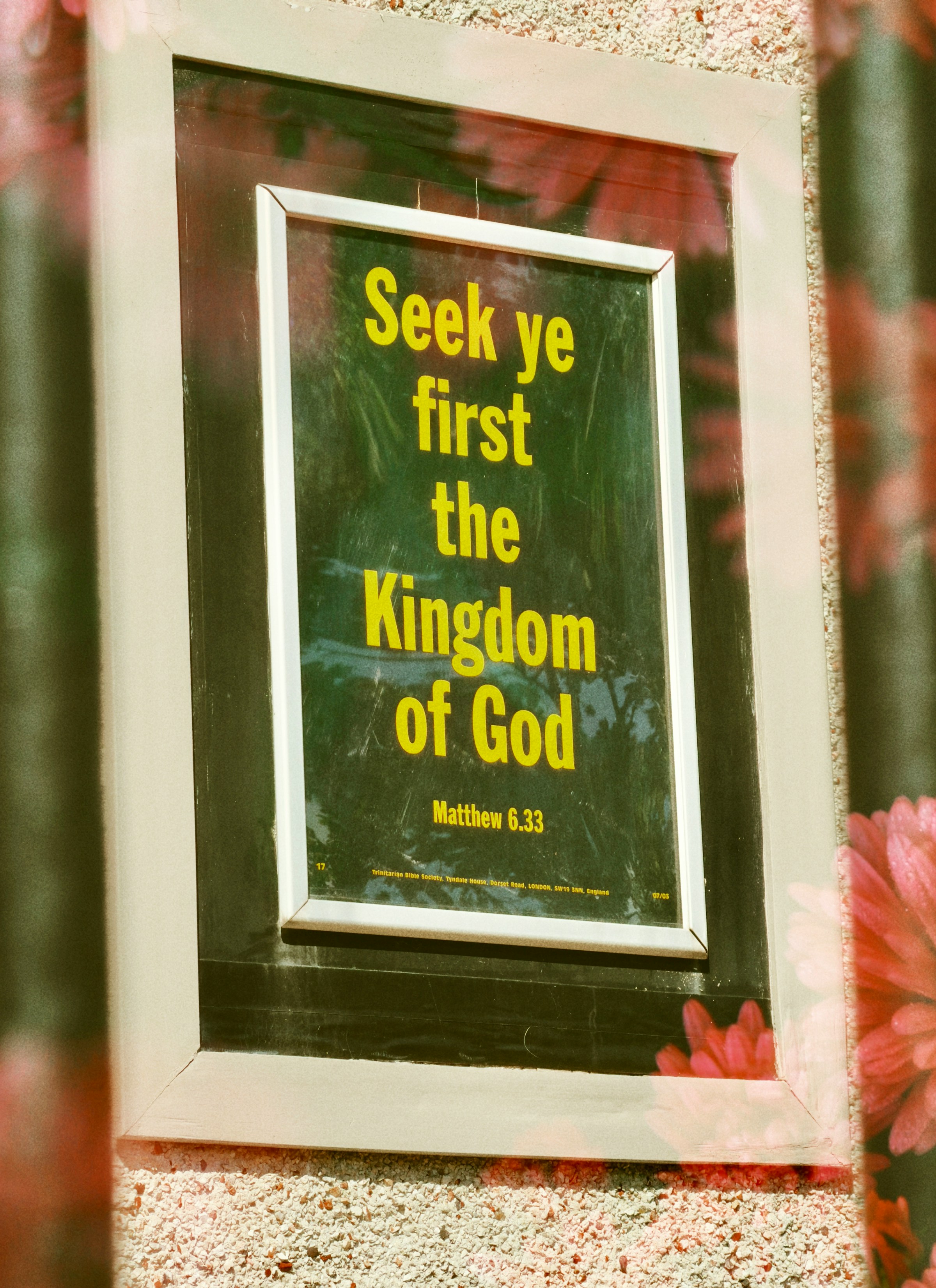
The gospel Jesus taught must remain at the center of our daily lives. That is why the lectionary is centered on the Gospel reading. As we hear the words of Jesus each week, the Holy Spirit gives us the ever-living words of Christ and the faith to believe them. In this way, Jesus himself teaches us the gospel.
The gospel is the announcement that God the Son has taken on human flesh and, on the cross, has defeated all the enemies of God—including us. Through his resurrection and ascension, he now holds all authority in heaven and on earth. He uses that authority to rule today as the all-powerful King of creation. No one can hinder his reign; even those who resist him only end up accomplishing his purpose. Jesus could have destroyed all his enemies when he defeated them on the cross. Instead, he offers forgiveness and mercy, and even the full inheritance of his Father—including his throne—because through his blood we too are made children of God.
If Jesus is ruling, why is it so hard for us to notice? It is because he does not rule from the top down like worldly leaders. He rules from the bottom up. He rules as the servant of all. This is not a temporary way of ruling that will change when he returns and displays his “real power.” God’s eternal character is and always will be that of a servant and shepherd who lays down his life moment by moment for those under his care. Because they recognize only top-down power, none of the “rulers” of this age can perceive his bottom-up reign.
The rulers of this age still exercise power as they always have, and those under them still act as though they hold the power. Only through hearing the proclamation of the gospel can we know that Christ is truly reigning, and we are invited to stop rebelling against him and submit to his reign. We do so through baptism. In baptism, we enter Christ’s death and die with him to this world. We receive the indestructible and inalienable life of Christ, who is the Holy Spirit, who brings Christ’s teachings to life so that we know how to relate to God and to our neighbors. We relate to both only on the basis of Christ’s teachings.
Evangelism is not a method we memorize or a tract we hand out. It is our day-to-day words and actions bearing witness to God and others that Christ is our only King. In this way, everyone can see that we rely on Jesus as our only teacher and provider. Just as Jesus rules by laying down his life, we serve him by willingly laying down our lives moment by moment—not only for our friends, but also for our enemies.
We willingly give up what this world considers valuable because God provides for all our needs. Each day, the Father, Son, and Holy Spirit give us a small portion of our inheritance from the age to come. We are able to lay down our lives for Christ because we know that our bodies will be raised from the dead when he returns.
On that day, the rule of Christ, already underway, will finally become visible. All who rejected his rule will experience eternal destruction. Those who welcomed his kingdom by faith will reign with him forever in the new heavens and new earth.
This is the gospel as taught directly by Jesus in the Gospels and in Revelation. It is the same gospel the apostles recorded in their letters. None of it can be omitted without creating a false gospel. Jesus called it “the gospel of the kingdom,” and so did the apostles.
“Now I know that none of you among whom I have gone about preaching the kingdom will ever see me again. (Acts 20:25)
They arranged to meet Paul on a certain day, and came in even larger numbers to the place where he was staying. He witnessed to them from morning till evening, explaining about the kingdom of God, and from the Law of Moses and from the Prophets he tried to persuade them about Jesus. (Acts 28:23)
The apostles did not create new teachings that did not originate with Jesus. Instead, they answered questions and gave instruction about how to live according to the gospel Jesus taught. Their letters were written with the assumption that readers already had a basic understanding of the gospel of the kingdom.
Unfortunately, many pastors today preach their own selected topics, claiming to be led by the Holy Spirit in what to preach each week. Others preach verse by verse through the Bible, believing this is the best way to hear Jesus directly. But the Gospels were written to be read aloud in a single sitting, sometimes more than once. If we preach only verse by verse, it may take years to hear key context from earlier or later passages. This is one of the tragic consequences of the modern church’s abandonment of the lectionary.
During the Protestant Reformation, reformers such as Zwingli and Calvin, in a sense, over-reformed by doing away with the lectionary and advocating verse-by-verse preaching. Later, Methodists and Anabaptists promoted preaching whatever the Holy Spirit seemed to lead at a given time and place. After that, many Christians in the United States began to preach primarily about personal salvation.
There is no separate gospel of personal salvation that the Lord Jesus taught before the gospel of the kingdom. Jesus did not teach a personal-salvation gospel. So later evangelists constructed one by patching together passages from across the Bible and centering them on personal salvation. They also developed methods for evangelizing with this new gospel. Because this evangelism was often done outdoors or one-to-one, where baptism was impractical, conversion came to be identified with the altar call or the sinner’s prayer. As a result, baptism largely became a formality for church membership rather than an essential part of entering Christ’s life.
As a result, many modern Christians believe the gospel is simply, “Jesus died for my sins, and if I believe in him, I will go to heaven when I die and live forever.” But this is a false gospel. They do not know the words and gospel of Christ. To set aside Christ’s words in exchange for ideas that seem more attractive or easier to understand is folly. Churches and organizations built on this false gospel are now falling with a great crash.
Therefore everyone who hears these words of mine and puts them into practice is like a wise man who built his house on the rock. The rain came down, the streams rose, and the winds blew and beat against that house; yet it did not fall, because it had its foundation on the rock. But everyone who hears these words of mine and does not put them into practice is like a foolish man who built his house on sand. The rain came down, the streams rose, and the winds blew and beat against that house, and it fell with a great crash.” (Matthew 7:24-27)
The proponents of the gospel of personal salvation believe that people must first be prepared through relationships and need-meeting without talking about Jesus and then receive personal salvation before discipleship happens. But Jesus commanded us to use his own words and teachings for baptism and for our discipleship. He commanded us to preach the whole of his gospel of the kingdom, omitting nothing. He is the one who tells us what is of first importance about who he is and what he does:
- When the time was fulfilled, God sent forth his Son, born of a woman, born of the seed of David.
- He died for our sins as according to the Scriptures.
- He was buried.
- He rose on the third day as according to the Scriptures.
- He ascended into heaven and is seated at the right hand of the Father.
- He will come again to judge the living and the dead.
We are not free to invent the meaning of Christ’s death, burial, and resurrection. Rather, we must learn and teach what Jesus himself said about his death and resurrection and how they fulfill the Scriptures. Sadly, most modern Christians do not know what Jesus taught about his own death and resurrection.
In every situation and on every subject, we are to begin by reading and teaching the actual words of Jesus himself. The words and teachings of Jesus have primacy for the Christian.
We should never begin with the words of the apostles and only then move to the words of Jesus. If we do, we risk ending up with a false, partial, and distorted gospel, because the apostles assumed their readers already knew the gospel Jesus taught. We read the words and teachings of Christ first, and then consult the rest of the New Testament as inspired commentary on Jesus’ words—not as additional or new teaching. The apostles preached the gospel of the kingdom faithfully to the end.
He proclaimed the kingdom of God and taught about the Lord Jesus Christ—with all boldness and without hindrance! (Acts 28:31)
It is important for the church to be built on Jesus’ gospel and to hear it every week. The lectionary is one helpful tool for doing so. We are not saved through a “personal salvation method,” nor are we prepared to hear the gospel by having our “soil prepared.” We are saved by entering into the life of Christ through hearing his gospel. And when we are persecuted for the gospel, we do not flee merely for our own safety; we flee so that the gospel may be preached in other places.
You may think, “If we only focus on the words and teachings of the Lord Jesus, don’t we neglect the Father and the Holy Spirit and the Old Testament and the writings of the Apostles?” The answer is no. Jesus’ words and teachings are all about the Father and the Holy Spirit and the Old Testament, and the writings of the Apostles are all about the words and teachings of the Lord Jesus. From the beginning, Christianity was called “The Way”. What way? The way of the Lord Jesus. In every situation, about every subject, we are to begin and end with the words and teachings of the Lord Jesus. They are our standard and the reason for our existence. As Paul writes in 1 Timothy 6:3:
If anyone teaches otherwise and does not agree to the sound instruction of our Lord Jesus Christ and to godly teaching, they are conceited and understand nothing. (1 Timothy 6:3–4a)
Let us repent of any gospel that does not give primacy to the words, teachings, and way of Jesus.







