
For centuries, Christians did not view Matthew 28:16-20 as “The Great Commission.” Instead, it was seen as a revelation of who Christ is and as an invitation for us to join his work. This passage could be renamed “The Great Declaration,” since through his declaration, he reveals who he is.
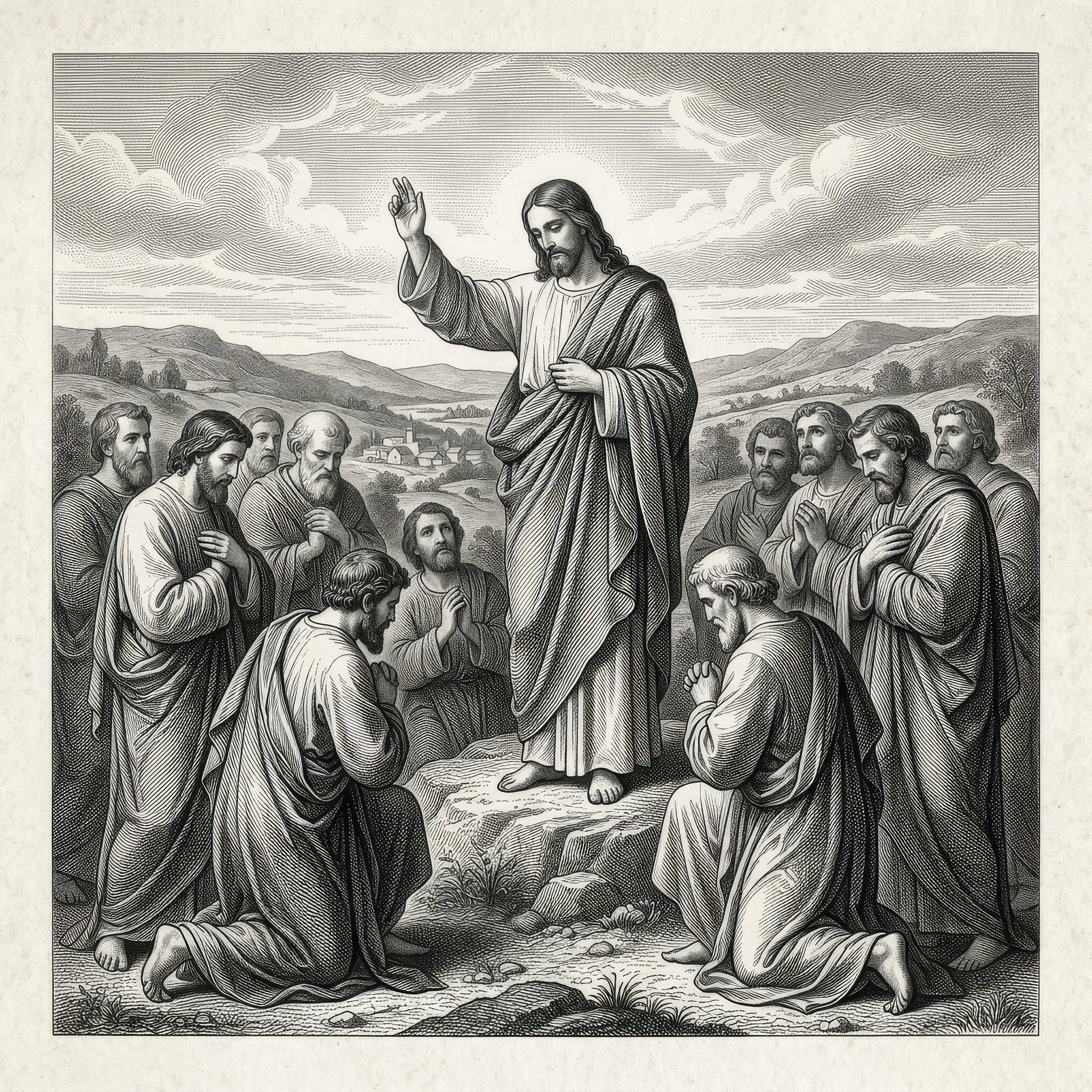
What does this Scripture passage reveal about Jesus Christ?
Then the eleven disciples went to Galilee, to the mountain where Jesus had told them to go. When they saw him, they worshiped him; but some doubted. Then Jesus came to them and said, “All authority in heaven and on earth has been given to me. Therefore go and make disciples of all nations, baptizing them in the name of the Father and of the Son and of the Holy Spirit, and teaching them to obey everything I have commanded you. And surely I am with you always, to the very end of the age.” (Matthew 28:16–20)
First, it reminds us of who Christ is as Emmanuel, “God with us”. The very beginning and end of Matthew contain this same promise about who Christ is. Being with us is not only something that Christ does; it is who he is. It is his character. In Greek, the word “always” means “the whole of every day”. In the details of every day, Christ is with us.
Therefore the Lord himself will give you a sign: The virgin will conceive and give birth to a son, and will call him Immanuel. (Isaiah 7:14)
In more than one hundred verses in the Old Testament, God promises to be with us. But, in the Old Testament, the Lord was present through various mediators, such as Moses, the tabernacle, the temple, etc.
Then have them make a sanctuary for me, and I will dwell among them. (Exodus 25:8)
When the priests withdrew from the Holy Place, the cloud filled the temple of the Lord. And the priests could not perform their service because of the cloud, for the glory of the Lord filled his temple. (1 Kings 8:10–11)
In the beginning of John, in the Greek, it says that Jesus “tabernacled” or “pitched his tent” among us. In the Old Testament, it says that God dwelled in the tabernacle. But in the New Testament, Jesus “tabernacled” among us. In the Old Testament, God’s glory was shrouded by the cloud. But now God’s glory is fully visible to us in Jesus Christ.
The Word became flesh and made his dwelling among us. We have seen his glory, the glory of the one and only Son, who came from the Father, full of grace and truth. (John 1:14)
In the New Testament, Jesus describes himself as the temple, and since we are being built together in Christ, we also have a part in God’s temple. This very real temple is being built with living stones, and the Bible says we are those living stones. We are God’s house. The presence of God now dwells in us.
As you come to him, the living Stone—rejected by humans but chosen by God and precious to him—you also, like living stones, are being built into a spiritual house to be a holy priesthood, offering spiritual sacrifices acceptable to God through Jesus Christ. (1 Peter 2:4–5)
This Old Testament promise of God’s presence has been specifically and completely fulfilled in the person of Jesus Christ. This promise is given to us through the death, resurrection and ascension of Jesus Christ. The promise of his direct, unmediated presence.
Jesus not only gave the disciples the promise of his presence, but also the promise of his power in Matthew 28:16-20. He told them that all authority in heaven and on earth had been given to him. We know from John 3:35 that it was given to him by the Father.
The Father loves the Son and has placed everything in his hands. (John 3:35)
This is confusing because we know that Jesus has always been God. So has Jesus not already had all power and authority? In fact, John 1 tells us that the Word is God and that all things were created by the Word. So why must power and authority be given to Jesus?
Because, as we read in John 1:14, the Son took on flesh.
Jesus has two natures. He has human nature and divine nature. There have been many issues throughout church history understanding this. Some cults have said that Jesus has a kind of “third nature” or that the two natures are separate. But, in Christ, Jesus’ two natures are inseparable.
In the Father’s exalting Jesus, God’s original plan for humanity, that humanity would reign as God’s image on earth, is fulfilled. Not only is Jesus’ divine nature exalted, but his human nature is as well. As the “Son of Man” he is given all dominion.
In my vision at night, I looked, and there before me was one like a son of man, coming with the clouds of heaven. He approached the Ancient of Days and was led into his presence. He was given authority, glory and sovereign power; all nations and peoples of every language worshiped him. His dominion is an everlasting dominion that will not pass away, and his kingdom is one that will never be destroyed. (Daniel 7:13-14)
Now that we understand Christ’s character, we can properly understand what he commanded us to do.
In Matthew 28:19-20, in English there seem to be four commands “go, make disciples, baptize, and teach”. But, in Greek, there is properly only one command, “make disciples”. The other verbs in this passage modify the verb “make disciples”. We don’t have to come up with our own plan of how to make disciples. We don’t need larger churches, outreach events or humanitarian aid projects. We only make disciples through the word (“teaching them to obey everything I have commanded you”) and the sacrament (“baptizing them”).
Because Jesus uses many words interchangeably, instead of “teaching them to obey everything I have commanded you”, he could just as easily have said, “teaching them to abide in my word” or “teaching them to believe in my word”. The main point is to have firm faith in all that he taught.
Jesus also says that we make disciples by baptizing. Disciples are not made by having them come forward during an altar call. Disciples are not made by praying the “sinner’s prayer”. According to scripture, disciples are made through baptism, through which we die and are raised with Christ and receive the Holy Spirit.
It may seem like we should first get saved and then get baptized so we can publicly declare our faith. But that is not how the Bible describes baptism at all. Baptism is a gift of God. It is not something that we do, it is something which God does to us.
A person once said that making disciples is like one beggar telling another beggar where to find bread. We are beggars who bring other beggars to Christ for Christ to work, not for us to work.
In Matthew 28, everything seems upside-down. The Jewish elders and Roman guards conspired to lie about what happened to Jesus’ body. The disciples even doubt Jesus as they are looking at him. In the midst of all this, Jesus declares his absolute authority in front of only eleven people. It is quite an anti-climactic moment.
But remember, this has always been the way that Jesus has worked. He doesn’t work according to the ways and standards of this world. His ways are totally different from our ways.
In John 13, Jesus washed the disciples’ feet. But the story starts out much differently than we would think. It starts with Jesus knowing that the Father had given all things into his hands.
Jesus knew that the Father had put all things under his power, and that he had come from God and was returning to God; (John 13:3)
We would think that Jesus would take all power and use it to humiliate his enemies and stop them from crucifying him. But, instead, he washed the feet of the disciples who would later betray and deny him.
On the cross, we see the true power and authority of Jesus on display. And, on an obscure mountain before the disciples who had just failed miserably, we see the same power and authority of Jesus on display.
This upside-down work of Jesus is the same with making disciples. We think that if we had enough money, power, and freedom, we could make disciples better. But God always works through his word, which may seem weak and inefficient to us. But Jesus says that is what is powerful and effective.
Christ’s presence is not dependent on how you feel. You don’t have to feel good or happy. You can’t use your emotions to determine whether God is with you or not. The Bible tells us that God’s presence is a gift which is given to us in the person of Jesus Christ. His name is Emmanuel.
Through his death, resurrection, and ascension, we are given the gift of unmediated access to God himself.







