
From Chapter 9 onward in the Gospel of Luke, Jesus is not only on a journey to Jerusalem. He is leading his people on an Exodus out of the present age and into the kingdom of God. Along the way, Jesus teaches three things he requires of his followers:
- Give up everything they have
- Hate their families
- Take up their cross
Why these three things?
Because Jesus has not come to reform the present age. He has come to bring it to an end. His coming is the beginning of the end of the present age. On the cross, it is not only our sins which are put to death, but the present age as a whole is buried in the tomb with him. As we learn from Colossians, it is on the cross, not in a future battle, that he defeats the enemies of God:
“And having disarmed the powers and authorities, he made a public spectacle of them, triumphing over them by the cross” (Colossians 2:15).
That’s confusing to us, because it seems like the world is still continuing on its way. But Scripture says that the only reason God keeps the present age from ending immediately is so that his offer of mercy to his defeated enemies—which Scripture calls “the gospel”—can be proclaimed to and received by them.
When we as Christ’s defeated enemies accept that offer of mercy, we do so by entering into Christ’s death and new-creation life through his baptism. In doing so, we are cut off from this present age and grafted into Christ. From that point on, we are dead to the world—and that’s no mere metaphor. Everything we need comes from him, and the present age cannot provide anything we need. In fact, if we accept what the present age provides, we will be “choked by life’s worries, riches and pleasures” (Luke 8:14).
What are the things that the present age provides to which we are still clinging? It’s that familiar list of three things we’ve been noting:
- Our flesh-and-blood family
- Our money and possessions
- Our self-fulfillment
These three things give us a “share” in the present age. In clinging to them, we ultimately end up being choked by them. This is why in order to follow Christ on the Exodus out of the present age into the Kingdom of God, we must leave these idols behind. Instead, we must cling to the three things that take their place in the Kingdom of God:
- Becoming members of Christ’s family instead of clinging to our flesh-and-blood family
- Becoming depending on Christ for day-to-day support instead of depending on our money and possessions
- Taking up the cross instead of looking for self-fulfillment
Jesus tells us it is not possible to live in two kingdoms at the same time. This would be like having two masters. We’ll always hate the one and love the other. And the one we will love is the age that includes our flesh-and-blood family, our money and possessions, and our self-fulfillment. Jesus says this is why so few people enter his kingdom.
“No one can serve two masters. Either you will hate the one and love the other, or you will be devoted to the one and despise the other. You cannot serve both God and money.” (Luke 16:13)
Many Christians today reject Jesus’ plan and replace it with their own. They claim that Jesus’ kingdom is his call to reform the present age, not follow him on an exodus out of it. They claim that Jesus wants us to:
- Reform our families through Christian values
- Use our money to do good things for God
- Help people to find Christian self-fulfillment
Thus, instead of entering the Kingdom of God, people prefer to live in a Christianized form of the present age. This is because they have more of a share in the present age than they realize.
It is in this context that Jesus tells the story of The Rich Man and Lazarus:
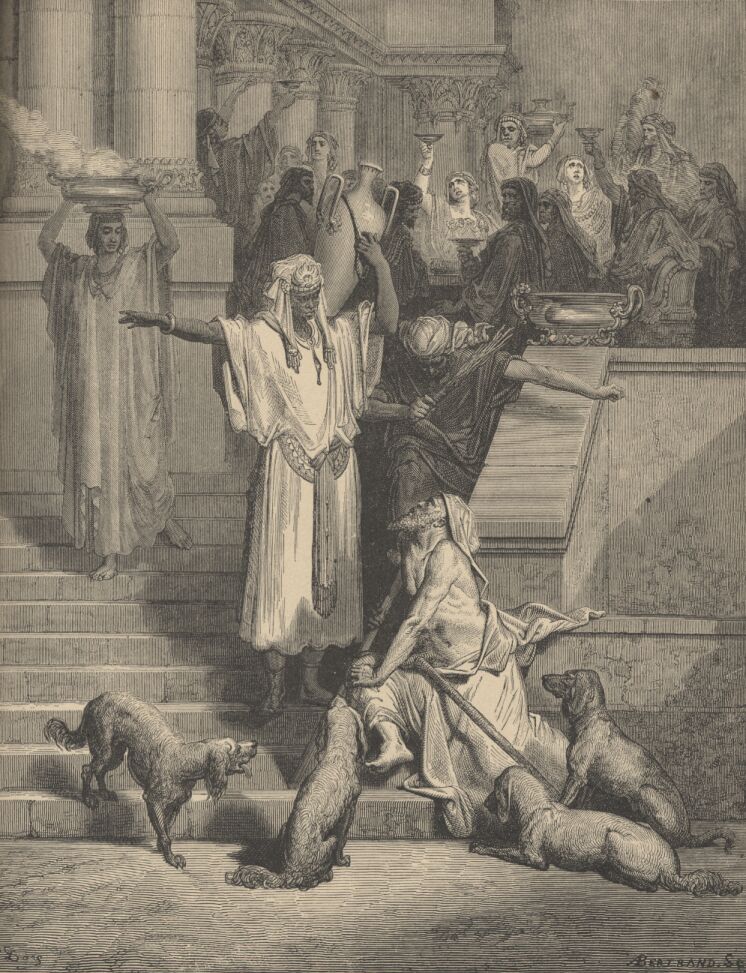
“There was a rich man who was dressed in purple and fine linen and lived in luxury every day. At his gate was laid a beggar named Lazarus, covered with sores and longing to eat what fell from the rich man’s table. Even the dogs came and licked his sores. The time came when the beggar died and the angels carried him to Abraham’s side. The rich man also died and was buried. In Hades, where he was in torment, he looked up and saw Abraham far away, with Lazarus by his side. So he called to him, ‘Father Abraham, have pity on me and send Lazarus to dip the tip of his finger in water and cool my tongue, because I am in agony in this fire.’ But Abraham replied, ‘Son, remember that in your lifetime you received your good things, while Lazarus received bad things, but now he is comforted here and you are in agony. And besides all this, between us and you a great chasm has been set in place, so that those who want to go from here to you cannot, nor can anyone cross over from there to us.’ He answered, ‘Then I beg you, father, send Lazarus to my family, for I have five brothers. Let him warn them, so that they will not also come to this place of torment.’ Abraham replied, ‘They have Moses and the Prophets; let them listen to them.’ ‘No, father Abraham,’ he said, ‘but if someone from the dead goes to them, they will repent.’ He said to him, ‘If they do not listen to Moses and the Prophets, they will not be convinced even if someone rises from the dead.’” (Luke 16:19-31)
When we Christians hear this parable, the problem and the solution seem very clear to us. We think that the problem is that the rich man was selfish and greedy and should have helped Lazarus by giving him food, money, or medical care but did not, so he was sent to hell—apparently because it was a sign that he did not repent. If he had repented, we think, he would have been more generous.
But, interestingly, Abraham does not say that the rich man is in hell because he was selfish and greedy and did not help Lazarus. Abraham’s explanation is this: “Son, remember that in your lifetime you received your good things, while Lazarus received bad things, but now he is comforted here and you are in agony.”
This is very different from how we have been taught to think about salvation and damnation. We think that salvation is when we repent of doing things wrong and ask Christ into our hearts and damnation is what happens when we don’t do that. But Abraham says simply that the rich man is in hell because he already received all his good things during his life time.
The problem is not with Abraham’s explanation but with our wrong way of thinking about salvation and damnation. Our thinking is too small. We are so self-focused that we only think about confessing and repenting of our own individual sins. But Scripture is clear that the message of Jesus and the apostles is much bigger and much deeper than the sin in our own hearts:
“Grace and peace to you from God our Father and the Lord Jesus Christ, who gave himself for our sins to rescue us from the present evil age, according to the will of our God and Father, to whom be glory for ever and ever. Amen.” (Galatians 1:3-5)
Notice here that Paul didn’t say that Christ died for our sins simply so he could forgive us. Paul says Christ died for our sins in order to rescue us from the present evil age. In other words, the problem is not only our hearts. The problem is the whole present age. We are like fish that are swimming in a filthy fish tank. The filthy fish tank is the present age. Fish become diseased from being in that filthy water all the time. If the only thing that Christ did was to forgive your sins, that would be like being a clean fish in a dirty tank. You would not be a clean fish for very long!
But that does not mean that the fish is okay and only the filthy fish tank is the problem. The tank is filthy and the fish is filthy, too. This is why salvation is always presented in the New Testament as a two part solution:
- Christ gives himself for our sins
- Christ rescues us from the present evil age
Just as Paul preached that message to the Galatians, Peter preached it in Acts 2 at Pentecost:
“Peter replied, “Repent and be baptized, every one of you, in the name of Jesus Christ for the forgiveness of your sins. And you will receive the gift of the Holy Spirit. The promise is for you and your children and for all who are far off—for all whom the Lord our God will call.” With many other words he warned them; and he pleaded with them,“Save yourselves from this corrupt generation.” (Acts 2:38-40)
Or to put it in the words we’ve been using as we’ve been studying Luke, give up your “share” in this present generation. Or to use Paul’s words from Colossians 3:3, we have died to this present age. We no longer receive anything from this present age to sustain us. Instead, we are already living in and being sustained by the kingdom of God.
There are two amazing truths here that we Christians rarely realize.
The first truth: The Kingdom of God is present now.
Both the present age and the kingdom of God are now present. The Kingdom of God cannot be seen with our eyes, but it is fully present to us by faith. It is more real than the present age, which according to Scripture has already begun to fall apart. The Kingdom of not something we enter after we die or when Christ returns. Christ’s whole message is for us to enter into the Kingdom and live in it today by believing in Christ and being baptized into his death.
In doing so:
- Christ’s family becomes our family
- Christ supports us with his riches
- It is no longer we who live, but Christ
The second amazing truth is this: Christ came not only to deal with our sins, but to bring the Kingdom—and to bring us into it.
That is why we don’t say, “Christ went to Jerusalem to die for my sins.” That’s only half the truth. Christ came not only to forgive the fish but to replace the fish tank! Most of the time when Christians read in the Bible about a “new creation”, they wrongly think that the Bible is talking about them individually being changed into little “new creations”. But when the Bible talks about a new creation, it means a new creation: A new heavens and a new earth. A new kingdom. A new king.
These days, Christians don’t realize or understand that Christ brings a new kingdom for us to live in and be sustained by today. They wrongly think that Christ’s plan is to work through Christians to reform the present age. They are like fish who think that the maker of the fish tank is going to clean up the tank through them! They talk about the present situation as a “battle” that Christ helps them “win” by giving them strength and wisdom and all the resources that are needed to Christianize the present age. They look at their “share” in the present age—their family, their money, their possessions—and they think, “God wants me to use these things to improve the present age.” This is why they get involved in politics. They believe that the problem is the wrong use of money and power and the weakening of the family. They believe the solution is the right use of money and power and the strengthening of the family.
But Jesus defines neither the problem nor the solution in these terms.
Jesus talks about two problems:
- Our evil hearts
- The present evil age
Jesus himself solves both of these problems on the cross. It is not that he fixes our hearts in order to use us to reform the present evil age. He brings to us new hearts and a new age: the kingdom of God, established permanently in his blood. He calls us to enter the kingdom today by being baptized into his death.
Think about it like this: We Christians don’t actually die when we die physically. Scripture says that we actually die when we are baptized. We don’t enter the Kingdom of God after our physical death. We enter it when we are baptized into his death.
Many Christians respond to the gospel of the kingdom like this: “So you’re saying we should do nothing and just go to the mountains and pray while the world falls apart?”
But Christians who respond like this do not know the Scriptures. In Acts, we see neither Christians who try to fix the present evil age by Christianizing the “resources” of this age—money, possessions, flesh-and-blood families, and self-interest.
In the Book of Acts, what we see is Christians being moved from their birth family into Christ’s family, which is called the church. We see them giving up their possessions in order to care for each other. We see them being sustained on a day-to-day basis by Christ. We see them no longer focusing on their self-fulfillment and safety and happiness but instead laying down their lives for each other and for their enemies.
To use the language of our fish tank example, Christ does not work through the fish to fix the fish tank. But he also doesn’t remove his fish from the tank. Instead, his fish are transformed into new creatures, just like a tadpole becomes a frog. Frogs can still live in the tank, but they don’t rely on anything in the tank at all. They don’t breathe the water. They don’t eat the food. There is a gigantic world outside the fish tank, and the frogs rely on that world for everything they need. But they don’t leave the fish tank behind. They actually stay there and testify to the fish, “Your purpose isn’t to be a fish. It’s not even to be a clean fish. Your purpose isn’t to live in a clean tank. Your purpose is to be a new kind of creature. And the One who created us made a gigantic world outside this fish tank, and I am supported by that world today.” In other words, the purpose of the frog is to point beyond the fish and the fish tank and testify to how the Creator made us to live today in a much greater kingdom.
With all this in mind, we can understand the parable of the Rich Man and Lazarus.
The Rich Man’s share was entirely in this present age. He was completely sustained and satisfied by the things of this age. He had no share in the Kingdom at all. The problem is not that he was greedy and selfish. All of us in this present age are greedy and selfish! The present age is itself an age of greed and selfishness. The greedy and selfish succeed in this present age.
That’s why the solution is not for the rich man to be more generous to Lazarus by giving him food, or money, or access to the hospital. The solution, according to Abraham, is to listen to the words of Moses and the prophets, which testify to the mission and ministry of Jesus Christ and the kingdom of God that he brings. If the rich man had listened to Moses and the prophets, then he would have seen the evil of his heart and the evil of the present age. He would have done what Jesus commanded the Pharisees and the teachers of the Law to do back in Luke 14: 13: He would have invited Lazarus, not his flesh-and-blood brothers, to his daily banquets:
“But when you give a banquet, invite the poor, the crippled, the lame, the blind” (Luke 14:13)
Jesus isn’t talking here about giving charity to poor people. Jesus is talking about us receiving his family as our family. He is talking about us giving up our own possessions so that we become stewards of Jesus’ possessions. And the most precious possession Jesus has is the cross. The cross is what cuts us off from the present evil age. The cross is what cuts us off from our self-love. The cross cuts out our evil hearts and replaces them with Christ’s own heart. The cross is how we are set free to love the outcasts as our family and our enemies as ourselves. “So if you have not been trustworthy in handling worldly wealth, who will trust you with true riches?” (Luke 16:11).
Lazarus, on the other hand, had no “share” in the present age. The present age did not sustain him in any way. That doesn’t mean that he had a good heart, though. Remember: In order for us to be saved, Christ has to deal with two problems. He has to save us from our sins, and he has to deliver us from the present evil age. So how did Lazarus end up in Abraham’s side if he didn’t repent?
Here we need to remember the truth we studied two weeks ago: Repentance is not a work we do. It is a gift God gives to us. Repentance and forgiveness are equally gifts from God.
And repentance does not mean “realizing I did bad things and feeling bad about it”. Repentance means “realizing my complete dependence upon God for salvation and my complete inability to save myself”. It means knowing that I contribute absolutely nothing to Christ’s saving work except my need. It means that he opens his arms and I fall into them.
That is why Jesus says in Luke 6:20:
“Looking at his disciples, he said: “Blessed are you who are poor, for yours is the kingdom of God” (Luke 6:20).
The poor are blessed because the present evil age does not even try to sustain such people. Jesus is the only one opening his arms to them. Jesus opened his arms and Lazarus fell into them.
That is exactly what repentance looks like: Jesus opens his arms, and we fall into them. He gives us his heart to replace our evil hearts. He gives us his kingdom to replace this present evil age. And he gives us his family to receive us into his kingdom..
Blessed are we, for ours is the kingdom of God!








 Do the Word