The Lord’s Supper: The New Covenant in His Blood

It is a very good thing to preach and teach regularly about Christian essentials such as the Lord’s Supper. Many preachers these days do not like to preach on, e.g., the Lord’s return, the Lord’s Supper, Baptism, and other essentials because, although Christians agree on the basics, they argue much about the nonessentials, and such preachers would like to avoid such arguments. But, if preachers do this, the only people who end up teaching about such things are the extremists and crazy people who preach nonessentials as if they were essentials. So we need to preach about Christian essentials often, focusing on the parts on which all Protestant Christians should agree.

Accordingly, let’s talk about the Lord’s Supper.

Pastor Foley leads a group of Chinese house church pastors in the Lord’s Supper.

There is a difference between the Lord’s Supper and the Last Supper. The Last Supper was the last meal that Jesus ate with his disciples before his death. But the Lord’s Supper is the sacrament which the Lord Jesus himself instituted at the Last Supper.

We can see that it is the Lord Jesus himself who instituted the sacrament of Lord’s Supper in the command that he gave. Jesus said, “Do this in remembrance of me”. In the Greek, the verb tense used shows that the statement does not mean “Do this one time in remembrance of me” but rather “Do this and keep on doing it in remembrance of me.”

But what is a sacrament? For Protestants, a sacrament is a promise of Christ that he binds to a physical object such that the way that we receive the promise is by receiving that object in faith.

Because Jesus has bound his promise to these things, it means that we cannot receive the promise in our hearts and disregard the Lord’s Supper. We cannot discard the bread and cup and just believe we are receiving the promise of Christ spiritually when we believe in our heart.

It is the same with Baptism. Through baptism, we enter into the Lord’s death, are forgiven of our sins, receive the Holy Spirit, and are marked to be resurrected bodily to eternal life by Christ on the Last Day. These are the promises which Christ has bound to the waters of baptism. The way that we receive those promises are to “believe and be baptized” (Mark 16:16).

Many Protestants these days wrongly think of baptism not as a sacrament but as a public confirmation of something that has already happened inside our hearts. And they also wrongly believe that the way that we access the promises of Christ is by praying the Sinner’s Prayer. So they wrongly turn the Sinner’s Prayer into a sacrament: They wrongly bind the promises of salvation to that prayer.

Beware of people who do this. They sound very biblical and spiritual. But they are, in fact, setting aside the command of the Lord Jesus Himself. They are replacing the Lord’s command with human thinking. They will affirm that baptism is good, but they think of it as a kind of optional public ceremony. For them, the Sinner’s Prayer prayed in faith is how we enter into God’s salvation.

If you try to reason with these people, they will often say something like, “But what if there is a soldier on the battlefield and he is about to die. He prays to God saying that he is a sinner and believes in Jesus and then immediately dies. But he didn’t get baptized. Are you saying that he was not saved? See, the important thing is the prayer, and baptism is optional.”

But neither the Lord nor anyone in scripture ever said anything like that. In fact, they always hold up baptism as the act of faith through which we enter into God’s salvation (cf. Acts 8:36). This is why throughout history the church has always made provision for emergency baptisms in emergency situations. The early church said that, in an emergency situation, anybody can baptize, and it can even be done without water if none is around.

Why is baptism so important? It is because salvation is a promise that the Lord makes not only to your soul, but to your whole body. The Lord is not only saving you on the inside, but also on the outside, so that we will be bodily resurrected by the Lord Jesus. Gnostic people who teach that we become spirits and go to live in heaven forever when we die have no need for baptism because they do not preach the bodily resurrection.

Martin Luther said, “If you see somebody trying to climb up into heaven”—i.e., by being so spiritual that everything happens in their hearts, not their bodies—”drag them back down to earth”, because the Lord’s will is to save us body and soul. He creates a new heavens and a new earth as the future home for our future bodies.

That is why sacraments are bound to physical things: because we are physical beings, and the Lord’s promises are for our whole being, not only our “hearts”.

We must avoid the mistake of many modern Protestants of disregarding the physical and locating the sacrament in their own hearts or actions rather than in the action of the Lord upon our whole being.

One common side effect of misunderstanding baptism is that some Christians wrongly feel the need to be re-baptized when they “become serious” about their faith. But baptism is not about our realization. It is about the promise of the Lord that he will keep us. If we “become serious” about our faith, that is not a sign that we need to get re-baptized. It is a sign that the Lord has been faithful to the promise he made to us at our baptism.

What makes baptism effective is not what you bring to the baptism, but what the Lord brings to the baptism. In baptism, the Lord marks you as his own. Our role is to accept that passively and to trust that, from that point on, he will fulfill the promises he made to us.

I had the least exciting baptism. I was nervous and I did not know what was going on. But in that baptism the Lord marked me and kept me and brought me to where I am today in my faith. I am thankful that my baptism was so humanly unspectacular because it serves as a constant reminder to me that my Christian life is a gift from him from start to finish. Baptism is not a public confession of seriousness. It is an act of simple trust that the Lord will do what He promises to do.

What we have talked about with regard to baptism applies equally to the Lord’s Supper, because they are both sacraments. But baptism is done one time, but the Lord’s Supper is done repeatedly. And baptism we receive individually, but the Lord’s Supper we receive together. Why the differences?

It is a vital question because the Lord does not make the promises he made on the night of the Last Supper available to us any other way than through the Lord’s Supper. We cannot receive those promises simply through “believing with our heart” alone. He bound those promises to the bread and cup.

But here is a big problem: If you ask the average Christian what the promises are that Jesus made at the Lord’s Supper, they will either not know, or they will guess wrong. That is absolutely tragic, because the Lord arranged that the two central promises he makes to us are to be received through the two sacraments of baptism and the Lord’s Supper. They are not ideas we accept in our minds or hearts. They are body-and-soul acts of the Lord through which he ministers to our whole self. So if we don’t know the promise and we fail to partake of it through the sacrament the Lord ordained to give it to us, we fail to receive it. The Apostle Paul told the Corinthians that has dire consequences.

Sadly, the main conversation in many churches about the Lord’s Supper is not about the meaning but about how—and how often—to do the Lord’s Supper.

All of the evidence in scripture and Church history shows that the reason why early Christians gathered together was not primarily to hear a sermon, pray, or give an offering. It was to partake of the Lord’s Supper. When they gathered, they did these other things as well. But it was the Lord’s Supper that prompted the gathering of the whole group of believers in an area.

This changed in the fourth century, when the Christianization of the Roman empire resulted in pagan temples becoming church buildings, pagan priests becoming Christian priests, and pagan sacrifices re-shaping the purpose and understanding of the Lord’s Supper, which could then only be performed by a priest. Over time, the Lord’s Supper and the conditions for partaking of it became so exclusive that not many people were able to partake of it, and not very often.

The Protestant Reformers brought the bread and cup back to the people and back to a regular and central place in the worship service. But modern Christian leaders have begun to take it away again in fear that it would become less special if they did it too regularly. (Why do they never say this about the offering?).

Part of the reason they believe that the Lord’s Supper must be done only occasionally is because they teach the Lord’s Supper as a time for deep, personal, emotional, spiritual reflection that produces repentance and gratitude. But Jesus never indicated in the scripture that the Lord’s Supper should be a deep individual emotional exercise or that it should be for this purpose. At the Last Supper, Jesus did not ask the disciples to take time to reflect deeply on his death for them. Sacraments are not about our emotional experience. They are about Christ’s promises which he gives for our salvation and life. Our role is only to humbly receive what he gives us.

Here is the key point: Baptism is the individual one-time sacrament of salvation. We do it once because we are saved once. The Lord’s Supper is not a second or supplemental sacrament of salvation. The Lord’s Supper is the Lord’s inauguration of the new covenant promised in Jeremiah 31:31-34. The old covenant is the covenant that was given through Moses, which was broken by the Israelites, which led to God divorcing them but promising to reclaim them as his people through a new covenant. We read in Isaiah about the suffering servant who inaugurates the new covenant.

When the Lord became incarnate, he did not “come to die.” He came to proclaim the gospel, the new Israel with himself as the cornerstone, the new covenant with himself as the only shepherd, mediator, teacher, forgiver of sins, and defeater of death. He came to inaugurate the covenant on the night he was betrayed, and then to seal that covenant in His own blood so it would stand forever.

Note that in the Lord’s Supper he builds the New Israel on the foundation of the twelve apostles (cf. Luke 22:28-30, Revelation 21:14). When there is a new covenant there is a new people. But when the Lord makes a new thing, he doesn’t throw away the old thing. He transforms it. When he reconstitutes Israel, he doesn’t throw the old one away, he puts it to death through his word and his own death on the cross, and he raises it to new life in himself. His whole ministry is not him waiting around to die. It is him coming in person to call Israel to himself, to the new covenant he promised to them.

But ultimately he is rejected. All that remained were His closest disciples. He inaugurates the new covenant, conferring upon them a kingdom.

But he still had to be betrayed by even these disciples and he still had to die on the cross because that is always how God makes things new: He puts the old thing to death through his word, and then he raises it to new life in himself. When Jesus was resurrected, he went to the apostles and restored them, and, through the preaching of the apostles, he went in his word to the Israelites who had rejected him. Many received him, and they preached the gospel to the Gentiles, even to us.

To sum up:

  • The Lord made the old covenant through Moses, but he made the new covenant with us directly
  • When the Lord made the old covenant, he ate with Moses and the elders. In the new covenant, he eats the Lord’s Supper with us
  • We receive the Lord’s promises of the new covenant through the bread and cup
  • The Last Supper inaugurated the new covenant and now we live in the new covenant
  • The Lord’s Supper is the meal at which he gathers us to host us and serve us. It is the sign that the new covenant and all of its terms have been inaugurated and will stand forever, even unto his return

To close, a story:

In the U.S., there was a woman who was a new believer. She saw in the church bulletin that the Lord’s Supper would be next week. She told the pastor, “Great! I will bring the salad.” But the pastor looked at her sternly and said, “We don’t bring a salad to the Lord’s Supper.”

But, actually, the woman understood the Lord’s Supper better than the pastor. For the first Christians, the Lord’s Supper was frequently connected to a full meal. During the Protestant Reformation, Martin Luther arranged that after the Lord’s Supper, believers would take loaves of bread—along with the word of God—out to the hungry. This table is the beginning of every meal. Those who eat at this table are our family and the New Israel. From here the Lord provides everything we need, and he serves us from now until the last day, in which he will transform the heavens and the earth himself, along with our bodies, so that he may serve us here, face to face (cf. Luke 12:37).

Posted in baptism, sacraments, Uncategorized | Tagged , , , , , , , , , , , , , | Leave a comment

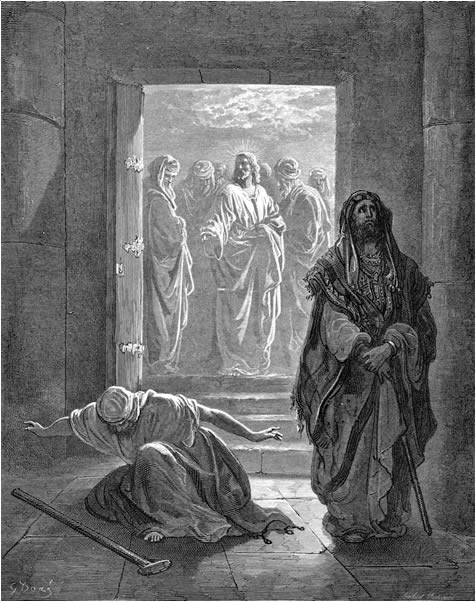
This man welcomes sinners and eats with them!

The titles of the three parables in Luke 15 are usually listed in study Bibles as “The Parable of the Lost Sheep”, “The Parable of the Lost Coin”, and “The Parable of the Prodigal Son”. These titles focus our attention on the “lost” thing or person. This is symptomatic of our tendency to focus on ourselves and not on the Lord.

These days, when people say that they are proclaiming the gospel, what they usually proclaim is something along the lines of “God loves you so much”. They portray Jesus as on an urgent mission to tell people how much God loves them and how precious they are to God.

But in fact, Jesus’ reason for telling these three parables is as a specific response to a specific comment from a specific group of people. We see this in Luke 15:1-2:

“Now the tax collectors and sinners were all drawing near to hear him. And the Pharisees and the scribes grumbled, saying, ‘This man receives sinners and eats with them.’”

The Pharisees and the scribes had been carefully watching Jesus since Luke 5:17-26. Jesus healed a paralytic in the presence of the Pharisees and teachers of the law, pronouncing his sins forgiven. On account of this, they begin to suspect Jesus of blasphemy.

Later, Jesus called the tax collector Levi and began to recline at table with tax collectors and others. At this, the Pharisees and scribes grumbled at his disciples, saying “Why do you eat and drink with tax collectors and sinners?”

The Pharisees and scribes’ question is not a question focused on themselves: “What does Jesus think about me?” Their question is: “Who does this man think he is?”

The parables of Luke 15 are Jesus’ reply to that question.

Who does Jesus say he is in these parables?

In the first parable, he hearkens back to Ezekiel 34 and claims to be the true shepherd of the sheep, the Lord God, who looks for the lost sheep which have been lost by the neglectful shepherds of Israel.

The Pharisees and teachers of the law think that Jesus is a blaspheming man, the crowds who are following him are sinners, and they themselves are God’s servants. But in Jesus’ parable, he identifies everyone differently. In Jesus’ parable, Jesus is the good shepherd, the crowds are the sheep who belong to him, and the Pharisees and the teachers of the law are hypocrites who only serve themselves.

God’s search for us is not driven by our value. Our love and God’s love are different. We love things that are valuable. But God loves his enemies and, by his love, we become valuable. Having turned away from God to idols, we have become worthless (cf. Jeremiah 2:5).

The early church leader Athanasius said that we were created in the image of God. But sin destroyed that image in us. God the Son becomes incarnate and restores the image of God to humanity so that all who Christ calls who enter his death through baptism will also be restored to the image of God on the last day when he raises them from the dead.

This is what it means to be saved. It means that we are rescued from worthlessness and restored to the image of God.

God does not save us because we are worthy. Our salvation is what restores our worth. This is why Jesus did not say, “The Son of Man came to seek and to save what is valuable.” Instead, he said, “For the Son of Man came to seek and to save the lost.”

In Jesus’ parable of the coin, the coin is not valuable; the coin is lost. The coin is restored to value by the woman who searches for it and finds it.

This is why Jesus’ message to the crowds was not, “I have come to die for you because you are so precious.” Instead, the message that Jesus preaches—the gospel—is that the day of final judgment is coming soon. God will come in person on that day—in Christ—to judge and punish his enemies. A short time remains, during which time God is offering his mercy through Christ to save anyone who is willing.

The problem: few are willing!

Jesus laments over Jerusalem that is was not willing (Luke 13:34). And, in the parable of the great banquet, the invited guests were not willing, so the master of the house invited anyone who could be compelled to come (Luke 14:12-24).

That is who we are— the poor, the crippled, the blind and the lame, who have been compelled by the master and his servants to come to the banquet because there is space available.

That is why the characteristic attitude of the authentic Christian is not that we know how precious we are and thus we love ourselves so much. It is that we know how worthless we are and thus what great mercy we have received from God.

These days there is a counterfeit gospel that says that our problem is our lack of self-acceptance. We don’t love ourselves. In this false gospel, God’s love is God’s acceptance of us, which enables us to accept ourselves. This then enables us to accept others.

But in the actual gospel, our problem is not a lack of self-love but idolatry. There is something or someone (or a bunch of things) in place of the one true God in our lives. Christ comes not to accept us but to warn us that God’s judgment against us will come suddenly and fully. He dies not because we are so valuable and he doesn’t want to live without us. He dies because his death and resurrection is how God makes a way for us to be saved from our idolatry. This, says Jesus in John 3:16, is how God loves the world. We love God because he shows us this mercy. We love others because of the mercy God shows to us. As for loving ourselves, we, along with our other brothers and sisters in Christ, have been made the permanent temple of God and the bride of Christ, and so we treat our bodies, souls, and spirits accordingly.

One question remains which still needs to be resolved in today’s scripture is this: Why do the Pharisees and scribes look at the crowd and call them “sinners”?

The answer is very important: The Pharisees and scribes understood sin as a moral issue. They believed that what made someone a sinner is that that person broke the law and is not in good standing with the temple because they have not made the proper sacrifices there to atone for their sins.

The Pharisees and teachers of the law believed that only God could forgive, but that God had given them the list of what counts as sin and put them in charge of administering the system of how we repent and receive forgiveness for those sins.

According to the Pharisees and the teachers of the law—and then also for the temple authorities, as we will see later in Luke and then also in Acts—the crowd that gathered around Jesus had not repented. They had not taken the right steps to receive forgiveness for their sins. Those steps were only available through the law (as interpreted by the Pharisees and the teachers of the law) and the temple (using the sacrifices administered by the temple authorities).

But beginning with John the Baptist, God revealed that that system could no longer make people right with him. It no longer mediated his presence. In the beginning, in the time of Moses, God gave the law and the tabernacle as the means by which his presence could go with the people. But over time, the law and the tabernacle no longer mediated his presence. It obscured and distorted it. That is because those who interpreted the law and those who operated the temple claimed to be representing God, but they were actually representing themselves and their interests. They claimed that the tax collectors were bad, but they themselves were no different than the tax collectors. They were driven by greed and a desire to exploit their positions for their own power.

In the book of Ezekiel, God’s presence left the temple. The religious authorities had distorted the law and the temple so much that, when Christ came according to God’s promises, the authorities called him a blasphemer and put him to death.

Jesus is the way that God comes. He sent John the Baptist ahead of himself to baptize and let people know that the law and the temple were temporary mediators until God came himself in Christ. From that point, repentance would be mediated through Christ alone.

Through Jesus being baptized by John the Baptist, Jesus was revealed to be God through the voice of the Father and the Holy Spirit’s descending on him. And the fact that he was baptized together with sinners (unlike the religious authorities) revealed that he came to seek and to save the lost (cf. Luke 7:24-34).

The religious leaders were blind guides who could not see who Christ is or what God’s purpose was for themselves. They could only follow Jesus around and grumble. They were like the children of Israel in the wilderness.

When Christ came, he revealed the true nature of sin. Sin is not a moral violation. It is not a breaking of the law. Sin is the breaking of relationship with God. It is the rejection of God and replacing God with something or someone else. It is idolatry.

So how does someone repent? They receive Christ when He comes to them.

Christ’s coming signals the end of the age. The present age is characterized by God’s mercy and man’s disobedience. This age, the age of mercy, will end on the Day of the Lord. That is the day on which God’s enemies will be punished and condemned and the people of God will be saved, raised bodily from the dead, and restored to life on the renewed earth.

Keeping this in mind, the parables in Luke 15 make perfect sense. All three parables are about Christ searching for and finding the lost. To be lost means to be out of connection with Christ. That disconnection is caused from the human side, not from God. It comes from human rebellion and idolatry.

When someone is out of connection with Christ, the connection can only be restored by Christ.

IIn times past, the connection with God was mediated by the law, the prophets, and the temple. But in these last days, God has come in Christ, as the fulfillment of the law, the prophets, and the temple. Those who had gathered around Christ were forgiven because they had repented, which means that when Christ came to them, they welcomed him and followed him and recognized him as Lord. They were no longer lost. Their sins were forgiven.

We don’t come to Christ and then confess a list of moral sins. In the so-called “Parable of the Prodigal Son”, the lost son tried to come to a list of sins to confess to his father. But the father cuts him off and receives him. This is because sin is not at root a moral problem, but repentance is at root a restoration of relationship.

Christ has come to you today, directly. He comes to you in his word. His word is his own direct speech. His word does not require me or the study notes in your Bible to mediate it for you or explain it to you. He teaches us directly, through his Holy Spirit, who was given to us at our baptism. He comes to us in the Lord’s Supper. The Lord’s Supper is not mediated by pastors or priests. It does not require a special people to consecrate it or to serve it to you. At that table Christ comes to you directly. That is what a sacrament means: Christ’s direct presence without mediation. And when he offers himself through his word and through the Lord’s Supper, and you receive these in his name as his very word and his very presence, then you are no longer lost.

And your sins are forgiven. 

Posted in Bible, Lord's Supper | Tagged , , , , , , , , , , , , , , , | Leave a comment

If we understand death wrongly, then we understand salvation wrongly

Paul said that “If there is no resurrection of the dead, then not even Christ has been raised. If Christ has not been raised, our preaching is useless and so is your faith” (1 Corinthians 15:13-14). But why does it matter whether people believe that they go to heaven as spirits when they die, or whether there will be a bodily resurrection of all who have ever lived? What makes it “useless” when people deny the resurrection of the dead, as long as they believe in Jesus’ resurrection?

It is useless because if there is no bodily resurrection of all who die, then Jesus did not defeat death. He simply escaped from it and helped others escape—though only partially, since their bodies would still be in death’s possession. But Christ conquers death. Death must give back everything. Everything.

If you ask a Christian, “Are you saved? From what are you saved? When were you saved?” They may answer, “I was saved from my sins when I prayed the sinner’s prayer.” But this understanding of salvation is not found in scripture. When scripture talks about salvation or justification, it is talking about more than being saved from our sins through a special prayer. It is primarily talking about being saved from the curse of death which came to us through Adam’s disobedience. So, the answer to the above question, according to scripture, would be, “I possess the sure and certain hope of the resurrection from the dead on the day of judgment, when I will be justified and declared righteous by the Lord himself, with whom I will live forever in my Spirit-animated physical body on this earth, which will be made new by God.”

Caption: Salvation Mountain in Niland, California

Because the Lord is coming to earth to make his home among those whom he resurrects and justifies, the earth, which was previously polluted by sin and death, has to be purified (cf. Numbers 35:33-34). It must give up her dead. According to Paul, the earth is pretty excited about that, because at the coming of the Lord, “creation itself will be liberated from its bondage to decay and brought into the freedom and glory of the children of God” (Romans 8:21).

At the present time, we have the “firstfruits” of salvation through the forgiveness of sins and the Holy Spirit, and we receive both of these when we are baptized (cf. Romans 8:23). The Holy Spirit then teaches us directly and reveals Christ fully to us through the word (cf. John 16:13-14, Jeremiah 31:31-34). So salvation has begun and will be brought to completion at the coming of Christ Jesus. This, says Paul along with all the Apostles, is “the blessed hope” (Titus 2:13).

 Some Christians say that it is not possible for people to “lose their salvation”. But this way of talking views salvation as something that is already fully possessed. But scripture talks about salvation as something that is presently underway, that we can drift away from if we do not pay attention to the gospel and hold tightly to the word but instead ignore it (cf. Hebrews 2:1-3).

This is what Paul was warning the Corinthians about in 1 Corinthians 15, and it is also what we need to warn the Christians of our own time about. Many Christians believe that salvation from sin is a past tense matter and can be safely set aside from our daily deliberations. They believe that at issue today is the salvation of our nation and of our Christian way of life, and that Christ’s focus today is on raising up specially anointed political leaders to wage this battle. The focus of Christians, they say, is to support these leaders and win this battle at all costs.

But to do so is to ignore the great salvation of the Gospel and to go backwards from the New Covenant to the Old Covenant.

In the New Covenant, our present citizenship is in heaven and we are a “chosen people, a royal priesthood, a holy nation, God’s special possession, that you may declare the praises of him who called you out of darkness into his wonderful light” (1 Peter 2:9). God is not saving nations. He is raising up a holy nation from among all nations.

In the New Covenant, God is not raising up anointed political leaders but rather “there is one God and one mediator between God and mankind, the man Christ Jesus,” (1 Timothy 2:5).

In the New Covenant, “Nor are you to be called instructors, for you have one Instructor, the Messiah.” (Matthew 23:10).

In the New Covenant, “All authority in heaven and on earth has been given to” Jesus. (Matthew 28:18).

In the New Covenant, Jesus said, “It is finished” (John 19:30).

Many Christians gladly affirm these things as spiritual truths but believe they are not political realities. But scripture does not distinguish in this way between spiritual truths and political realities. The Lord Jesus has all power in every realm. Jesus did not die so that we could rewrite the laws in our country. Jesus died so that he could write his law on our hearts.

Christ did not leave the Kingdom of God in the future to be lived in after death. He brought it back to the present in seed form. And those who do not receive it as a seed in the present, watering it and caring for it, will not see it sprout in them in the future. If we do not live the way of the Kingdom in this life, Christ warns us that, “the kingdom of God will be taken away from you and given to a people who will produce its fruit” (Matthew 21:43).

Christ already holds all authority in heaven and on earth. So Christ even uses the politicians who oppose him to accomplish his purpose. So we should never worry that a politician can be raised up who can destroy God’s work—this is impossible.

This present evil age is seeking to destroy us not only through governments but also through our flesh-and-blood families and even our own flesh because these things are all hostile to Christ’s kingdom. In Galatians 1:4 Paul says being saved from this present evil age requires Christ’s active work on our behalf today.  

So if Jesus is not focused on saving our nation, what is he focused on today? And what does he expect us to focus on today if we are not focused on supporting certain political leaders?

He tells us in Matthew 10:8:

“Freely you have received; freely give.”

He directs us to pass on the love for enemies, opening his home, sharing his bread, etc. which is the grace he himself gives us daily. If we receive these things from him and what we extend to other people is not that same grace, even the grace we have received will be taken away.

A simple illustration: My wife loves to give clothes, food, and tools to other people. But, when she finds a year later that what she has given to other people is still sitting in the closet and not being used, she asks for those things back in order to give them to someone else who will use them. The kingdom of God is like that. Grace that is not passed on to others is grace that is received in vain (2 Cor 6:1).

We cannot receive mercy from Christ and give others judgment. We cannot receive love from Christ and hate our enemies. We cannot receive hospitality from Christ and close our homes. We cannot receive bread from Christ and let others starve. If we do this, we reveal ourselves to be tares and not wheat and we will be plucked up and burned on the last day, even if we call ourselves Christians and seek to save the nation in his name during our lifetime.

It is absolutely true that nations cannot turn the other cheek to people who attack them, open their home to strangers, or cancel debts and give freely. This is why we are not called to disciple nations. Governments are not instruments of God’s grace, they are instruments of God’s wrath to punish wrongdoers (Romans 13:1-5).

So Christ calls us to discipleship people, not governments, and he calls us to teach people to obey everything he has commanded. Some Christians may say that it is not practical or realistic to live according to Christ’s commandments in this world. What they mean is, “If I obey everything Christ commanded, then my nation and my present way of life will be lost, not saved.”

Jesus responds like this, “Very truly I tell you, unless a kernel of wheat falls to the ground and dies, it remains only a single seed. But if it dies, it produces many seeds” (John 12:24). And “Whoever loves his life loses it, and whoever hates his life in this world will keep it for eternal life.” (John 12:25)

Posted in Uncategorized | Tagged , , , , | Leave a comment