If we understand death wrongly, then we understand salvation wrongly

Paul said that “If there is no resurrection of the dead, then not even Christ has been raised. If Christ has not been raised, our preaching is useless and so is your faith” (1 Corinthians 15:13-14). But why does it matter whether people believe that they go to heaven as spirits when they die, or whether there will be a bodily resurrection of all who have ever lived? What makes it “useless” when people deny the resurrection of the dead, as long as they believe in Jesus’ resurrection?

It is useless because if there is no bodily resurrection of all who die, then Jesus did not defeat death. He simply escaped from it and helped others escape—though only partially, since their bodies would still be in death’s possession. But Christ conquers death. Death must give back everything. Everything.

If you ask a Christian, “Are you saved? From what are you saved? When were you saved?” They may answer, “I was saved from my sins when I prayed the sinner’s prayer.” But this understanding of salvation is not found in scripture. When scripture talks about salvation or justification, it is talking about more than being saved from our sins through a special prayer. It is primarily talking about being saved from the curse of death which came to us through Adam’s disobedience. So, the answer to the above question, according to scripture, would be, “I possess the sure and certain hope of the resurrection from the dead on the day of judgment, when I will be justified and declared righteous by the Lord himself, with whom I will live forever in my Spirit-animated physical body on this earth, which will be made new by God.”

Caption: Salvation Mountain in Niland, California

Because the Lord is coming to earth to make his home among those whom he resurrects and justifies, the earth, which was previously polluted by sin and death, has to be purified (cf. Numbers 35:33-34). It must give up her dead. According to Paul, the earth is pretty excited about that, because at the coming of the Lord, “creation itself will be liberated from its bondage to decay and brought into the freedom and glory of the children of God” (Romans 8:21).

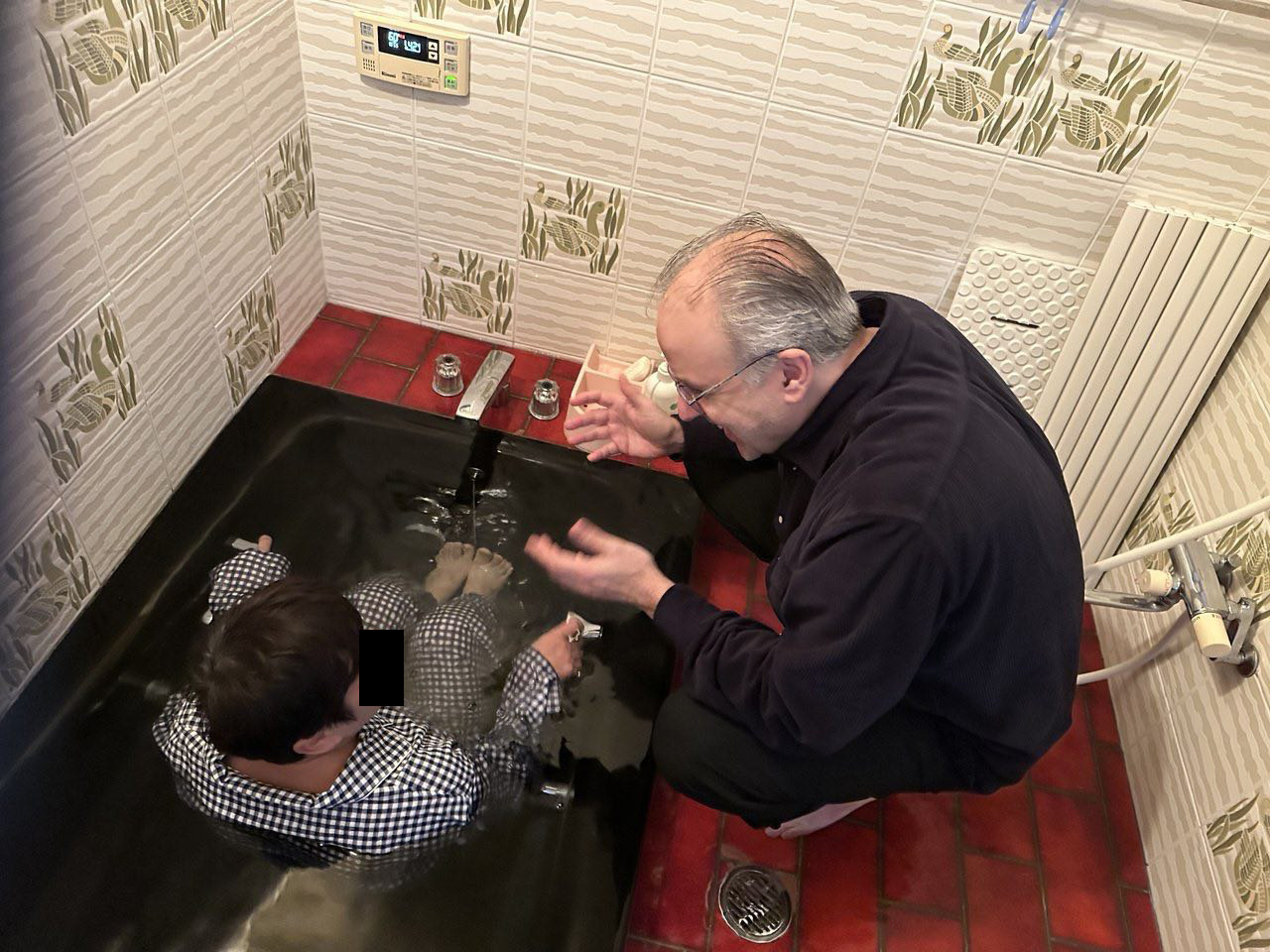
At the present time, we have the “firstfruits” of salvation through the forgiveness of sins and the Holy Spirit, and we receive both of these when we are baptized (cf. Romans 8:23). The Holy Spirit then teaches us directly and reveals Christ fully to us through the word (cf. John 16:13-14, Jeremiah 31:31-34). So salvation has begun and will be brought to completion at the coming of Christ Jesus. This, says Paul along with all the Apostles, is “the blessed hope” (Titus 2:13).

 Some Christians say that it is not possible for people to “lose their salvation”. But this way of talking views salvation as something that is already fully possessed. But scripture talks about salvation as something that is presently underway, that we can drift away from if we do not pay attention to the gospel and hold tightly to the word but instead ignore it (cf. Hebrews 2:1-3).

This is what Paul was warning the Corinthians about in 1 Corinthians 15, and it is also what we need to warn the Christians of our own time about. Many Christians believe that salvation from sin is a past tense matter and can be safely set aside from our daily deliberations. They believe that at issue today is the salvation of our nation and of our Christian way of life, and that Christ’s focus today is on raising up specially anointed political leaders to wage this battle. The focus of Christians, they say, is to support these leaders and win this battle at all costs.

But to do so is to ignore the great salvation of the Gospel and to go backwards from the New Covenant to the Old Covenant.

In the New Covenant, our present citizenship is in heaven and we are a “chosen people, a royal priesthood, a holy nation, God’s special possession, that you may declare the praises of him who called you out of darkness into his wonderful light” (1 Peter 2:9). God is not saving nations. He is raising up a holy nation from among all nations.

In the New Covenant, God is not raising up anointed political leaders but rather “there is one God and one mediator between God and mankind, the man Christ Jesus,” (1 Timothy 2:5).

In the New Covenant, “Nor are you to be called instructors, for you have one Instructor, the Messiah.” (Matthew 23:10).

In the New Covenant, “All authority in heaven and on earth has been given to” Jesus. (Matthew 28:18).

In the New Covenant, Jesus said, “It is finished” (John 19:30).

Many Christians gladly affirm these things as spiritual truths but believe they are not political realities. But scripture does not distinguish in this way between spiritual truths and political realities. The Lord Jesus has all power in every realm. Jesus did not die so that we could rewrite the laws in our country. Jesus died so that he could write his law on our hearts.

Christ did not leave the Kingdom of God in the future to be lived in after death. He brought it back to the present in seed form. And those who do not receive it as a seed in the present, watering it and caring for it, will not see it sprout in them in the future. If we do not live the way of the Kingdom in this life, Christ warns us that, “the kingdom of God will be taken away from you and given to a people who will produce its fruit” (Matthew 21:43).

Christ already holds all authority in heaven and on earth. So Christ even uses the politicians who oppose him to accomplish his purpose. So we should never worry that a politician can be raised up who can destroy God’s work—this is impossible.

This present evil age is seeking to destroy us not only through governments but also through our flesh-and-blood families and even our own flesh because these things are all hostile to Christ’s kingdom. In Galatians 1:4 Paul says being saved from this present evil age requires Christ’s active work on our behalf today.  

So if Jesus is not focused on saving our nation, what is he focused on today? And what does he expect us to focus on today if we are not focused on supporting certain political leaders?

He tells us in Matthew 10:8:

“Freely you have received; freely give.”

He directs us to pass on the love for enemies, opening his home, sharing his bread, etc. which is the grace he himself gives us daily. If we receive these things from him and what we extend to other people is not that same grace, even the grace we have received will be taken away.

A simple illustration: My wife loves to give clothes, food, and tools to other people. But, when she finds a year later that what she has given to other people is still sitting in the closet and not being used, she asks for those things back in order to give them to someone else who will use them. The kingdom of God is like that. Grace that is not passed on to others is grace that is received in vain (2 Cor 6:1).

We cannot receive mercy from Christ and give others judgment. We cannot receive love from Christ and hate our enemies. We cannot receive hospitality from Christ and close our homes. We cannot receive bread from Christ and let others starve. If we do this, we reveal ourselves to be tares and not wheat and we will be plucked up and burned on the last day, even if we call ourselves Christians and seek to save the nation in his name during our lifetime.

It is absolutely true that nations cannot turn the other cheek to people who attack them, open their home to strangers, or cancel debts and give freely. This is why we are not called to disciple nations. Governments are not instruments of God’s grace, they are instruments of God’s wrath to punish wrongdoers (Romans 13:1-5).

So Christ calls us to discipleship people, not governments, and he calls us to teach people to obey everything he has commanded. Some Christians may say that it is not practical or realistic to live according to Christ’s commandments in this world. What they mean is, “If I obey everything Christ commanded, then my nation and my present way of life will be lost, not saved.”

Jesus responds like this, “Very truly I tell you, unless a kernel of wheat falls to the ground and dies, it remains only a single seed. But if it dies, it produces many seeds” (John 12:24). And “Whoever loves his life loses it, and whoever hates his life in this world will keep it for eternal life.” (John 12:25)

Posted in Uncategorized | Tagged , , , , | Leave a comment

The teaching that makes the gospel–and your faith–useless

“But in fact Christ has been raised from the dead, the firstfruits of those who have fallen asleep.” (1 Corinthians 15:20)

In 1 Corinthians 3:10, Paul wrote that he laid the foundation of Jesus Christ in Corinth but “someone else is building upon it”. We do not know who this “someone else” is, but we can get a sense of what they were trying to tack on to the gospel when we read 1 Corinthians 15:12. This person was denying the “ἀνάστασις”, or the bodily resurrection of the dead. They were denying that we will all be raised again with bodies of flesh and blood, some to eternal life on a renewed earth and some to the second death, at the second coming of Jesus Christ.

In the church today as well, many “someones” are spreading the same false teaching. It is an unfortunate fact of modern Christianity in the West that the default Christian hope is to “die and go to heaven”. But the scriptural Christian hope is to be resurrected in a physical body of flesh and blood and bones which will live forever on a renewed earth in the presence of the Lord. As Paul says, “we testified about God that he raised Christ, whom he did not raise if it is true that the dead are not raised.” (1 Corinthians 15:15).

Then what does Paul mean in 1 Corinthians 15:44 when he talks about a “spiritual body”? Paul is not talking about what material our bodies will be made of. He is not saying that we have a material body now but will be resurrected as a spirit. Instead, Paul is distinguishing between the life source that animates our bodies. In this world, our life source is “natural”, that is, it comes from our parents (cf. John 1:13). But when we are resurrected, our life source will be the Holy Spirit, thus making us “spiritual” bodies.

In Philippians 3:20-21, Paul teaches us that Christ’s resurrection body is the pattern of our resurrection body. And Christ’s body was not a ghostly body, but a material body. In Luke 24:39, the resurrected Jesus says, “See my hands and my feet, that it is I myself. Touch me, and see. For a spirit does not have flesh and bones as you see that I have.” (Luke 24:39). He has flesh, blood, bones, and he ate fish. This is the kind of body that we will have when we are resurrected.

Our understanding of the resurrection will strongly shape our understanding of two key concepts: death and salvation. As we’ll see, a wrong understanding of the resurrection always gives rise to a wrong understanding of death which always gives rise to a wrong understanding of salvation.

So we must understand what “death’ is according to scripture. In scripture, death is not when the spirit and body are separated–a Greek concept. Genesis 3 shows that death is a curse from God for disobeying his word.

Originally, humans were created in a state of blessing in the Garden of Eden. This does not mean that there were no steep cliffs, fierce animals, or sharp stones that could have afflicted Adam. It means that such things posed no threat to Him because God’s blessing on him ensured that these dangerous things served him (cf. Psalm 91:12).

But due to Adam’s sin, the things which previously served him became his master and thus a threat to him.

The ground which once served to nourish him became a grave for him and for every human who followed—a curse on the ground for which it was never purposed (cf. Genesis 3:19). In the Old Testament, God describes the ground as a prison in which people await punishment (cf. Isaiah 24). And God prophesies the resurrection, saying, “Your dead shall live; their bodies shall rise. You who dwell in the dust, awake and sing for joy! For your dew is a dew of light and the earth will give birth to the dead.” (Isaiah 26:19).

Right after Jesus says that He goes to prepare a place for us, Jesus is crucified and buried—he goes into the ground (cf. John 14:2-3). In doing so, Jesus reverses the curse and provides a “room” in which he invites us to take refuge from the wrath of God. This we do by being baptized into Christ’s body (cf. Isaiah 26:20).

When people who are not in Christ die, they do not go anywhere. Their soul and body stay in the prison of the ground, awaiting the judgment at the return of Christ. But, for those of us who die in Christ, we remain with Him even when we die. But this way of being in Him is not the end. It is temporary until He returns on the Day of the Lord and takes us to be with Him by resurrecting us bodily from the dead.

As for the day of judgment, it is spoken of even in Isaiah 25:21, saying, “For behold, the Lord is coming out from his place to punish the inhabitants of the earth for their iniquity, and the earth will disclose the blood shed on it, and will no more cover its slain.” This is why Paul writes in Romans 8:19-25 that the “creation waits with eager longing” and even “we ourselves” wait for the day when the curses on creation are reversed and we are resurrected bodily.

This is why the Christian hope is not the slipping off of our bodies like banana peels while we go on to eternal life as spirits. The Christian hope is that the curse will be reversed, the ground and the sea will give up their dead, and the resurrected dead will be judged, the creation will be redeemed, and those who are in Christ will live forever with him on a renewed earth, in flesh and blood bodies animated by the Holy Spirit.

This is the gospel hope.

Posted in Uncategorized | Tagged , , , , , | 2 Comments

1 Corinthians 13: Church love, not married love

If I speak in the tongues of men and of angels, but have not love, I am a noisy gong or a clanging cymbal. (1 Corinthians 13:1)

In 1 Corinthians, chapter 13 is a new chapter, but it does not introduce a new subject. In 1 Corinthians 13, the Apostle Paul is still talking about unity in the body of Christ, as he does in the rest of 1 Corinthians. This means that when Paul tells us what “love” is in this passage, he is not speaking about love in general. Neither is he speaking about married love. He is not even directing us to have a certain attitude or emotion toward other people. There are no commands for us in 1 Corinthians 13!

Paul is doing the same thing in 1 Corinthians 13 that he usually does when he responds to the problems of the Church in his letters. Paul is preaching Christ. Paul is speaking of a perfect love which never fails, always protects, always trusts, always hopes, and always perseveres. This is not our human love. What is love? Love is a who. Who is love? God is love.

In 1 Corinthians 14:1, Paul commands us to “pursue love”. This means that our focus should not be on trying to become better at loving other people. Our focus should be on looking toward the love of God which comes to us through Christ on the cross. As 1 John 4:10 says, “This is love: not that we loved God, but that he loved us and sent his Son as an atoning sacrifice for our sins.”

For Paul, being spiritual is not about having extraordinary human talents such as linguistic skill, knowledge, foresight, or any of these things. Being spiritual is not even about having a loving attitude toward other people. It is about knowing nothing “except Jesus Christ and him crucified” (1 Corinthians 2:2).

We tend to like it when celebrities become Christians because they have the power, finances, and exposure to influence many other people to become Christians. We assume that celebrities and powerful people would be the people whom God would be most likely to use to build the church. But because the way of love is the way of cross, the people who pursue love tend not to be people who have superpowers, but people who are weak, fearful, and foolish.

Among the attributes of love, at the very center of 1 Corinthians 13, we see that love “does not insist on its own way.” We see this aspect of love in the prayers of Jesus in the Garden of Gethsemane and in the Lord’s Prayer. This means that love is not what happens when we do what we want to do with a loving attitude. Love is not even us giving up what we want to do and doing what other people want to do. Love is what happens when God’s will is what is done instead of our will.

But how do we know what God’s will is? God spreads the answer to what His will is throughout the whole congregation so that, in order to know what His will is, we need to seek God’s will together. Paul never put his faith and trust in talented leaders with loving attitudes to run churches under his oversight. Instead, Paul put his faith and trust in the whole congregation being brought together at the foot of the cross.

At the foot of the cross, everyone is available to be used by the Lord on any particular day for any particular purpose. There, everyone is responsible together for discerning the will of the Lord in unity. Church should not be set up as a hierarchy. Church has to be set up so that everyone is prepared to preach, pray, or die at a moment’s notice.

So, having one person or even a small group of people set up to lead the church and make the decisions is dangerous, deadly, and unbiblical. Paul never writes his letters to the pastor or to the elder board, but to the whole congregation. Paul believed that God is the one who leads throughout the whole congregation jointly gathered, and submitted to the Lord’s will. The job of pastors and elders is to point to the Lord and ensure that the congregational leadership is his alone, not usurped by…pastors and elders.

In the Church, the Lord Himself is present among us to lead.

Posted in Discipleship | Tagged , , , , , , , , | Leave a comment