Christians are not saved from suffering. We are saved in the midst of suffering.

The Christian life is a life of great tribulation.

You may be wondering, “Why would the whole Christian life be called that? Doesn’t persecution come and go, depending on what country you’re in and who’s running the government and whether there are protections for religious freedom and whether the culture upholds Christian values?”

No.

When the world rejected Christ–through the religious and political leaders and all the people putting Jesus to death on the cross—it was not because the world was confused or made a mistake or because there was a misunderstanding. The world is always hostile to the gospel. Christ was the first preacher of the gospel. The gospel is the message of who Christ is and what he does. Christ handed on the gospel message to his apostles, and then to us. Wherever that message is faithfully preached in this present age, the world will make sure that the one who preaches it will pay the price.  

“But wait!” you may be thinking. “Revelation 7 says that we are ‘sealed’! So that means we Christians are kept safe from trouble! The modern evangelist told me that God wants me to have a joyful and peaceful life!”

And indeed, beginning in the mid-19th century, a man named John Darby began to teach that the Great Tribulation would happen at the end of history and last for 3 and a half years, and that Christians would get taken up to heaven before it happened. This is the idea of the “rapture”.  Darby’s ideas have become popular with some groups of Christians, because of course people want to believe that God will spare them from big suffering if they believe in Jesus!

But God doesn’t seal Christians in order to protect us from suffering. God seals Christians in order to protect us in the midst of suffering.

So what are we being protected from?

From denying our testimony of who Christ is and what he does. Because that’s what the world hates. Despite what you may have been taught, the world doesn’t hate Christians. The world doesn’t even hate “Christian values”. What the world hates—and has always hated, and will always hate is the gospel—the faithful testimony of who Christ is and what he does. And the world will do anything to silence that message.   

We can understand what faithful Christians always have to endure in every generation when we read Revelation 7:16-17. Here, as John is seeing the Christians after they have made it through the Great Tribulation, one of the elders says to him:

Never again will they hunger; never again will they thirst. The sun will not beat upon them, nor any scorching heat. For the Lamb at the center of the throne will be their shepherd; he will lead them to springs of living water. And God will wipe away every tear from their eyes.”

Notice it says “never again”, meaning “In this present age, Christians will face hunger; and will experience thirst; and will be scorched by the heat; and will thirst; and will certainly cry many tears.”

If you want to see a really good example of what it means for Christians to be “sealed”, look at the story of the two witnesses in Revelation 11:  

And I will give power to my two witnesses, and they will prophesy for 1,260 days, clothed in sackcloth”…If anyone tries to harm them, fire comes from their mouths and devours their enemies. This is how anyone who wants to harm them must die. These men have power to shut up the sky so that it will not rain during the time they are prophesying; and they have power to turn the waters into blood and to strike the earth with every kind of plague as often as they want. Now when they have finished their testimony, the beast that comes up from the Abyss will attack them, and overpower and kill them.

We are “sealed” in order to be able to accomplish our purpose of testifying faithfully to the hostile world. Nothing can stop us from making the testimony Christ has appointed us to make! But after our work is complete, we can expect to pay the price.

So you may be thinking, “Well, where is the good news in that?”

And if you have been following Jesus because you were told he could bring you a joyful and peaceful life in this world—a life of prosperity and freedom from suffering—then this is bad news indeed.

But if that’s why you have been following Jesus, then what you were taught wasn’t the gospel.  

The true Christian life is a life of great tribulation in this present age. From the moment we are sealed in baptism we are called to stand and testify to who Christ is and what he does. As we do this, Christ shakes the whole creation around us, as he opens seal after seal in order to bring the present age to an end.

And we get shaken along with the whole creation. Christ warns us that when we are sealed with his seal, we will face hunger, thirst, rejection, the division of our own families, and even our death. 

But that seal, which you received at your baptism, is his promise that although everything else will be shaken and ultimately destroyed (which it will—he promised that, too), we are bound to him. And because of that, we will be able to stand through the Great Tribulation.

Posted in Suffering | Tagged , , , , , , , , , , , | 1 Comment

The Biblical alternative to modern evangelism

In the Gospel confession, “Christ died for our sins according to the Scriptures”, the importance of the first words–“Christ died for our sins”–is obvious. But it is rarely noted that the rest of that confession–“according to the Scriptures”–are as important as the first words.

Pastor Foley baptizes a Chinese believer at a recent training for underground Chinese Christians.

Many of the things preached and taught these days about Christ’s death for our sins don’t come from the Scriptures at all but instead come from efforts by some Christian evangelists to create a simple, easy way to explain Christ’s death. They formulate this the same way advertisers sell cars and cosmetics: By using a “problem-solution-benefits” model.

It usually goes something like this:

  • God wants us to have a peaceful and joyful life.
  • We ourselves are the source of a problem—sin—that keeps us from having that life.
  • God sent Jesus to remove that problem.
  • If we believe in Jesus, we can have that peace and joyful life both now and even after we die.

This modern evangelistic method provides everything that’s needed for someone to say yes to Jesus. Often a video presentation is provided that you can show to others if you are unsure about your own ability to present it well yourself. Or if you want to do the presentation, there are tracts available, as well as drawings that you can draw out for other people as your doing the presentation.  There is even a standard prayer form that a person can pray to receive Jesus.

How different this is from the gospel that is preached in the Scriptures! Paul says that the gospel is the things of first importance about who Christ is and what he does. Who decides what is of first importance about Christ? Christ does! He is the first preacher of the gospel, and he passes the gospel on to his Apostles, and this proclamation is recorded in Scripture.

Modern evangelistic methods also share “what is of first importance”, but here “what is of first importance” means “what is of first importance to the listener”, namely, our own happiness and well-being and how it is advanced by the gospel.

But the gospel proclamation says that Christ died for our sins “as according to the
Scriptures”, not “as according to our human understanding”. We are not free to give our own explanations of how Christ died, or why. These things are all given to us in the Scriptures.

If we ask, “Which Scriptures?”, Jesus gives the answer in the Scripture we have been studying this week. It’s the story of Jesus on Easter, walking on the road to Emmaus with two disciples who don’t recognize him. And the things that have happened regarding Jesus don’t make sense according to their human understanding. Jesus says to them in Luke 24 beginning in v. 25:

“How foolish you are, and how slow of heart to believe all that the prophets have spoken! Did not the Christ have to suffer these things and then enter his glory?” And beginning with Moses and all the Prophets, he explained to them what was said in all the Scriptures concerning himself.

Jesus says it is foolish to use our human understanding to understand how and why he died. He says we have to turn to the Old Testament—all of it, he says—in order to understand. And even then, Christ has to open our minds through his Holy Spirit to understand the things that are written there.

In fact, that’s exactly what we see a few verses later, beginning in v. 44, when Jesus comes to the Apostles for the first time since his resurrection. Jesus says to them also, just like he told the two disciples on the road earlier that day, that it will be necessary for them to go back to the Old Testament to understand what it means that he died for their sins:

He said to them, “This is what I told you while I was still with you: Everything must be fulfilled that is written about me in the Law of Moses, the Prophets and the Psalms.” Then he opened their minds so they could understand the Scriptures.

When we go back to those Old Testament scriptures, it challenges many of the things we hear preached these days about why and how Christ died.

Even when Christ teaches us and the Holy Spirit opens the Scripture to us, that doesn’t mean that it is a magic process where everything instantly makes sense to us. It’s not like the Buddhist idea of enlightenment. It feels like a lot of hard work.

And that’s what we see with the disciples in the Scriptures too. All the way through the book of Acts, Peter and Paul and James and all the Apostles and early Christians are still figuring things out. It’s a kind of “two steps forward, one step backward” process.

Jesus told us it would be like that. In John 16:13, when Jesus is preparing the disciples for his death, he says:

But when he, the Spirit of truth, comes, he will guide you into all truth.

The Holy Spirit doesn’t suddenly and instantly make everything clear to us. He guides us into all truth. That’s a long-time process. That was true for John himself. Even in the very last chapter of the Bible, Revelation 22 beginning in v. 8, he says:

I, John, am the one who heard and saw these things. And when I had heard and seen them, I fell down to worship at the feet of the angel who had been showing them to me. But he said to me, “Do not do it! I am a fellow servant with you and with your brothers the prophets and of all who keep the words of this book. Worship God!”

So for our whole lives, Christ will be teaching us through his Holy Spirit, and it will always go against our human understanding. Two steps forward, one step back.

So you may be thinking, “Why does it have to be like that? To lead people to Christ, do we really have to take them through the whole Old Testament like Christ does with the disciples on the road to Emmaus? Why couldn’t Christ have given us something simple to share with other people–as simple as the 4-step problem-solution-benefit models of modern evangelism?”

And the answer is:

He did!

What I want you to notice in today’s scripture is that it does not say:

And beginning with Moses and all the Prophets, he explained to them what was said in all the Scriptures concerning himself. Then their eyes were opened and they recognized him, and he disappeared from their sight.

Something very important happens in between those verses. It says:

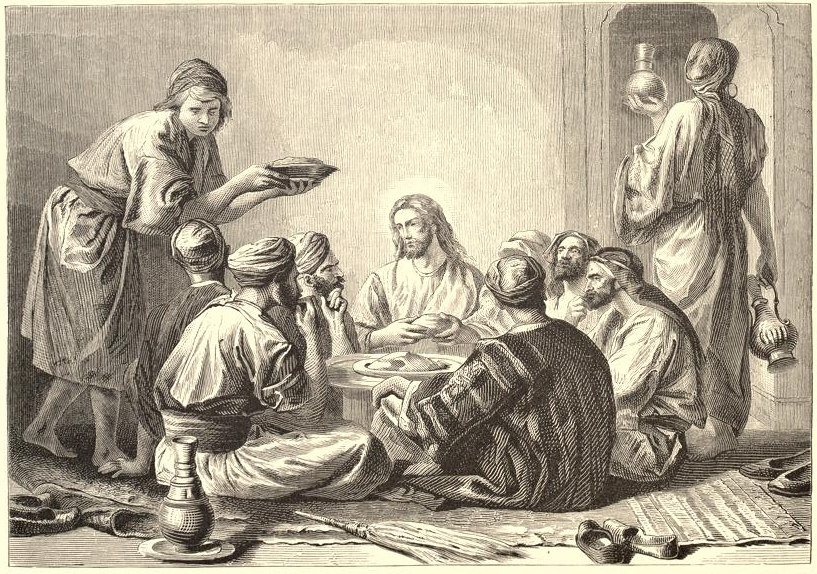
When he was at the table with them, he took bread, gave thanks, broke it and began to give it to them.

Christ is our only teacher. And yet, it was not through his teaching that their eyes were open and they recognized him. It was through him breaking the bread.

You see, Jesus has given us the simplest, easiest way to understand and receive his two great promises. He has given us Baptism and the Lord’s Supper.

Through baptism, we enter into the Lord’s death; we receive the forgiveness of our sins; we receive the Holy Spirit; and we are marked to be resurrected bodily and raised up to live eternally with Christ on the New Earth on the Last Day. Christ binds these promises to the waters of baptism, so that the way we receive these promises is to believe and be baptized. Those are the Lord Jesus’ own words in Mark 16:16.

At the Lord’s Table, we eat the meal that seals the New Covenant. Our role is to receive the promises that the Lord makes in the New Covenant. We receive these promises by partaking of the bread and the cup to which he bound the New Covenant. The Lord’s Supper is the meal we eat with the Lord as part of the New Israel.

These two sacraments are how the Lord commands us to understand and receive his two great promises to us: Salvation and incorporation into the New Israel under the New Covenant. They are simple, but profoundly deep.

And they are according to the Scriptures.

Posted in Proclaiming The Gospel | Tagged , , , , , , , , , , , | Leave a comment

The Lord’s Supper: The New Covenant in His Blood

It is a very good thing to preach and teach regularly about Christian essentials such as the Lord’s Supper. Many preachers these days do not like to preach on, e.g., the Lord’s return, the Lord’s Supper, Baptism, and other essentials because, although Christians agree on the basics, they argue much about the nonessentials, and such preachers would like to avoid such arguments. But, if preachers do this, the only people who end up teaching about such things are the extremists and crazy people who preach nonessentials as if they were essentials. So we need to preach about Christian essentials often, focusing on the parts on which all Protestant Christians should agree.

Accordingly, let’s talk about the Lord’s Supper.

Pastor Foley leads a group of Chinese house church pastors in the Lord’s Supper.

There is a difference between the Lord’s Supper and the Last Supper. The Last Supper was the last meal that Jesus ate with his disciples before his death. But the Lord’s Supper is the sacrament which the Lord Jesus himself instituted at the Last Supper.

We can see that it is the Lord Jesus himself who instituted the sacrament of Lord’s Supper in the command that he gave. Jesus said, “Do this in remembrance of me”. In the Greek, the verb tense used shows that the statement does not mean “Do this one time in remembrance of me” but rather “Do this and keep on doing it in remembrance of me.”

But what is a sacrament? For Protestants, a sacrament is a promise of Christ that he binds to a physical object such that the way that we receive the promise is by receiving that object in faith.

Because Jesus has bound his promise to these things, it means that we cannot receive the promise in our hearts and disregard the Lord’s Supper. We cannot discard the bread and cup and just believe we are receiving the promise of Christ spiritually when we believe in our heart.

It is the same with Baptism. Through baptism, we enter into the Lord’s death, are forgiven of our sins, receive the Holy Spirit, and are marked to be resurrected bodily to eternal life by Christ on the Last Day. These are the promises which Christ has bound to the waters of baptism. The way that we receive those promises are to “believe and be baptized” (Mark 16:16).

Many Protestants these days wrongly think of baptism not as a sacrament but as a public confirmation of something that has already happened inside our hearts. And they also wrongly believe that the way that we access the promises of Christ is by praying the Sinner’s Prayer. So they wrongly turn the Sinner’s Prayer into a sacrament: They wrongly bind the promises of salvation to that prayer.

Beware of people who do this. They sound very biblical and spiritual. But they are, in fact, setting aside the command of the Lord Jesus Himself. They are replacing the Lord’s command with human thinking. They will affirm that baptism is good, but they think of it as a kind of optional public ceremony. For them, the Sinner’s Prayer prayed in faith is how we enter into God’s salvation.

If you try to reason with these people, they will often say something like, “But what if there is a soldier on the battlefield and he is about to die. He prays to God saying that he is a sinner and believes in Jesus and then immediately dies. But he didn’t get baptized. Are you saying that he was not saved? See, the important thing is the prayer, and baptism is optional.”

But neither the Lord nor anyone in scripture ever said anything like that. In fact, they always hold up baptism as the act of faith through which we enter into God’s salvation (cf. Acts 8:36). This is why throughout history the church has always made provision for emergency baptisms in emergency situations. The early church said that, in an emergency situation, anybody can baptize, and it can even be done without water if none is around.

Why is baptism so important? It is because salvation is a promise that the Lord makes not only to your soul, but to your whole body. The Lord is not only saving you on the inside, but also on the outside, so that we will be bodily resurrected by the Lord Jesus. Gnostic people who teach that we become spirits and go to live in heaven forever when we die have no need for baptism because they do not preach the bodily resurrection.

Martin Luther said, “If you see somebody trying to climb up into heaven”—i.e., by being so spiritual that everything happens in their hearts, not their bodies—”drag them back down to earth”, because the Lord’s will is to save us body and soul. He creates a new heavens and a new earth as the future home for our future bodies.

That is why sacraments are bound to physical things: because we are physical beings, and the Lord’s promises are for our whole being, not only our “hearts”.

We must avoid the mistake of many modern Protestants of disregarding the physical and locating the sacrament in their own hearts or actions rather than in the action of the Lord upon our whole being.

One common side effect of misunderstanding baptism is that some Christians wrongly feel the need to be re-baptized when they “become serious” about their faith. But baptism is not about our realization. It is about the promise of the Lord that he will keep us. If we “become serious” about our faith, that is not a sign that we need to get re-baptized. It is a sign that the Lord has been faithful to the promise he made to us at our baptism.

What makes baptism effective is not what you bring to the baptism, but what the Lord brings to the baptism. In baptism, the Lord marks you as his own. Our role is to accept that passively and to trust that, from that point on, he will fulfill the promises he made to us.

I had the least exciting baptism. I was nervous and I did not know what was going on. But in that baptism the Lord marked me and kept me and brought me to where I am today in my faith. I am thankful that my baptism was so humanly unspectacular because it serves as a constant reminder to me that my Christian life is a gift from him from start to finish. Baptism is not a public confession of seriousness. It is an act of simple trust that the Lord will do what He promises to do.

What we have talked about with regard to baptism applies equally to the Lord’s Supper, because they are both sacraments. But baptism is done one time, but the Lord’s Supper is done repeatedly. And baptism we receive individually, but the Lord’s Supper we receive together. Why the differences?

It is a vital question because the Lord does not make the promises he made on the night of the Last Supper available to us any other way than through the Lord’s Supper. We cannot receive those promises simply through “believing with our heart” alone. He bound those promises to the bread and cup.

But here is a big problem: If you ask the average Christian what the promises are that Jesus made at the Lord’s Supper, they will either not know, or they will guess wrong. That is absolutely tragic, because the Lord arranged that the two central promises he makes to us are to be received through the two sacraments of baptism and the Lord’s Supper. They are not ideas we accept in our minds or hearts. They are body-and-soul acts of the Lord through which he ministers to our whole self. So if we don’t know the promise and we fail to partake of it through the sacrament the Lord ordained to give it to us, we fail to receive it. The Apostle Paul told the Corinthians that has dire consequences.

Sadly, the main conversation in many churches about the Lord’s Supper is not about the meaning but about how—and how often—to do the Lord’s Supper.

All of the evidence in scripture and Church history shows that the reason why early Christians gathered together was not primarily to hear a sermon, pray, or give an offering. It was to partake of the Lord’s Supper. When they gathered, they did these other things as well. But it was the Lord’s Supper that prompted the gathering of the whole group of believers in an area.

This changed in the fourth century, when the Christianization of the Roman empire resulted in pagan temples becoming church buildings, pagan priests becoming Christian priests, and pagan sacrifices re-shaping the purpose and understanding of the Lord’s Supper, which could then only be performed by a priest. Over time, the Lord’s Supper and the conditions for partaking of it became so exclusive that not many people were able to partake of it, and not very often.

The Protestant Reformers brought the bread and cup back to the people and back to a regular and central place in the worship service. But modern Christian leaders have begun to take it away again in fear that it would become less special if they did it too regularly. (Why do they never say this about the offering?).

Part of the reason they believe that the Lord’s Supper must be done only occasionally is because they teach the Lord’s Supper as a time for deep, personal, emotional, spiritual reflection that produces repentance and gratitude. But Jesus never indicated in the scripture that the Lord’s Supper should be a deep individual emotional exercise or that it should be for this purpose. At the Last Supper, Jesus did not ask the disciples to take time to reflect deeply on his death for them. Sacraments are not about our emotional experience. They are about Christ’s promises which he gives for our salvation and life. Our role is only to humbly receive what he gives us.

Here is the key point: Baptism is the individual one-time sacrament of salvation. We do it once because we are saved once. The Lord’s Supper is not a second or supplemental sacrament of salvation. The Lord’s Supper is the Lord’s inauguration of the new covenant promised in Jeremiah 31:31-34. The old covenant is the covenant that was given through Moses, which was broken by the Israelites, which led to God divorcing them but promising to reclaim them as his people through a new covenant. We read in Isaiah about the suffering servant who inaugurates the new covenant.

When the Lord became incarnate, he did not “come to die.” He came to proclaim the gospel, the new Israel with himself as the cornerstone, the new covenant with himself as the only shepherd, mediator, teacher, forgiver of sins, and defeater of death. He came to inaugurate the covenant on the night he was betrayed, and then to seal that covenant in His own blood so it would stand forever.

Note that in the Lord’s Supper he builds the New Israel on the foundation of the twelve apostles (cf. Luke 22:28-30, Revelation 21:14). When there is a new covenant there is a new people. But when the Lord makes a new thing, he doesn’t throw away the old thing. He transforms it. When he reconstitutes Israel, he doesn’t throw the old one away, he puts it to death through his word and his own death on the cross, and he raises it to new life in himself. His whole ministry is not him waiting around to die. It is him coming in person to call Israel to himself, to the new covenant he promised to them.

But ultimately he is rejected. All that remained were His closest disciples. He inaugurates the new covenant, conferring upon them a kingdom.

But he still had to be betrayed by even these disciples and he still had to die on the cross because that is always how God makes things new: He puts the old thing to death through his word, and then he raises it to new life in himself. When Jesus was resurrected, he went to the apostles and restored them, and, through the preaching of the apostles, he went in his word to the Israelites who had rejected him. Many received him, and they preached the gospel to the Gentiles, even to us.

To sum up:

  • The Lord made the old covenant through Moses, but he made the new covenant with us directly
  • When the Lord made the old covenant, he ate with Moses and the elders. In the new covenant, he eats the Lord’s Supper with us
  • We receive the Lord’s promises of the new covenant through the bread and cup
  • The Last Supper inaugurated the new covenant and now we live in the new covenant
  • The Lord’s Supper is the meal at which he gathers us to host us and serve us. It is the sign that the new covenant and all of its terms have been inaugurated and will stand forever, even unto his return

To close, a story:

In the U.S., there was a woman who was a new believer. She saw in the church bulletin that the Lord’s Supper would be next week. She told the pastor, “Great! I will bring the salad.” But the pastor looked at her sternly and said, “We don’t bring a salad to the Lord’s Supper.”

But, actually, the woman understood the Lord’s Supper better than the pastor. For the first Christians, the Lord’s Supper was frequently connected to a full meal. During the Protestant Reformation, Martin Luther arranged that after the Lord’s Supper, believers would take loaves of bread—along with the word of God—out to the hungry. This table is the beginning of every meal. Those who eat at this table are our family and the New Israel. From here the Lord provides everything we need, and he serves us from now until the last day, in which he will transform the heavens and the earth himself, along with our bodies, so that he may serve us here, face to face (cf. Luke 12:37).

Posted in baptism, sacraments, Uncategorized | Tagged , , , , , , , , , , , , , | Leave a comment