 Perhaps the Holy Spirit was the one that inspired the t-shirt that reads Failure to plan on your part does not constitute an emergency on my part.
What brings that thought to mind for me is the growing number of Christian brothers and sisters I meet at conferences who associate the work of the Holy Spirit primarily with leadings, spiritual sensations, and emotions and who are quite wary (or unaware-y) of Paul’s Romans 12:2 call for the renewal of the mind as a vital and essential means of discernment.
The connection of all of this to the Work of Mercy of ransoming the captives was brought home to me during Mrs. Foley’s and my NK Special Briefing in Honolulu on behalf of Voice of the Martyrs earlier this month.
One sister observed to me after the presentation, “I’m surprised you speak more logically than emotionally when you talk about North Korean Christians.” She referenced other missionary presentations she had seen which were built around emotional songs and photos, and she registered her surprise that I was quite open about the strategic (rather than funding) challenges involved in the work.
Next, a young brother, after hearing about the secure communications and project management technology that are so central to our work, asked me, “Don’t you think if we pray that the Holy Spirit will lead us at exactly the right time to exactly the right location where we need to be to meet up with others to carry out a project? And if we pray won’t the Holy Spirit show us who are the real underground Christians and who are the counterfeit Christians planted by the government as spies and fundraisers?”
Of the many excellent questions I received during the day, these were the two I found myself thinking about on the flight back to the mainland. (Well, I was thinking about those two questions and the fact that it was 85 and sunny in Hawaii and snowing in Colorado.)
What occurred to me as I thought was how many of our Seoul USA programs have been created to remedy new–and achingly worse–problems created by well-meaning, purportedly Spirit-led Christians seeking to respond to the social problems they felt called to address. It was a sobering thought: We not only have to create projects to address the persecution of the North Korean government; we have to create projects (often costlier, more dangerous, and more time consuming) to remedy the work of Christians who insist they are/were following the leading of the Holy Spirit and didn’t (and often still don’t) realize the tragedy they are leaving in their wake.
Take, for example, the much-heralded “Underground Railroad,” which spirits North Koreans along defection routes from North Korea all the way across Asia to South Korea. One legacy of the Railroad is the more than ten thousand orphans in Northeast China without citizenship in any country whose mothers caught the Railroad and left them behind. Another legacy is the 16.5 percent suicide rate of defectors who, dropped off in South Korea by the Railroad, proceed to blow their brains out because life in South Korea is actually more difficult in many ways for North Koreans than their homeland.
Now many of the same organizations who brought the public emotional fundraising presentations of the Underground Railroad are now bringing the public emotional fundraising presentations about orphans in China and struggling defectors in South Korea. One emotion they omit, however, is sorrow; that is, they fail to repent and announce, “In seeking to solve one problem, we created two more–and these problems are worse than the one we started with.”
I was speaking with one Underground Railroad “conductor” about these issues some time ago, and he responded by chiding Seoul USA and VOM for equipping Christians to stay in North Korea and endure persecution rather than hopping on his Railroad south. “Doesn’t Jesus say to flee persecution?” he asked, as though I were missing something painfully obvious.
But one verse of Jesus does not a plan make. And even though I am perhaps likely to be a smidge more charitable than Jay Adams in his assessment that “Feelings and leadings [of the Holy Spirit] may go back to nothing more than sleeplessness, unfortunate combinations of pickles, bananas, and ketchup, the weather, etc,” I do find fascinating his contention that “the word ‘led’ occurs only twice in reference to the Spirit (in Rom. 8:14 and Gal. 5:18).”
The Spirit leads, in other words, not primarily through spontaneous bursts of inner prompting such as Christ does promise to send in moments of crises, but also in guiding our study of the Scriptures, our learning, and our planning. In the previous post we noted the phrase in Galatians 4:4-5, “the fullness of time.”
Time. The Holy Spirit works in time. Time, to phrase it differently, matters to the Spirit. He guides us not only in split-second moments but along paths that take years to unfold. And these are not only or typically paths of blind trust but of deepening understanding of the mind of Christ.
Jay Adams stresses that nowhere is the Holy Spirit’s shaping of our thoughts and planning more evident and needed than in situations where someone has harmed us and we are seeking to respond–or, I would add, in cases where anyone is harmed, or held captive, and we are seeking to effect a ransom. Writes Adams:
In 1 Thessalonians 5:15 we are commanded to “Seek after (the same word means ‘persecute’) what is good for one another and for all men.” Here, the idea of hard, diligent effort again comes to the fore. Seeking takes effort: You must work at, pursue, track down the answer like a hound. You may need to go over and over your plans, role playing what you will do and how you will do it, getting counsel and advice, etc.
Jay notes that Paul gives us an interesting test of the Spirit-inspired nature of our plans. He says when the Spirit is at the planning table our plans address problems “in such a way that even unbelievers are forced to acknowledge that it was well done.” Sadly, what we Christians are well known for among non-Christian experts on ransoming captives is the emotionalism of our responses and our propensity for creating bigger problems than the ones we seek to solve. Not a lot of secular agencies or experts are looking to Christians for insights in dealing with intractable social issues, and that’s not because of our principles but rather because of our sloppiness.
How, then, can we ground the leading of the Spirit in our ransoming of captives in something deeper than the pickles, ketchup, bananas, and weather?
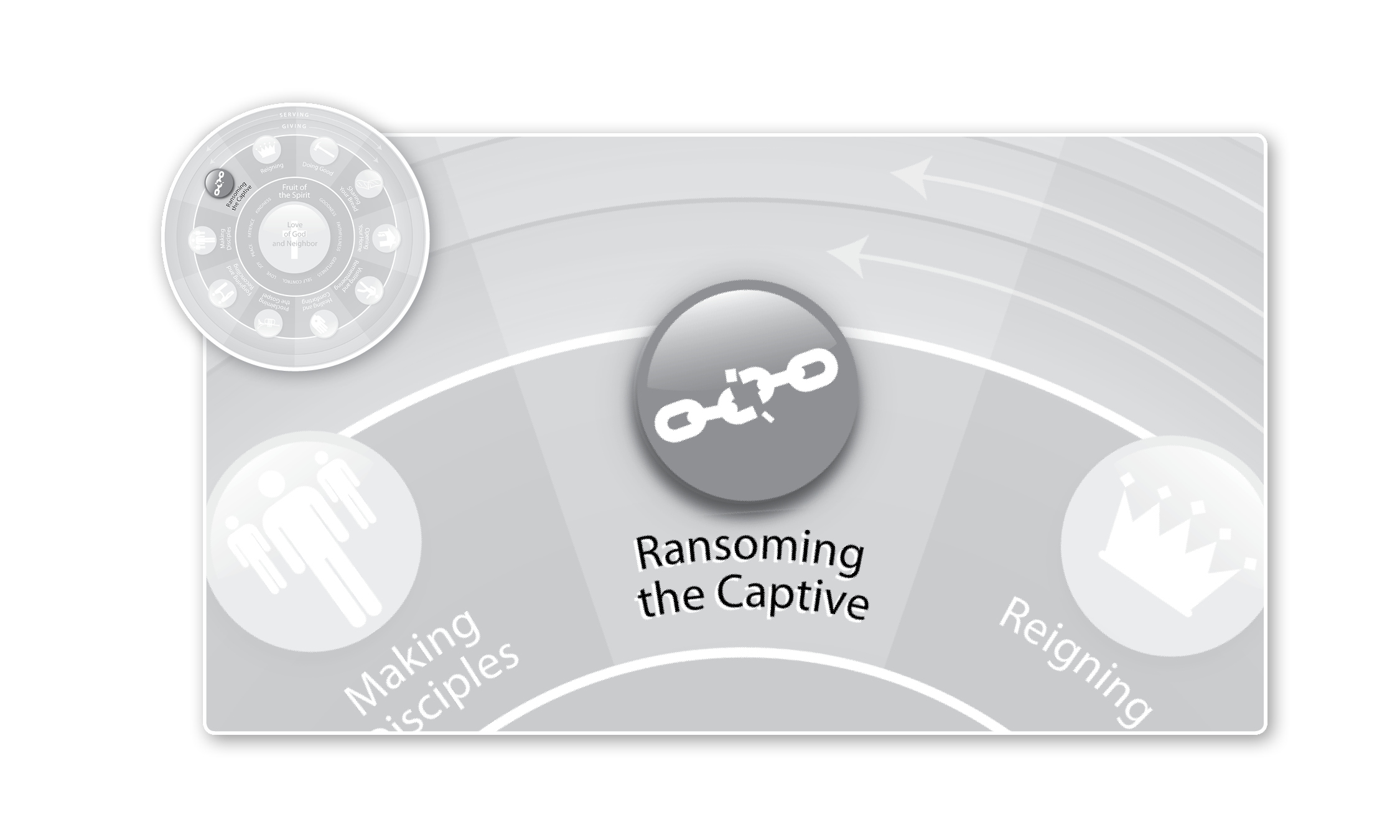
In the .W model in the Whole Life Offering book, I propose a seven-fold planning process in which, before we act, each Work of Mercy (including ransoming the captives) is grounded in the length and breadth of the Holy Spirit’s work in our lives. Those seven steps are:
- Searching the Scriptures
- Learning the response of the faithful Christians who came before us
- Worship
- Prayer
- Self-denial
- Serving
- Giving
So in our four-part Scriptural strategy of ransoming the captive, the second step is to plan, which Jay Adams reminds us, is a time-consuming process designed not only to solve the problem at hand, and not only to avoid creating new problems.
It’s designed to transform us, too, because, after all, we are the ones whom the Spirit is equipping to serve as ransoms, in re-presentation of the only Ransom that ever set anyone free.






 Do the Word