Well done, good and faithful servant! You have been faithful with a few things; I will put you in charge of many things. Come and share your master’s happiness! (Matthew 25:21)
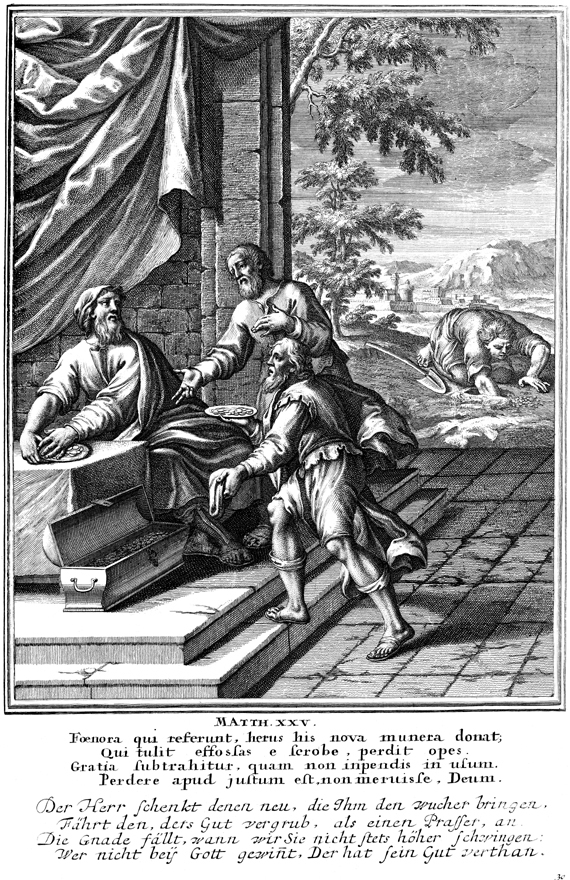
We are accustomed to hearing the Parable of the Talents preached as if it were about using our God-given skills for God, such as athletic ability or playing the trombone. But that is not what this parable is about. One big reason we know this is that the third servant, who was unfaithful with his talent, went to hell. Interpreting the talents as skills distorts the parable so much that disciples who didn’t practice their trombone would go to hell.
If the talents are not skills, what are they? Nothing in the world changes the work of Christ’s disciples. No matter what happens, they must remain focused on hearing and doing Christ’s word. The parable shows how.
Since the very beginning of his ministry, Jesus has announced that the Kingdom of God has come and that he has brought it. But if Jesus was going away for a while, what would happen to the Kingdom in his absence? He answers this question in the Parable of the Talents.
The answer: Jesus entrusts his Kingdom to his disciples.
The talents are the Kingdom.
Jesus does the same in Matthew 28, after his resurrection and before ascending into heaven:
Then Jesus came to them and said, “All authority in heaven and on earth has been given to me. Therefore go and make disciples of all nations, baptizing them in the name of the Father and of the Son and of the Holy Spirit, and teaching them to obey everything I have commanded you. And surely I am with you always, to the very end of the age.” (Matthew 28:18-20)
Based on current precious metal prices, one talent would be worth about five million US dollars. By that measure, the Kingdom entrusted to the disciples is immensely valuable.
This parable was not told to the religious leaders, the crowds, or even all of Jesus’ disciples. In context, it was told only to a handful of his closest disciples.
That helps us understand Jesus’ use of different amounts of talents entrusted to the servants: Not all the disciples had been entrusted with all of Jesus’ teachings. Jesus’ transfiguration, for example, had been witnessed only by Peter, James, and John. They were also the only ones who witnessed Jesus raising Jairus’ daughter from the dead. They were also the only ones who were together with Jesus when he prayed in the Garden of Gethsemane. Jesus’ empty tomb had been witnessed only by Peter and John. Of the twelve, only Matthew, Peter, and John were entrusted with the responsibility to write Gospels. (The Gospel according to Mark is known to be the remembrances of Peter.) Of the twelve, only Peter and John were entrusted with the responsibility of writing epistles that were included in the New Testament. And only John was shown the Revelation of Jesus which is recorded in the Book of Revelation. Jesus truly tasked each of the apostles according to their abilities.
Remember that the master entrusted his servants with all his property—everything he had. For Jesus that would include not only his words and teachings. It would also include his “little ones”—our fellow believers. They are certainly part of the “wealth” that he entrusts to the apostles at his ascension. Remember Jesus’ words when he restores Peter on the lakeshore after his resurrection?
Again Jesus said, “Simon son of John, do you love me?” He answered, “Yes, Lord, you know that I love you.” Jesus said, “Take care of my sheep.” (John 21:16)
In short, Jesus entrusts his disciples with his Kingdom, his possessions, his sheep, and his words. And Jesus lives in his word:
Anyone who loves me will obey my teaching. My Father will love them, and we will come to them and make our home with them. (John 14:23)
Jesus’ word, like a seed, grows exponentially when sown. The only things that multiply exponentially in Jesus’ parables are his word and his Kingdom.
Others, like seed sown on good soil, hear the word, accept it, and produce a crop—some thirty, some sixty, some a hundred times what was sown.” (Mark 4:20)
He told them another parable: “The kingdom of heaven is like a mustard seed, which a man took and planted in his field. Though it is the smallest of all seeds, yet when it grows, it is the largest of garden plants and becomes a tree, so that the birds come and perch in its branches.” (Matthew 13:31–32)
Jesus’ word is also a living word.
For the word of God is alive and active. Sharper than any double-edged sword, it penetrates even to dividing soul and spirit, joints and marrow; it judges the thoughts and attitudes of the heart. (Hebrews 4:12)
In Acts 6:7, 12:24, and 19:20, Luke does not say, “and the church grew”; he says, “and the word of God spread.” Likewise, in Mark 4, Jesus says that the Kingdom of God is like a man who scatters seed and goes to sleep, and the seed grows without his help:
All by itself the soil produces grain—first the stalk, then the head, then the full kernel in the head. (Mark 4:28)
Martin Luther once said of the Protestant Reformation, “I did nothing. The word did everything.” Jesus’ disciples have the same testimony. It wasn’t the servants’ business skills that multiplied the talents; the talents do all the work. The talents are special, not the servants. The servants serve the talents, not the other way around.
Jesus doesn’t tell his disciples, “Here’s the Kingdom, go finish it.” Instead, he gives them his word, which itself grows.
Other Christians are also part of the talents Jesus entrusts to his disciples, because he entrusts us with all his possessions. But growing the number of talents does not simply mean growing the number of Christians.
Likewise, a growing church is not always a sign that the word is doing the work. Sometimes a church shrinks or even faces persecution precisely because it preaches the word of Christ faithfully. Yet even persecution spreads the Gospel: in Acts, Stephen’s martyrdom led to the conversion of Paul. Jesus calls us to be faithful, not successful. In the parable, the master does not say, “Well done, good and successful servant.” Faithfulness is the narrow way, and few find it:
But small is the gate and narrow the road that leads to life, and only a few find it. (Matthew 7:14)
Still, the difference between the two faithful servants and the unfaithful one is not that the first two were disciples and the third was not. They were all disciples. Jesus told this parable to his closest disciples to warn them of dangers that apply to them.
Consider the Parable of the Ten Virgins, in which the bridegroom says to the foolish virgins, “I never knew you.” They were servants in name only. The wicked servant in the Parable of the Talents may also be a servant in name only. He called his master “master” but did not truly know him; he thought him a “hard man” and was afraid of him. The master’s verdict follows:
His master replied, ‘You wicked, lazy servant! So you knew that I harvest where I have not sown and gather where I have not scattered seed? Well then, you should have put my money on deposit with the bankers, so that when I returned I would have received it back with interest. So take the bag of gold from him and give it to the one who has ten bags. For whoever has will be given more, and they will have an abundance. Whoever does not have, even what they have will be taken from them. And throw that worthless servant outside, into the darkness, where there will be weeping and gnashing of teeth.’ (Matthew 25:26-30)
What made this servant wicked and worthy of hell is that, even though he found the narrow way that leads to life, he kept the map to himself. He disobeyed the Great Commission by keeping the teachings of Jesus to himself.
Moreover, when the servants invested their master’s wealth, they were publicly associated with him. The wicked servant hid his association with the master and effectively disowned him. Jesus warns of this:
But whoever disowns me before others, I will disown before my Father in heaven. (Matthew 10:33)
Not everyone who says to me, ‘Lord, Lord,’ will enter the kingdom of heaven, but only the one who does the will of my Father who is in heaven. (Matthew 7:21)
What, then, does it mean to enter into the joy of our master? Jesus’ joy is to do the Father’s will and keep his commands. That joy comes from treasuring the Father’s words and remaining in them; Jesus experiences the Father’s love through the Father’s words.
If you keep my commands, you will remain in my love, just as I have kept my Father’s commands and remain in his love. I have told you this so that my joy may be in you and that your joy may be complete. (John 15:10-11)
In the same way, when Jesus tells his disciples to “enter into the joy of your master,” that joy comes from treasuring Jesus’ words and teachings above all things and teaching others to do the same. This is what the wicked servant did not do.
Does this mean we will go to hell if we don’t evangelize? The deeper issue is motivation: we can still go to hell even if we evangelize. If our motivation for coming to Jesus is to preserve our self-focused, self-centered, self-sufficient lives eternally, we will certainly lose those lives, just like the wicked servant in the parable.
For whoever wants to save their life will lose it, but whoever loses their life for me will save it. (Luke 9:24)
You can be a world-famous evangelist, or the best evangelist in your church. But if your gospel is about how people can preserve their self-focused, self-centered, self-sufficient lives by coming to Christ, both you and those who believe that false gospel will lose the lives they sought to save.
The way to find our life is to die to ourselves through the waters of baptism. To repent is to turn from a self-focused life, in which Christ is buried and we are raised up, to a Christ-focused life, in which we are buried and Christ is raised up. We lay down our lives and take up his.