
When we sit down with Scripture, we should not primarily ask how it applies to our lives today. Instead, we should be prepared to lose our lives in it.
For whoever wants to save their life will lose it, but whoever loses their life for me and for the gospel will save it. (Mark 8:35)
The gospel is not merely a message about saving your life eternally. It is a call to abandon your life completely for something more valuable: the Kingdom of God and its King, Jesus.
Voice of the Martyrs founder Richard Wurmbrand once said, “Humans do not have the habit of committing suicide for another’s grief, but that is exactly what we demand from you: ‘To deny yourself, to die for yourself and to live for Christ, who is in grief and suffers again in his mystical body, to feel every pain of his holy martyrs as your own, to remember those in bonds as bound with them’ (Hebrews 13:3).’”
Our focus is not on individual salvation or personal gain, but on Christ our King, his Kingdom, and our new family—the family of Christ.
I will remove from you your heart of stone and give you a heart of flesh. (Ezekiel 36:26)
Our hearts were once set like stone on ourselves and our desires. But the new-covenant hearts we received at baptism are hearts of flesh, focused on Christ and his Kingdom. Our lives are not the context for understanding Scripture; the context is always Christ, the gospel, and his establishment of the Kingdom of God.
What, then, is the context of today’s Scripture, Matthew 22:1–14?
Jesus and his disciples are now in Jerusalem—the place where, as he had previously told them, he would be arrested, killed, and raised from the dead.
How did Jesus know this? He knew the Old Testament prophecies, of course. But he had also been in Jerusalem before beginning his ministry in Galilee, preaching the gospel of the Kingdom of God there until John the Baptist was arrested.
Now Jesus learned that the Pharisees had heard that he was gaining and baptizing more disciples than John—although in fact it was not Jesus who baptized, but his disciples. So he left Judea and went back once more to Galilee. (John 4:1–3)
The Pharisees had been concerned about Jesus’ ministry even before he began ministering in Galilee. They knew he was gaining more followers than John, who had been arrested.
When Jesus heard that John had been put in prison, he withdrew to Galilee. (Matthew 4:12)
Jerusalem had already rejected Jesus. After John the Baptist’s arrest, Jesus became the chief focus and concern of its religious leaders. This helps explain why they kept him under constant surveillance from the beginning of his Galilean ministry, repeatedly raising questions and objections. It also explains why Jesus moved progressively farther from Jerusalem to continue his ministry.
John records several occasions when Jesus returned discreetly to Jerusalem during his Galilean ministry, each time at great risk. We also see Jesus withdrawing to Tyre, Sidon, and Caesarea Philippi.
Jesus was not running away. He came to preach the gospel and usher in the Kingdom of God. His work led through death because the death, resurrection, and ascension of the King were necessary to establish his Kingdom. Our own death must likewise precede our entry into his Kingdom—that is what baptism signifies.
Jesus never lost sight of his purpose. His focus was not simply personal salvation, but the establishment of his Kingdom. He did not spend thirty-three years teaching parables and healing people, only to decide one day that it was time to die.
From the beginning, John baptized Jesus, and the Spirit drove him into the wilderness to be tempted. Afterward, he went to Jerusalem to preach the Kingdom, where he was rejected from the outset.
This is the normal way gospel ministry is done: Always under surveillance by the authorities. Always being watched by the religious leaders. Always being hated and insulted. Always on the move.
Richard Wurmbrand was called “the Phantom Preacher” because he would suddenly appear at an underground church meeting to preach and then disappear when he was done.
The Lord Jesus himself shows us that this is normal gospel ministry.
In Caesarea Philippi, Jesus asked his disciples, “Who do people say that I am? Who do you say that I am?” And when Peter said, “You are the Christ, the Son of the Living God”, Jesus said, “It’s time to go to Jerusalem.”
We find out from the Gospel according to John that just prior to entering Jerusalem, Jesus must stop in Bethany to raise Lazarus from the dead. This is when Thomas says to the other disciples, in John 11:16:
“Let us also go, that we may die with him.” (John 11:16)
We need to read all four of the Gospels and understand the relationship between them. Otherwise we will not understand passages like this one in Mark 14, when Jesus is making plans to enter Jerusalem:
So he sent two of his disciples, telling them, “Go into the city, and a man carrying a jar of water will meet you. Follow him. Say to the owner of the house he enters, ‘The Teacher asks: Where is my guest room, where I may eat the Passover with my disciples?’ He will show you a large room upstairs, furnished and ready. Make preparations for us there.” (Mark 14:13–15)
This is not some mysterious magical spooky spiritual experience. Jesus already had disciples in Jerusalem because of his previous ministry there. They cared for his needs whenever he went there, and he would call on them as he had need of them. As Richard Wurmbrand noted in Preparing for the Underground Church, the Gospels could not identify many people or locations when they were written because doing so would have endangered those involved.
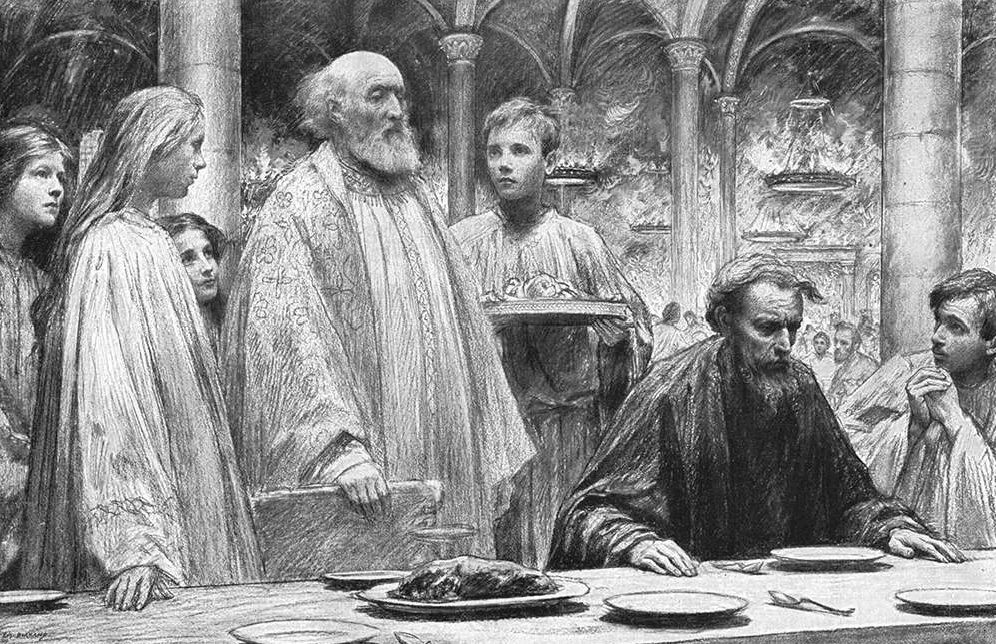
With this context in mind, consider the parable of the wedding banquet in Matthew 22:1–14. Jesus taught it publicly in the temple courts after cleansing the temple—possibly for the second time—not while in hiding.
Jesus spoke to them again in parables, saying: “The kingdom of heaven is like a king who prepared a wedding banquet for his son. He sent his servants to those who had been invited to the banquet to tell them to come, but they refused to come. “Then he sent some more servants and said, ‘Tell those who have been invited that I have prepared my dinner: My oxen and fattened cattle have been butchered, and everything is ready. Come to the wedding banquet.’ But they paid no attention and went off—one to his field, another to his business. The rest seized his servants, mistreated them, and killed them. The king was enraged. He sent his army and destroyed those murderers and burned their city. Then he said to his servants, ‘The wedding banquet is ready, but those I invited did not deserve to come. So go to the street corners and invite to the banquet anyone you find.’ So the servants went out into the streets and gathered all the people they could find, the bad as well as the good, and the wedding hall was filled with guests. But when the king came in to see the guests, he noticed a man there who was not wearing wedding clothes. He asked, ‘How did you get in here without wedding clothes, friend?’ The man was speechless. Then the king told the attendants, ‘Tie him hand and foot, and throw him outside, into the darkness, where there will be weeping and gnashing of teeth.’ For many are invited, but few are chosen.” (Matthew 22:1–14)
The guests had already accepted the invitation, yet they neither put on their wedding clothes in preparation for the banquet, nor did they attend when the announcement came. Worse, some mistreated and killed the king’s servants.
The Pharisees and religious leaders claimed to be waiting patiently for the Kingdom of Heaven and preparing for its arrival. Yet when John the Baptist announced it and Jesus brought it, they seized, mistreated, and killed the King’s servants—the prophets (including Jesus, who was a prophet in addition to being Son of God).
In Galilee he called the fisherman, the tax collectors, and the prostitutes into the kingdom of heaven. So we can understand that in this parable Jesus is talking about the present time when he was speaking, not our time in the future. He is talking about how when he was rejected in his Jerusalem ministry, he raised up guests for the wedding banquet from Galilee—both bad and good! When Jesus entered Jerusalem on Palm Sunday, he entered the Holy City with “the bad and the good” who followed him from outside Jerusalem, and he was met at the entrance to the city by many of the disciples he had previously made there in Jerusalem. The wedding hall was indeed filled with guests!
Some preachers will claim that in Middle Eastern cultures, wedding clothes are given to guests by those in the wedding party; these preachers say the man’s error was that he didn’t wear the wedding clothes given to him, which represents the “righteousness” Jesus freely gives. It sounds like a good explanation, but this claim about guests receiving free wedding clothes in Israel or other Middle Eastern cultures is simply not true. It is fake news! In Middle Eastern culture, everyone had their regular clothes and they also had an outfit they only wore on special occasions. They didn’t get free clothes for every wedding they went to!
So what are the wedding clothes Jesus is talking about? Jesus has already told us several times in the Gospel according to Matthew. John the Baptist told us also. It is the basic gospel announcement: “”Repent, for the kingdom of heaven is near.” The wedding clothes represent repentance—the garment we must wear to enter the Kingdom.
Repentance is more than feeling sorry for wrongdoing and trying not to repeat it. It is recognizing that life is entirely about Jesus and his Kingdom. Repentance means letting your old self-centered, self-satisfying life fall into the watery grave of baptism, then living in complete dependence on Christ and in total devotion to his Kingdom.
The prayer “Not my will, but yours be done” is not advanced Christianity. It is the cry of a repentant heart at the waters of baptism—our first words in the Kingdom of God.
“For many are invited, but few are chosen.” (Matthew 22:14)
Few are interested in the Kingdom of God, the King, or the King’s Son.
If the King promised better marriages, larger harvests, and more successful businesses, the guests would have come. But the Kingdom of Heaven is not about us.
It is entirely about Jesus.