Notes in the key of E: An Engagement chart for visual learners

I was talking with Generous Mind Jon Hirst last week about how Participation is rightly understood as but a prelude to Engagement and Ownership is rightly understand as but Engagement’s logical consequence; Engagement, in other words, is the core of Transformational Giving.

Jon portrayed this magnificently in a visual that not only shows the Einsteinian weight that Engagement should be given in the TGverse but also functions as a really helpful chart for you and your ministry to work through as you trace how/whether your P naturally flows into E and your O naturally flows from your P:
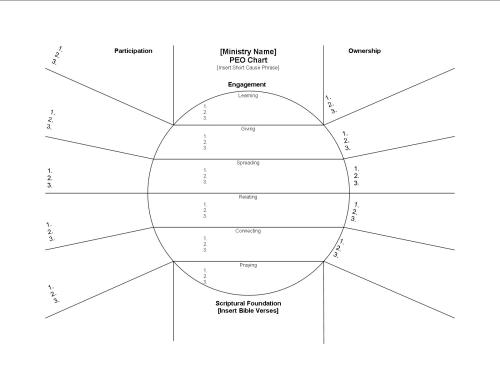
PEO_chart_graphical


(If you click on the chart a few times, it should become large and easy to read. If not, try right clicking and saving the image or smooshing your eyes right up against the screen. OK, or post a comment below and I can email it to you.)

Here’s why I like the chart:

  • If when you chart out all your champion activities you see that the preponderance fall in the Participation category, that means that the “weight” of your development program will always keep you “out of balance” when it comes to coaching your champions, i.e., you’ll have a lot of immature Participants which require constant tending and yet yield comparatively little fruit.
  • If you have Participation activities that do not clearly lead into Engagement, you really should consider discontinuing or seriously refining those Participation activities so that they serve primarily as a prelude to Engagement.
  • If you have both Participation and Ownership activities but no Engagement activities, it likely indicates that your Owners aren’t really owners but are actually self-replicating P’s, committed to owning and spreading a particular project they like rather than owning the cause in their sphere of influence.

Jon has supplied us with a powerful tool here, friend. Take the time to chart out your ministry’s champion activities and see–visually–what you can learn from the process.

Posted in Uncategorized | 1 Comment

Notes in the key of E: Experience and its false cognate, Emotion

Good advertising makes you feel something then do something.
–A Senior Marketer from General Motors

Didn’t General Motors just declare bankruptcy?
Me

Perhaps GM’s ad problem was simply that its ads didn’t make us feel something and then do something.

Or perhaps GM’s ad problem is that the old formula of feeling leading to doing (AKA tugging on heartstrings in order to tug on purse strings) just doesn’t quite pack the punch it once did.

Or perhaps for Christian ministries the problem goes much deeper than that.

With regard to fundraising, Christian ministries and missionaries continue to subscribe almost universally to that old GM formula as if it were Gospel. The truth is, it’s anything but. It’s actually quite problematic from a Christian discipleship standpoint to nudge people towards giving through appeal to emotion.

As Mission Increase Foundation‘s Suzanne Dubois and Tracy Tucker noted as we were preparing for this past summer’s Marketing Your Ministry workshop, there are no scriptures that guide us, lead us, or teach us how to drive people’s action through their feelings.

This is definitely not to say that emotion plays no part in the process of biblical giving. Far from it. The importance is the sequence.

Let’s read 1 Peter 1:22 together re-e-e-a-a-l-l-y carefully:

Now that you have purified yourselves by obeying the truth so that you have sincere love for each other, love one another deeply, from the heart.

(Interestingly, some early manuscripts have the verse ending with “from a pure heart“.)

So what’s the biblical counsel? Get everyone all lathered up with emotion so that on impulse they’ll respond rightly?

Far from it!

The Bible never places much trust in our emotions to guide right action!  My own life verifies that suspicion is well placed, thank you very much, You?

Instead, take a look at where emotion enters the process, according to Peter:

  1. We learn the truth and then obey it. This produces:
  2. Sincere love in love–an outflow of action–and because of this
  3. We love one another deeply.

Two key truths here.

First, the biblical model turns the GM marketing model on its head. (Praise God–perhaps we can avoid bankruptcy after all!) Biblically, action–obeying the truth–precedes feelings. As Christians, we may or may not initially feel like doing the right thing at all. As Christian leaders, our goal is not to manipulate feelings until our listeners feel like doing the right thing. Our goal is to work with the Holy Spirit to teach the truth, i.e. What does God call you to do in relation to this cause?

Second, the Bible associates the heart with depth, will, strength, and response to truth, not with emotions stirred courtesy of a heart-rending DVD. You can see that 1 John 3:17-18:

But if anyone has the world’s goods and sees his brother in need, yet closes his heart against him, how does God’s love abide in him? Little children, let us not love in word or talk but in deed and in truth.

For the Christian, the feelings equation is truth + deed; then God’s love can pour out through us.

That’s why the third component of E (Engagement) is experience, which is shorthand for truth + deed. Appealing to emotion may produce “success”, if success is defined as “getting someone to give me money”. But it sure isn’t the biblical path to growth in the likeness of Christ for our hearers.

And it sure didn’t sell a lot of cars for GM.

Posted in Uncategorized | Leave a comment

Notes in the key of E: Educate and its false cognate, Inform

The nonprofit sector’s commitment to informing is best seen in its love of newsletters. Newsletters are great for informing donors. They are not so great, however, for educating champions.

What is the difference between education and information?

I like the way the difference is described on worldeducationsites.com. Information, says the site, is the acquisition of new knowledge. Proper education requires information but goes beyond it–way beyond it, as the site notes:

Education has as one of its fundamental aspects the imparting of culture from generation to generation. Education also refers to the, facilitation of realization of self-potential and talents of an individual. It is an application of pedagogy, applied research related to teaching and learning and draws on many disciplines such as psychology, computer science, linguistics, sociology and anthropology.

That, my dear champion, is hard to pull off in a newsletter.

(It is not, however, impossible, as Mission Increase Foundation Regional Giving and Training Officer Matt Bates notes in his Thoughts on the Nonprofit Newsletter.)

The fundamental difference between informing and educating is the outcome:

  • When a champion is informed, s/he possesses knowledge.
  • When a champion is educated, s/he possesses not only knowledge but the critical judgment and values maturity to know how to act upon that knowledge in such a way that the cause is advanced.

Nonprofit ministries tend to make two heinous errors by conflating information and education:

  1. Nonprofit ministry leaders say, “I don’t ask anyone for money. I just share the need and leave it to the person to pray how to respond.” Sounds holy, but it’s really an exercise in wholesale negligence. We who know the cause well have the responsibility not only of informing our Christian brothers and sisters about the need but also of educating them why the need exists, what the Bible calls each Christian to do in relation to the cause, and the range of options of how the listener can respond. Else how will they reach full maturity in Christ in relation to the cause?
  2. Nonprofit ministry leaders typically inform Christians about a situation and then ask them to give and pray. But such an approach also leaves out the education step. Even if I give and pray, I am in most cases no more able to understand and act upon that challenge in the future than before I was asked. The nonprofit ministry may be better funded and supported with prayer, but the giver himself or herself is still wholly dependent on the nonprofit ministry to know what to do and when to do it. That state of permanent adolescence is never commended in the scripture.

Education, then, is one of the three key components of Engagement. You know that you have educated rather than simply informed when the end result of the process is that the champion is able to bring others to full maturity in the cause–the state of champion development known as “O”, or ownership.

We nonprofit ministries would do well to ponder Hebrews 5:11-14 as we ask, Are our champions living on the milk of information…or the solid food of education in relation to the cause?

We have much to say about this, but it is hard to explain because you are slow to learn. In fact, though by this time you ought to be teachers, you need someone to teach you the elementary truths of God’s word all over again. You need milk, not solid food! Anyone who lives on milk, being still an infant, is not acquainted with the teaching about righteousness. But solid food is for the mature, who by constant use have trained themselves to distinguish good from evil.

Posted in Uncategorized | Leave a comment