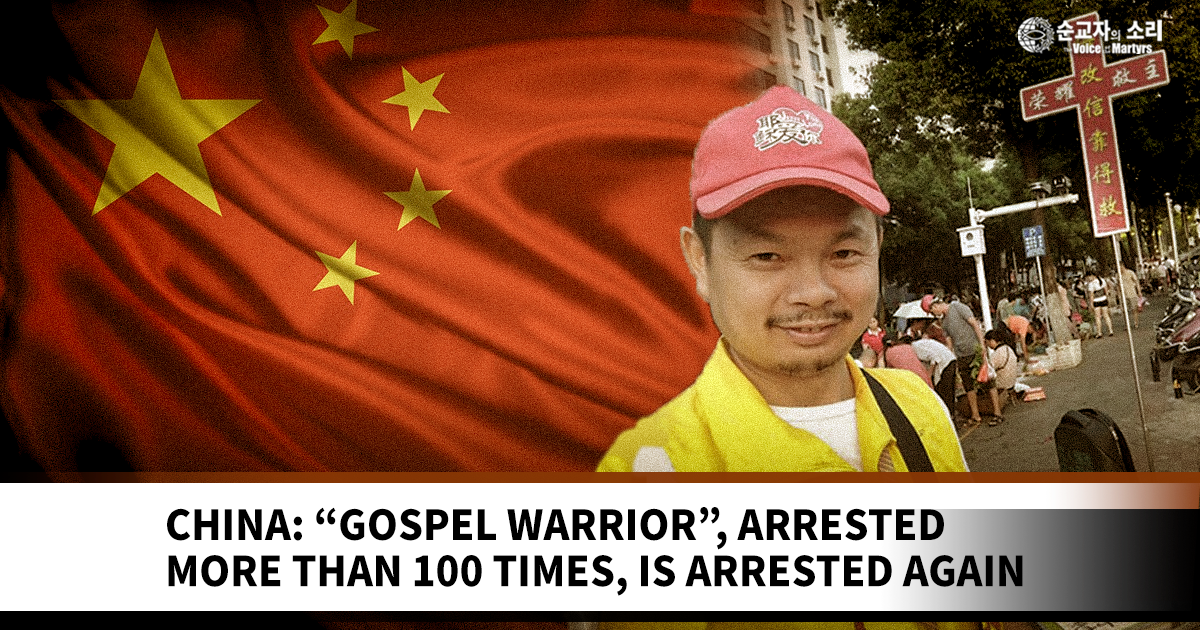
To Chinese authorities, Chen Wensheng is a troublemaker who was actually less trouble when he was just a drug addict on the street years ago. But to Chinese Christians, Chen Wensheng is a powerful street evangelist who even after 10 years refuses to stop preaching the gospel even though he has been arrested more than 100 times, including most recently on October 12.
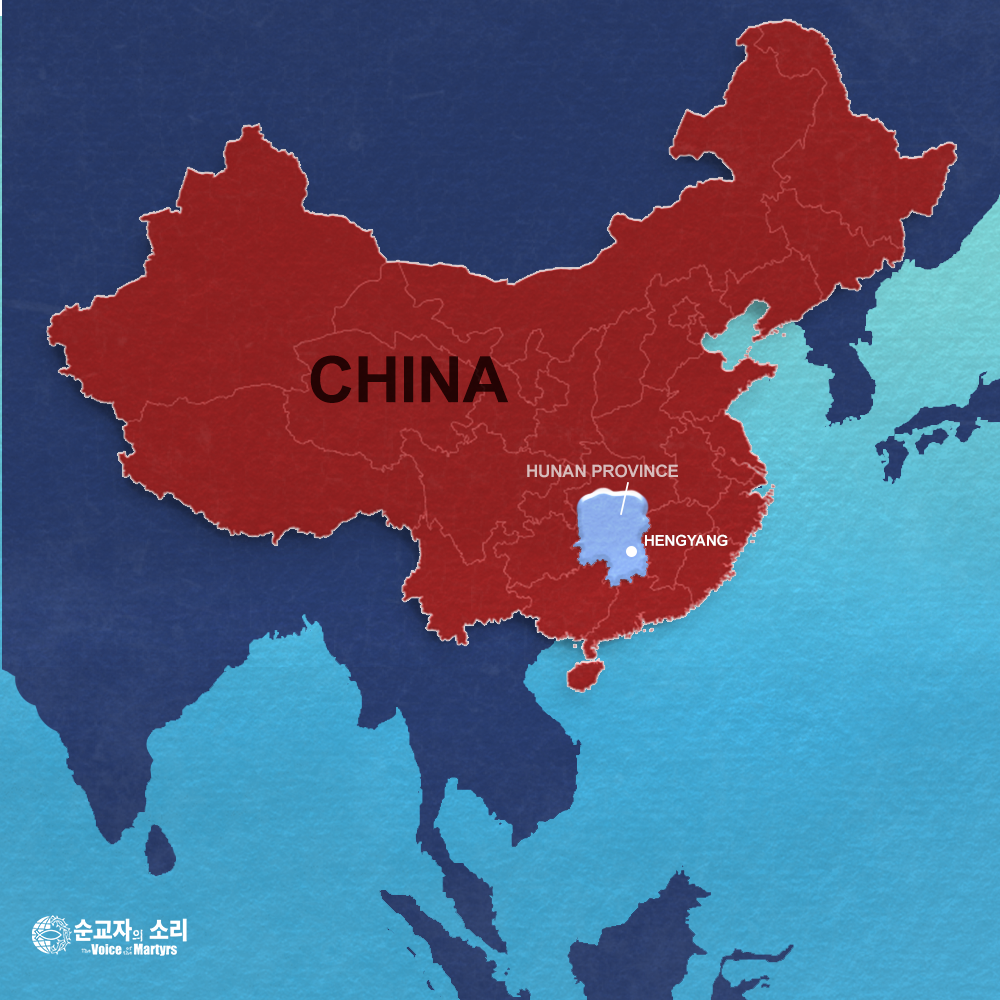
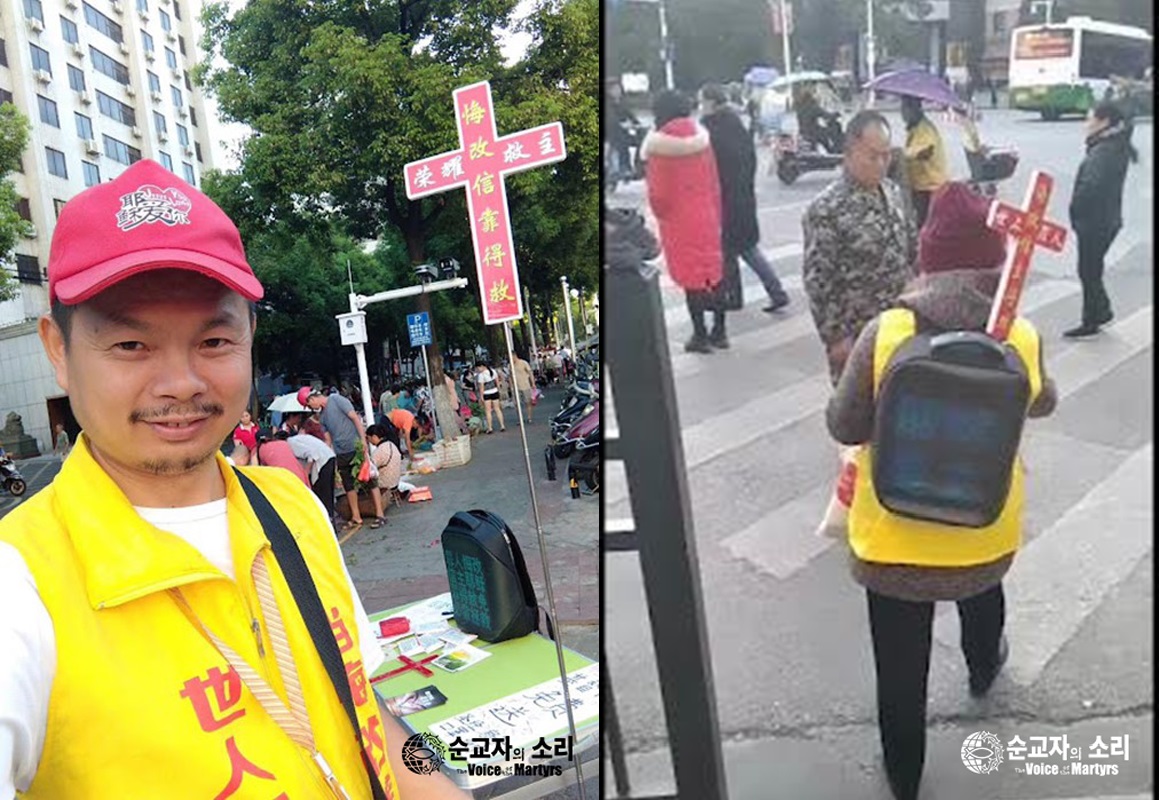
“They call him the ‘Gospel Warrior’,” says Voice of the Martyrs Korea Representative Dr. Hyun Sook Foley. “For years he has walked the streets of Hengyang City, Hunan Province, as well as in other provinces in China and even in Vietnam. He carries a wooden cross displaying the words ‘Glory to our Savior’ and ‘Repent and be saved by faith’, and he hands out gospel tracts, even to the police who arrest him.”
According to Representative Foley, local officials made multiple visits to Evangelist Chen’s home in advance of the 20th National Congress of the Chinese Communist Party in late October. “Police warned him not to preach during the congress,” she says. “Evangelist Chen says they tried to persuade him to join the local Three-Self church. He says they even offered to let him replace the two pastors of the local Three-Self church. He says they promised him the opportunity to preach to large crowds in government-approved locations in Hunan province. When he wouldn’t agree, they begged his wife to try to reason with him.”
“But Evangelist Chen just welcomed the officers into his home, gave them gospel tracts, and told them, ‘Officers, I’m glad you came again. Jesus loves you and blesses you!’” says Representative Foley.
She says that on October 12, authorities then took Evangelist Chen and his wife to a mountain for a half-month’s forced ‘vacation’, to prevent him from preaching during the Communist Party Congress. She says Chen used the time to rest and study.
Evangelist Chen, a former drug addict, reportedly heard the gospel in a rehab center.
“Years ago he was a drug addict. When he heard the gospel, he was delivered from his addiction and immediately began preaching on the streets. He’s been a street preacher for more than 10 years. He is a member of a small church, and yet even the authorities testify to the breadth of his impact.”
In 2020, national security officers told Chen that he had proclaimed the gospel four to five times each month in various regions to over a thousand people. “That year he was detained multiple times for sharing the gospel, and then he was detained another six times in 2021,” says Representative Foley. “He spent the 2021 New Year in a detention center. After 10 days, he and his 84-year-old mother shared the gospel and handed out gospel leaflets on the street, and they were detained again.”
According to Representative Foley, Evangelist Chen says he will never give up the mission God granted him, and he remains determined to spread the gospel even in prison.
Individuals interested in donating to Voice of the Martyrs Korea’s work in partnership with the house church Christians of China can visit www.vomkorea.com/en/donate or give via electronic transfer to:
“We are alive. We are fed. We have clothes. We are healthy.”
That was the reply of one pastor in Russia-occupied Ukraine to our question, “What message would you like us to share with Christians in the outside world about your situation?”
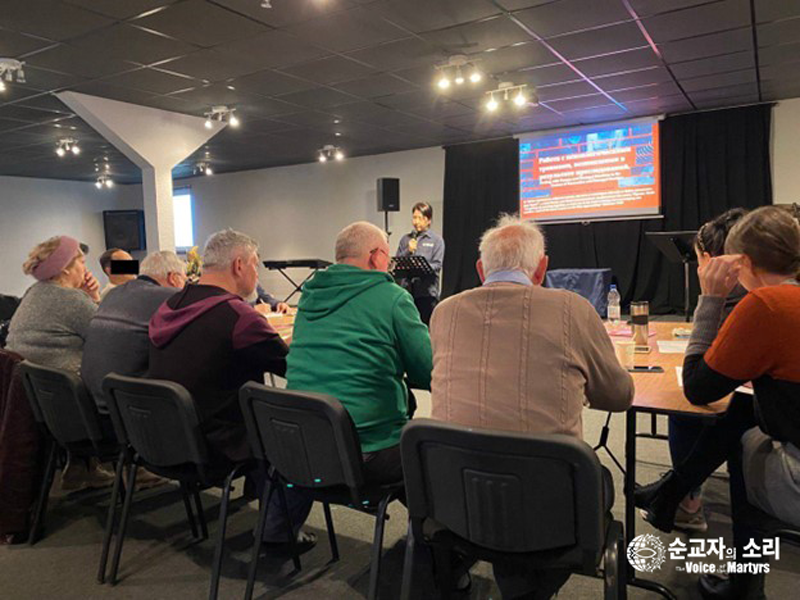
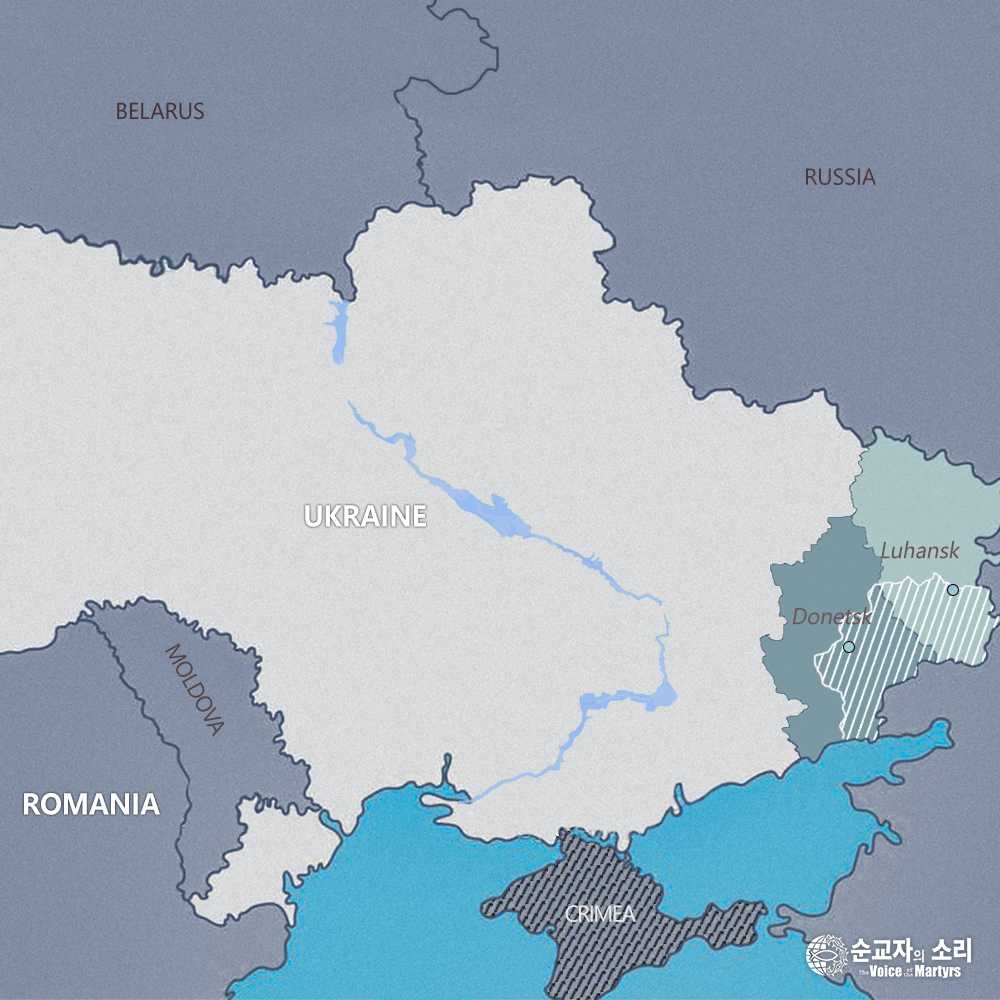
Dr Foley and Pastor Tim and I conducted a week-long martyrdom training event in late November in a secret location in Romania, attended by that pastor (who asked that his name be withheld for security reasons) along with eight others from Russia-occupied Ukraine and other parts of the country hit hard by the war.
Voice of the Martyrs Korea Representative Dr. Hyun Sook Foley teaches Christian-based trauma recovery to church leaders from Occupied Ukraine and the neighboring war zones.
Two things are true about the pastors who attended.
First, they are facing extremely difficult and dangerous ministry situations.
Second, they are choosing to stay in those situations and to make a faithful witness to Christ and the gospel.
While the location in Romania was selected because of its accessibility to the majority of invitees, four invitees were unable to attend due to border crossing restrictions.
Almost all the attendees had arduous travel, by car, bus, train, and even some other means. Getting visas and making it through passport checks was a constant challenge. One invitee was even turned back on the way, after a long journey. Two invitees became ill and had to cancel. Hearing about the travels of these Christian workers in and out of these war regions reminded us of the Apostle Paul’s recounting of his own travel experiences in 2 Corinthians 11:26, where he wrote, “I have been in danger from rivers and from bandits, in danger from my countrymen and from the Gentiles, in danger in the city and in the country, in danger on the sea and among false brothers.” But these nine said they came because they wanted to learn more effective strategies for faithful witness amidst persecution and war.
One day of training was devoted to the theology of martyrdom and persecution, another day to trauma recovery from a Christian perspective, and another to how to preach and teach martyrdom and persecution from each book of the Bible.
But the highlight of the training was taking the attendees on a day-long field trip to several locations from the life of Voice of the Martyrs global founder, Romanian pastor Richard Wurmbrand, who spent 14 years imprisoned and tortured by Communists during the Soviet era.
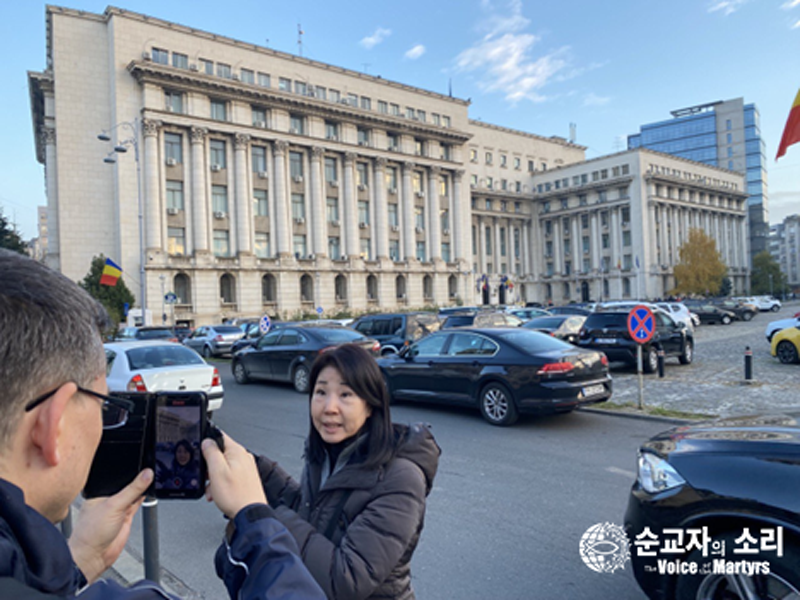
Voice of the Martyrs Korea Representative Dr. Hyun Sook Foley stands in front of the former Communist Party headquarters in Bucharest, Romania where Voice of the Martyrs founder Richard Wurmbrand was once imprisoned in an underground cell. The organization took Ukrainian pastors to the site as part of a recent training event in martyrdom.
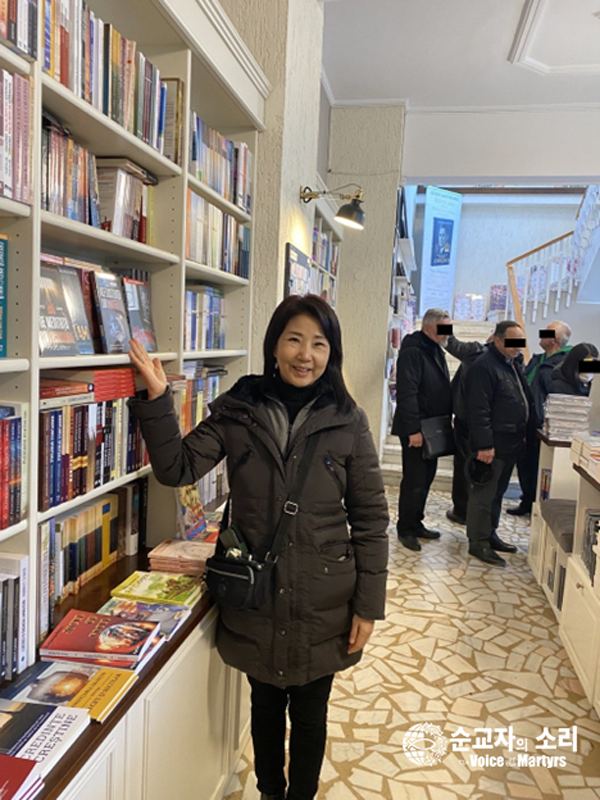
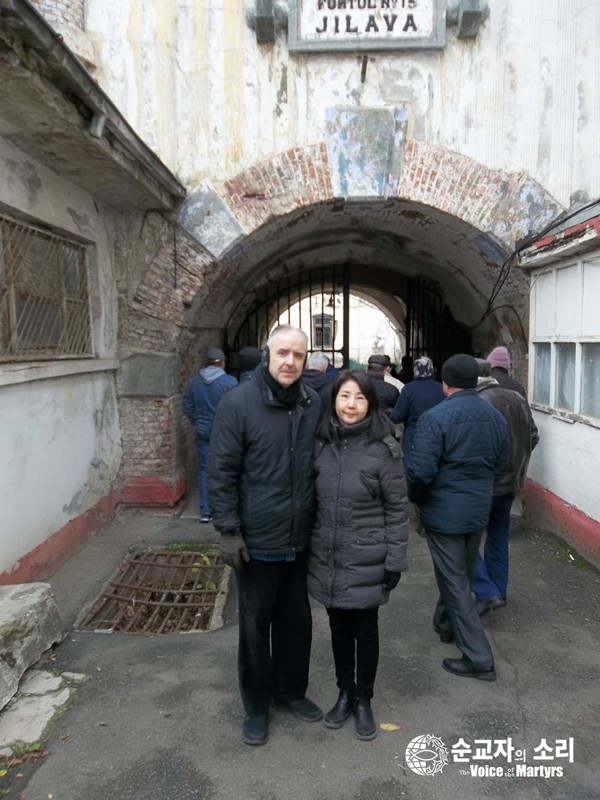
First, we watched the movie “Tortured for Christ” together with our Ukrainian training attendees. The movie tells the story of Pastor Wurmbrand’s imprisonment because of his faithful witness to the gospel. Then we took our attendees to Jilava Prison and to the old Communist Party headquarters, the two main locations where Pastor Wurmbrand was imprisoned and tortured. We also took the attendees to the Christian bookstore which was opened with the help of the Wurmbrands when communism fell. We told them how at that time the bookstore needed a place to store its extra books and Bibles, so the post-communist government offered the use of Pastor Wurmbrand’s former prison cell nearby. It was a powerful reminder to them that faithful witness can ultimately topple even the mightiest political and military power.
Voice of the Martyrs Korea Representative Dr. Hyun Sook Foley guides pastors from Occupied Ukraine through a Christian bookstore in Bucharest established with the help of Voice of the Martyrs founder Richard Wurmbrand. The tour was part of a week-long martyrdom training event the organization held in November for Ukrainian church leaders.
The attendees were deeply moved by the field trip.
One attendee said she felt physically ill inside the prison, thinking of the suffering Pastor Wurmrbrand and other Romanian Christians had endured there for so many years. But one attendee noted, “Although this prison was extremely bad, I have actually seen even worse prisons.” We talked about Christian leaders in Occupied Ukraine who have faced interrogation, imprisonment, and even death. Yet the attendees concluded the week with renewed strength and commitment to return home and be faithful just as Pastor Wurmbrand had been faithful.
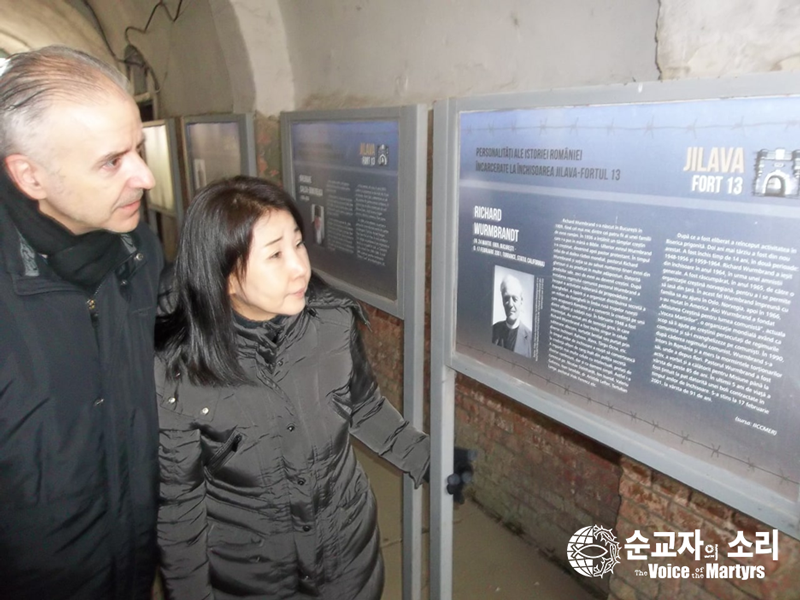
Voice of the Martyrs Korea Representative Dr. Hyun Sook Foley and CEO Pastor Eric Foley view a display about Rev. Richard Wurmbrand at Jilava Prison in Romania. The organization recently conducted a week-long martyrdom training event for pastors from Occupied Ukraine.
The time together provided an opportunity for attendees to consult with each other and with Voice of the Martyrs Korea on ministry strategy.
The situation is different in each area of Ukraine. The attendees agreed that the Luhansk Region is the most restrictive for Christians, with local Christians there hearing rumors that Russia is planning even tighter controls to be implemented from now through 2026.
The other challenge attendees reported facing is the need to separate humanitarian aid distribution from evangelism.
The attendees reported how they all were receiving large quantities of humanitarian aid from outside groups and how they had been trying to use it to “prepare the soil” for evangelism via distribution to non-Christians. But through their experiences they had all come to the realization that fallen, sinful human beings know how to take advantage of any system where material benefit is available to them. They said all the aid has produced many so-called “bread Christians”. So, our training attendees concluded that there really is no substitute for a direct, clear proclamation of the gospel totally separate from humanitarian aid. Both humanitarian aid and evangelism are important ministries for Christians, but faith can only come by hearing the word of God, and God neither uses nor requires any “preparation of the soil” when he gives the gift of faith to those who hear the word.
A particular highlight of the training for us was the opportunity to provide funds to attendees to enable them to continue their ministries of faithful witness.
Voice of the Martyrs Korea Representative Dr. Hyun Sook Foley and CEO Pastor Eric Foley lead a group of Ukrainian pastors into Jilava Prison in Romania. During the Soviet era the prison housed Voice of the Martyrs founder Richard Wurmbrand and other Christians who were detained and tortured for their faith.
Their needs are so varied. One attendee just needed snow tires for his car so he can return to his church now that it is winter. Another attendee needed help to cover the living expenses of his church deacons. Across the whole Donbas region of Eastern Ukraine, about half the Christians have left since 2014, including many pastors. One of the attendees now oversees a network of five churches with the help of deacons. But the deacons must remain out of public sight at all times because if they are caught, they will be automatically conscripted into the Russian military. So they are risking their safety to stay, but they are unable to earn money to support their families through outside jobs.
While other organizations are concentrating on providing humanitarian aid, Voice of the Martyrs Korea continues to focus on providing funds enabling churches to continue to make a faithful witness through direct evangelism, and to care for family members when that faithful witness leads to the death or imprisonment of church leaders.
Humanitarian aid is important, but as Jesus told us, man cannot live on bread alone. As our attendees have learned, combining humanitarian aid with evangelism usually yields ineffective and even counterproductive evangelism. Now in Eastern Ukraine, half the church has fled and no amount of bread can bring it back. Unless bold witnesses risk their lives proclaiming the gospel there, there can be no hearing of faith. Voice of the Martyrs Korea is honored to providing training and support to the church leaders who are doing just that.
Those who are interested in making a donation to Voice of the Martyrs Korea’s Ukraine Emergency Fund can do so at www.vomkorea.com/en/donation or via electronic transfer to:
국민은행 (KB Bank) 463501-01-243303
예금주 (Account Holder): (사)순교자의소리
Please include the word “Ukraine” with the donation.
Announcing that the project had achieved all goals set for it in the eight months since first signing on the air, Voice of the Martyrs Korea today announced that it has renewed its annual broadcast signal lease and will continue its daily Christian shortwave radio broadcast into the Maldives Islands in 2023.
“Should the Lord permit, it is our intention to continue to broadcast the gospel message into the Maldives until Christ returns,” says Voice of the Martys Korea Representative Dr Hyun Sook Foley, whose organization also operates 5 daily radio broadcasts into North Korea and 2 into China, aimed at supporting local Christians in those countries.
Representative Foley notes that while North Korea and China are better known for their extensive restrictions on Christian activity, the Maldives consistently ranks near the top in independent rankings of Christian persecution by religious watchdog agencies and governmental bodies.
“Neither mission work nor Christian literature has ever been allowed in the Maldives,” says Representative Foley. She notes that the Maldives’ constitution requires all citizens to be Muslim. “Conversion from Islam means that someone can be stripped of their citizenship and punished under Shariah law,” she says. “Even foreign workers who are Christians are closely watched, which makes church life extremely difficult and practically nonexistent. Churches are outlawed, and openly carrying the Bible is illegal. The country is so tightly controlled by Islamic law that there is not even a Bible fully translated into the native language of most citizens of the Maldives.”
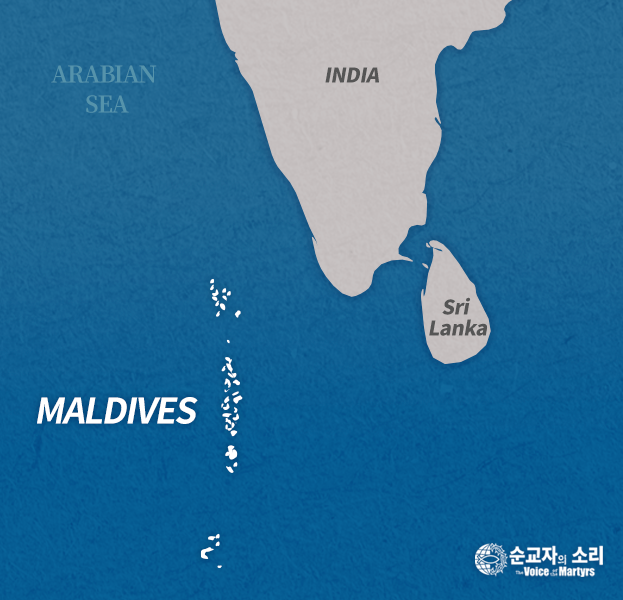
Originally, Maldivians were Buddhists, but in the twelfth century Islam was proclaimed the national religion. Today, more than 97% of the 300,000 citizens of the Maldives report affiliation with Sunni Islam.
Representative Foley say a host of laws are designed to ensure that only Islamic principles are taught within the country.
“In order to deliver a sermon or a religious talk, one must obtain a license from the Ministry of Islamic Affairs (MIA),” says Representative Foley. “Only a Sunni Muslim with a degree in religious studies from a government recognized university may apply for a license.”
She notes that criticism of Islam is against the law, with punishments up to a year in jail.
“The definition of ‘criticism of Islam’ is very broad, with even the distribution of materials promoting another religion considered as criticism of Islam, even if the literature makes no mention of Islam at all,” she says.
According to Representative Foley, separate laws prohibit the distribution of Christian literature. Violations may result in a prison sentence of 2 to 5 years.
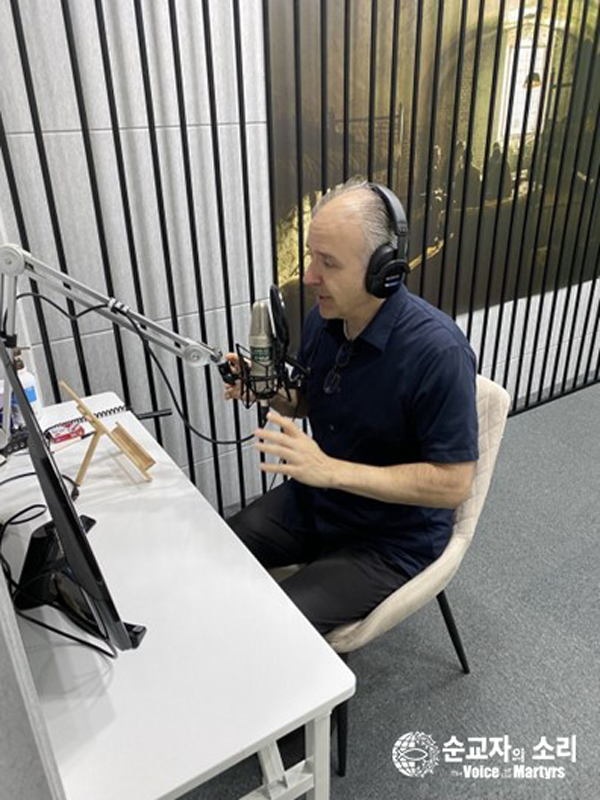
VOM Korea’s CEO Pastor Eric Foley records a daily radio broadcast to the Maldives.
On July 6th, 2021, Maldivian authorities announced that an investigation had determined that Christian literature in the Dhivehi language, the native language of the islands, was being mailed to both individuals and companies in the Maldives. Some of the literature is believed to have been confiscated, but the government was unable to verify the origin of the literature and closed the investigation.
Other unconfirmed reports indicate that the Maldives may station government agents in nearby countries like Sri Lanka to monitor or stop Christian outreach to the Maldives from originating there.
According to Representative Foley, Maldivian Christians must keep their faith secret. “If they are discovered, they may lose their citizenship,” she says. “Even owning a Bible can result in imprisonment.”
Most Christians in the Maldives are expatriates, and most prefer not to organize meetings out of fear of repercussions. Representative Foley says that while the law does permit “non-Muslim” foreigners to live in the Maldives, they are forbidden from expressing their religious beliefs in public. Sharing the gospel with Muslims is illegal and can result in deportation.
According to Representative Foley, these factors combine to create a “canopy of fear” when doing any kind of Christian activity in or near the Maldives.
“Many Christian groups that normally work in ‘closed countries’ have not been able to do any kind of work in the Maldives,” says Representative Foley. “That’s why radio broadcasting is so important: It replaces the ‘canopy of fear’ with a ‘gospel canopy’—daily presentation of the gospel in ways that local Christians as well as mission agencies can rely on and build upon in their evangelism and discipleship efforts.”
But according to Representative Foley, the “canopy of fear” nearly smothered her organization’s efforts to launch the daily radio broadcast earlier this year. “One of our possible partners for the project was unable to secure radio airtime due to the relationship of the Maldivian government with their own government. And several potential announcers were ultimately too scared to have their voices heard over the radio, even though we planned to alter the voices digitally to make detection difficult.”
Nevertheless, she says, Voice of the Martyrs Korea decided to press ahead on its own, and it launched its daily shortwave radio broadcast to the Maldives April 1, 2022.
Representative Foley says that while the use of shortwave radio for the broadcast may sound old fashioned, it is actually a cutting-edge effort. “Recently the Maldivian government has increased its efforts to block Christian content on the internet and on medium-wave radio,” she says. Blocking shortwave is much harder. “A shortwave radio signal can also effectively reach the full 90,000 square kilometers and 1,000+ islands of the Maldivian archipelago, and it is much more difficult for the government to block on a regular basis.”
Representative Foley notes that as much as 25% of the Maldivian population has regularly listened to popular shortwave broadcasts in recent years.
For the security of listeners, Voice of the Martyrs Korea does not release information regarding local listenership. But according to Representative Foley, the program has not experienced any jamming by the Maldivian government.
“We have received many reception reports from all around the world – India, Philippines, Morocco, Japan, China, Germany, Australia, Austria, and the United States – confirming that our broadcast is being received,” she says. “Our engineers remain at full alert and are daily monitoring our Maldivian broadcast in order to counteract any jamming efforts that may arise in the future.”
Representative Foley says that the Voice of the Martyrs Korea daily broadcasts utilize a combination of Dhivehi language content and English language content. “We use several books of the Bible that have been translated and recorded in Dhivehi, as well as other Christian content that has been recorded in Dhivehi. We supplement this with English language content that we record in our radio studio. English is used in the Maldivian school system and is gaining popularity across the islands.”
Representative Foley raises two prayer requests as the daily radio broadcast to the Maldives begins its second year. “First, please pray for a continued strong and clear signal for the VOMK broadcast to the Maldives. Second, since it is too dangerous for Maldivian Christians to gather for worship in small groups, please pray that our broadcast can encourage Christians who feel alone.”
Those interested in donating to support Voice of the Martyrs’ daily radio broadcast to the Maldives can do so at www.vomkorea.com/en/donation.








 Do the Word