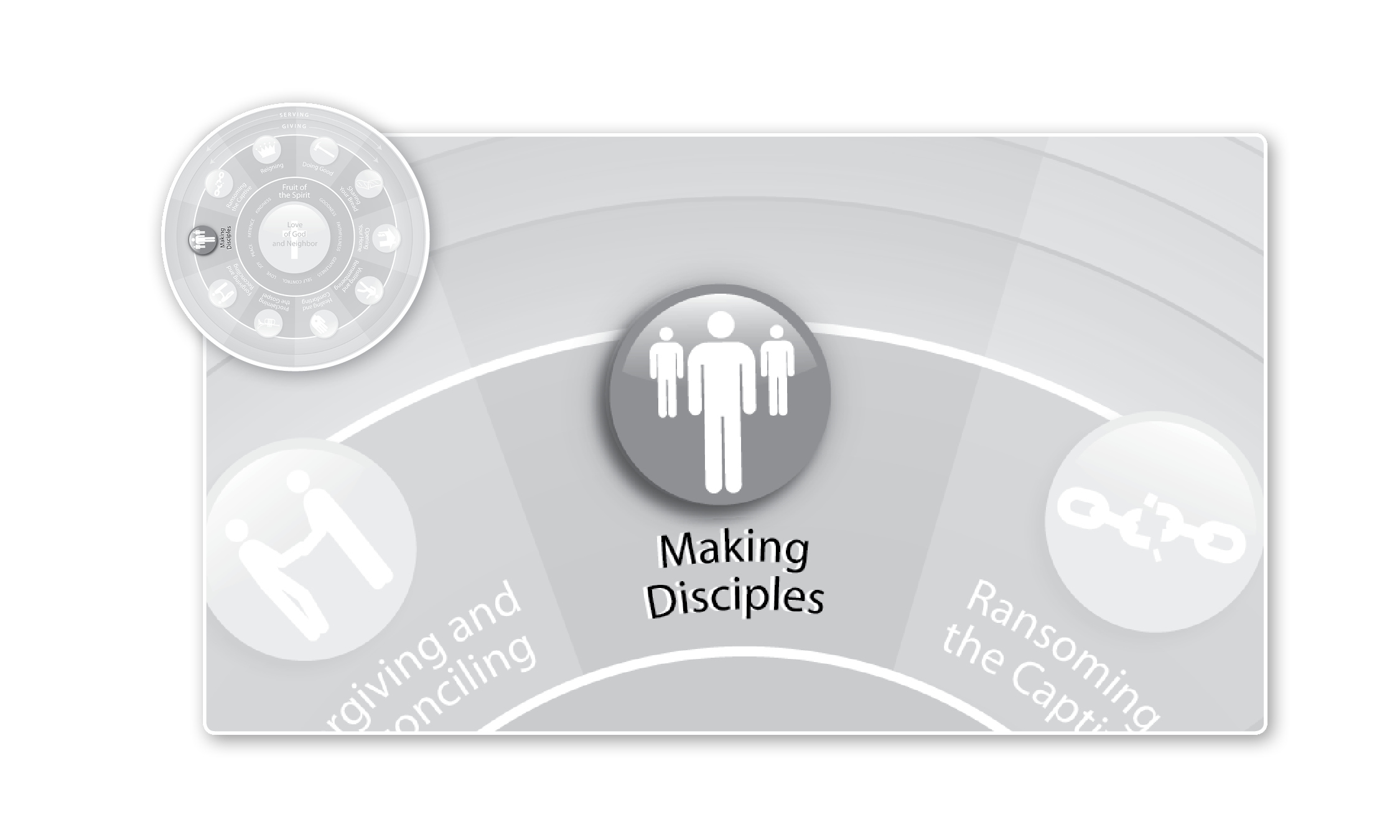
Be a Barnabas. Pursue a Paul. Train a Timothy.

Part X of our series on Making Disciples

“Therefore everyone who hears these words of mine and puts them into practice is like a wise man who built his house on the rock.”

So says Jesus in Matthew 7:24.

This month’s field trip for the Work of Mercy of Making Disciples will take you to three different places to connect with three people who will go on to be very, very important in your life.

In the words of Pastor Paul Martin, “Be a Barnabas; Pursue a Paul; Train a Timothy.”

In other words:

  • Make sure you have a peer disciple who is holding you accountable and who you are holding accountable;
  • Ask one person to disciple you formally;
  • Identify one person for you to disciple.

Commit all three of these requests to prayer today, and pray for each one daily in your family worship time until God fulfills all three—even if it takes six years. If he fulfills the first one but not yet the other two, thank him in prayer for the first one and beseech him for the other two. He’ll give them to you. It’s a request he’ll delight in fulfilling, because it’s in accordance with his word and how he desires to train you.

Utilize your offering to facilitate the process of discipling, being discipled, and being with another disciple. Build up a resource library like D. Michael Henderson talked about so that you can regularly be building up the person God sent you to disciple. Hit the Waffle House weekly—hey, three times a week; one for each relationship!—and let God produce the growth he delights to produce in each of these crucial and transformative relationships.

Just don’t order the chocolate chip waffle with extra bacon every time you go.
Oh, and remember to use an “After Action Review” to help make this a learning experience for you.  Here are the questions I ask myself after doing the word:

  • What was the intent?
  • What happened? Why? What are the implications?
  • What lessons did we learn?
  • Now what?
Posted in Uncategorized | Tagged , , | Leave a comment

Four Elements for Every Discipleship Conversation

Part IX of our series on Making Disciples

We’ve been talking this week about what discipleship is not.

First, we talked about how it is not therapy. As important as it may be to respond to people’s needs, which Jesus often did, he didn’t call that discipleship.  Teaching others to obey everything he commanded is how he defined discipleship.

Which, of course, means it cannot be spontaneous.  Discipleship must follow a plan: not just for what to talk about, but who to talk about it with.  It requires more than just a table by the window at Starbucks.

Today, I want to suggest some elements of such a plan with the help of D. Michael Henderson, an author and discipler whom I’ve quoted and made reference to repeatedly this week.

He suggests a predictable and manageable four-step process for conveying discipleship curriculum.  

This process is designed to keep conversations focused on pouring out and receiving the philanthropy of Christ rather than devolving into relationship chatter or—equally dangerously—endless introspection.  Despite the obviously strong application this process has for things like management and human development, our focus is on how this process characterized Jesus’ relationships with people and how those who are serious about discipleship will follow suit.

Here are four elements that every discipleship conversation should contain:

  1. A clear goal.  You don’t get to just pick one. The overarching goal is “and teach them to obey everything I’ve commanded you.” So the goal of every discipleship conversation needs to be a subset of that.
  2. Shared information which relates to that goal. Discipleship has real content. Teach specific, Scriptural command. Nothing fancy. Nothing cute. Just straight discipleship from the pages of Scripture.
  3. Strengthening of the relationship. Discipleship is more than information. Remember what we learned about Elijah and Elisha? Elisha learned by living with Elijah and following him around. That’s more than a standing weekly at Panera Bread.
  4. Agreement on the next steps toward the goal.  “Go and sin no more” is best understood, not as a platitude, but as a prescription. What’s the plan to do the word that the discipleship just heard you share from Scripture? (“That’s deep—thanks for sharing” is not a plan!)

And Henderson points out that the discipleship continues even when the conversation is over:

“The most effective conversations share information before, during, and after the conversation itself. The people who make the most difference in other people’s lives are constantly sending each other supplementary material: books, articles, quotations, personal notes, tapes, or reports.

People who are good at this follow up their discussion with a note that reaffirms their discussion, perhaps with an enclosure—an article, a photo, or a news clipping. And, just as often, they send some information prior to actually meeting:

‘John, you mentioned your interest in serving the poor in our own community. Here’s an article on Neighborhood Networks that might give you some ideas. We can discuss it when we meet on Tuesday.'”

This requires a level of planning and diligence on the part of the teacher to undertake a curriculum at this level of intentionality, direction, and rigor.

But perhaps you’re questioning whether you have the time to invest in someone’s life that way.  You have responsibilities at work, home, the gym, and your kid’s school.  Not to mention a hobby, church on Sundays, and a small group.

You’re right. You probably don’t have that kind of time. Better go and bury your father first.

Jesus will understand, I’m sure.

Are there elements of a discipleship conversation you would add or take away from this list?

Posted in Uncategorized | Tagged , , , , | 2 Comments

Discipleship Is Not Spontaneous

Part VIII of our series on Making Disciples
We started off talking in our last post about the importance of an “aggressive, comprehensive, systematic plan for discipleship” before discussing the differences between therapy and discipleship.

Today, I want to start off by admonishing every Christian disciple-maker with this:

Don’t be spontaneous when it comes to discipleship.

This is not only the advice given by D. Michael Henderson, one of my favorite disciplers, it’s also spot on biblical.

Why do we learn the Nicene Creed? Because it is the church’s “bookshelf”—if someone gives you a “book” (some kind of theological truth) and it doesn’t fit on that bookshelf, then reject it; it’s not part of the “everything I have commanded you” that Jesus said forms the curriculum of discipleship. So Henderson says:

Regarding the subject of conversations, in one of my classes a student objected to what he considered regimentation of discussions.

“I just like to be free to talk about whatever comes up,” he said. “I don’t like to be bound by rules. I want to say whatever comes to my mind.”

To which I answered: “It’s not all about you.”

Lots of people want to talk, and they do. They drone on and on about whatever strikes their fancy. But self-centered conversations don’t accomplish much.

If we want to serve God first, others second, and ourselves last, we need to shape the direction of our discourse. 

Denying ourselves the ability to dwell on the daily duties of life and instead focus on the deep, voluntary duties of discipleship is a recurring theme for both Jesus and Paul. Like in Luke 9:57-62:

As they were going along the road, someone said to him, “I will follow you wherever you go.” And Jesus said to him, “Foxes have holes, and birds of the air have nests, but the Son of Man has nowhere to lay his head.”

To another he said, “Follow me.” But he said, “Lord, let me first go and bury my father.” And Jesus said to him, “Leave the dead to bury their own dead. But as for you, go and proclaim the kingdom of God.”

Yet another said, “I will follow you, Lord, but let me first say farewell to those at my home.” Jesus said to him, “No one who puts his hand to the plow and looks back is fit for the kingdom of God.”

What sets the agenda in discipleship, according to Jesus?

  • Death does not.
  • Family obligations do not.
  • Personal doubts or religious questions do not.
  • Physical needs do not.

“Follow me,” says Jesus. “This is the Jesus Medical School of Discipleship. Today we study the circulatory system. You don’t want to study the circulatory system? You’d rather study muscles? Too bad. I know how to make you a doctor, so you’re going to need to follow my curriculum, not your interests or needs or wishes.”

That’s how Jesus rolls, and that’s discipleship.

So let’s switch gears and talk a bit about who we should be discipling.  Chances are, you’re not going to have people dropping out of the sky saying, “Hi.  I’d like to be discipled.”

Not even Jesus or the disciples had that.  But something they did have – and which we have, too – is friends, family members and neighbors. Remember the Gesarene demoniac? Jesus stopped him from getting in the boat and going with the disciples to disciple those who would have been complete strangers to him. Jesus says, “You have people to disciple here, Mr. Former Demoniac.”

That’s not an unusual exception. That’s the core of Jesus’ discipleship strategy!

Henderson puts it like this:

The method Jesus taught us is simple: help our friends follow Him. Encourage them to put into practice all He taught us about the kingdom of God. Jesus built His instructional system on the basis of His own personal friendships. He chose men to be His followers who were not only His friends but also already friends, relatives, and neighbors of each other. They were bound together by ties of familiarity, blood relationships, and hearty companionship—and most of them worked together every day.

Think about that. Jesus called as his disciples people from among his neighbors in Galilee. He did not seek out the super-spiritual. He simply shared with those who were already around him.

“Yes, but Pastor Foley, no one around me is jumping up and down for Jesus. Clearly no one in my sphere of influence wants to be discipled.” And James and John and Peter were super-spiritual Jesus-jumpers before Jesus recruited them by going aboard their boats?

Don’t discount that God has already given you a bumper crop of people to disciple.

“Then he said to his disciples, ‘The harvest is plentiful, but the laborers are few; therefore pray earnestly to the Lord of the harvest to send out laborers into his harvest.’” (Matthew 9:37-39)

In Jesus’ view, there is not a shortage of people interested in being discipled.  Or therapists.  Or even tables by the window at Starbucks.  There’s a shortage of disciplers.

Do you think most discipleship efforts tend towards being spontaneous?  What elements might need to be put in place to avoid “spontaneous discipleship”?

Posted in Uncategorized | Tagged , , , | 3 Comments