The Whole Life Offering Diagram: A Practical Strategy for Comprehensive Discipleship

Part VI of our series on Preparation
As we talked about in our previous post, we need a discipleship strategy that links the hearing and the doing of the word.  The good news is, we don’t need to develop anything new because this goal of linking the hearing and the doing of the word has been the basic approach to discipleship through most of Christian history.

We can look at many great Christian teachers to learn how they linked the hearing and doing of the word.  In the ancient church there were those like Origen, Tertullian, and Augustine.  And then the Protestant reformers: Luther, Calvin, and Simons all wrote about this question.  As did John Wesley in the 1700s , and so on.

In other words, it’s not a denominational question.

It is a question that all Christians must deal with regardless of whether we come from Presbyterian, Methodist, Baptist or any other background.

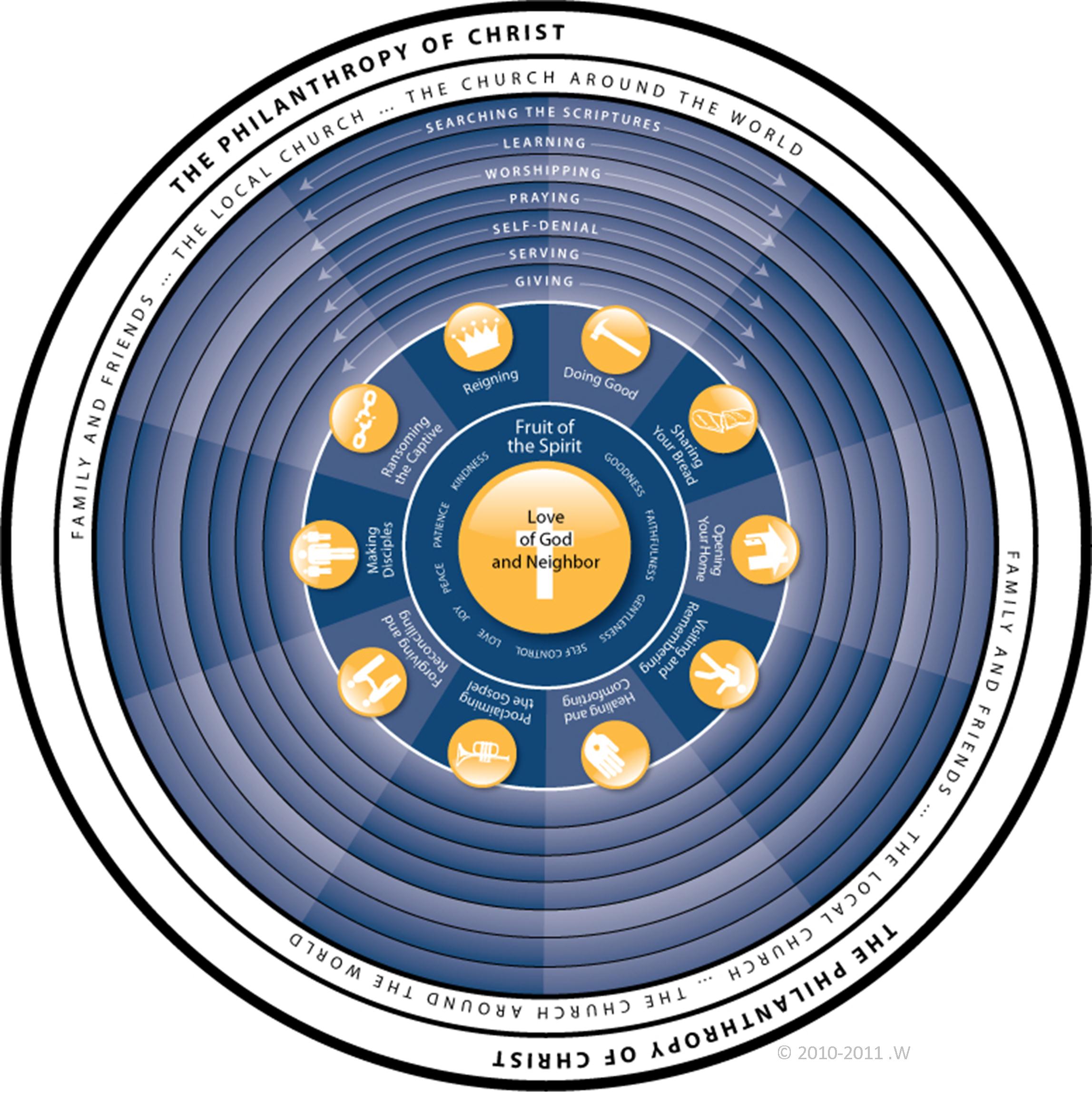
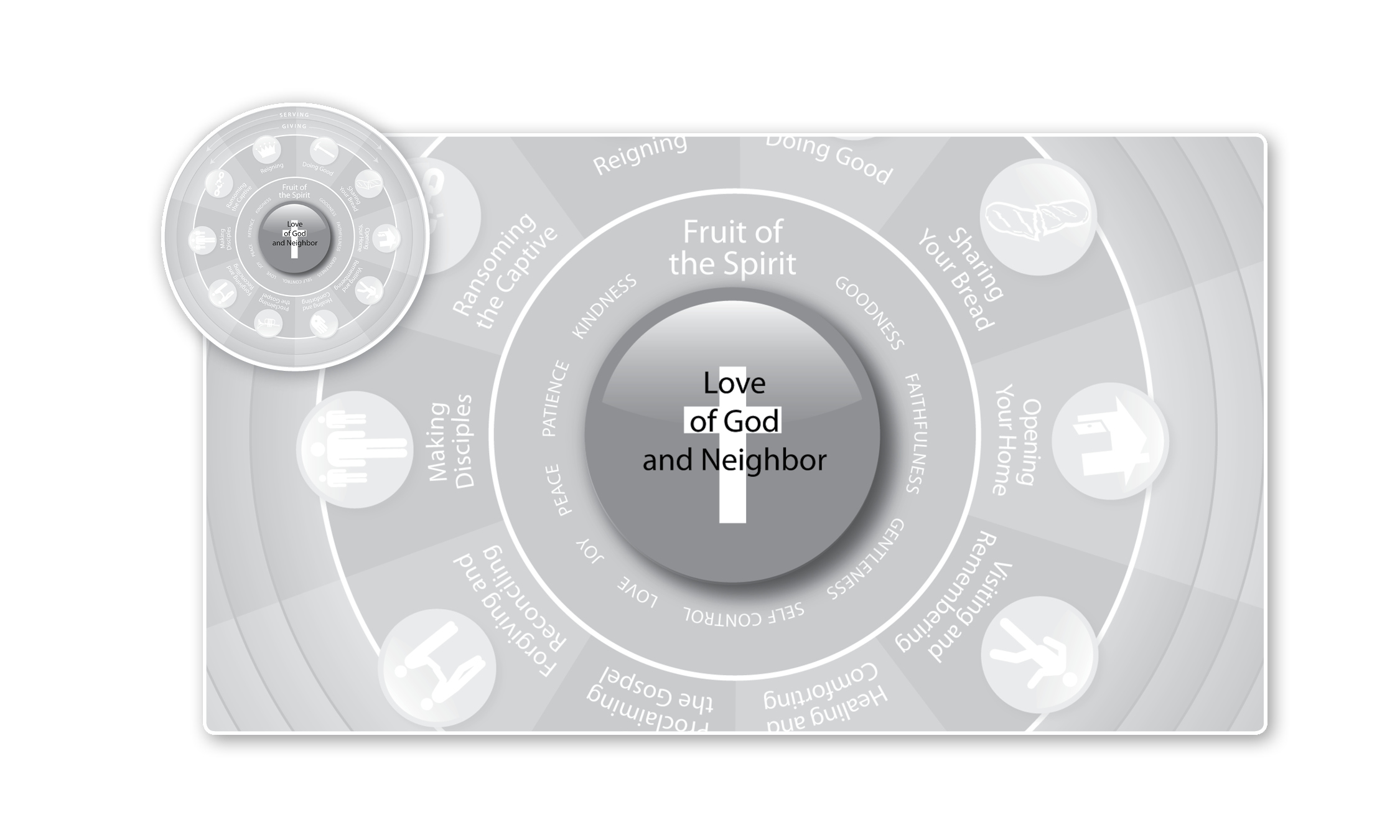
The model I want to show you today comes from a book that I wrote called The Whole Life Offering (click the image to view a larger version).
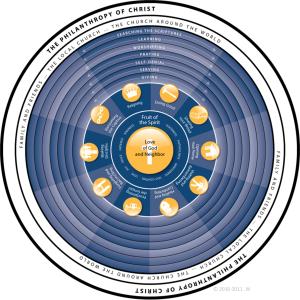
In Romans 12 Paul says, “Present your bodies as a living sacrifice.”  That is a whole life offering. That’s what is being represented in this diagram.

It is a practical strategy for comprehensive discipleship.  It may look very complicated but it’s not hard to understand.

By using a diagram like this, we can make sure that we are helping our disciples to grow in all of the areas God calls us to.  With a tool like this we can make sure that the hearing of the word and the doing of the word stay joined at the hip.

For the better part of 2000 years in the church, that internal spiritual development part of discipleship has been called “Works of Piety” and you can see those represented on the diagram as Searching Scripture, Learning, Worshipping, Praying, Self-Denial, Serving, and Giving.

Let’s look at Ephesians 2:10:

For we are God’s handiwork, created in Christ Jesus to do good works, which God prepared in advance for us to do.

According to this verse, we were created for works that he prepared for us to do beforehand. So on the one hand we have Works of Piety, and on the other hand we have these good works, which the church has typically referred to as “Works of Mercy”.

The Works of Piety are internal, while the Works of Mercy are external.

Now look at the center of the circle. There are two commandments there: love God and love neighbor.

Jesus says these are the great commandments.  At the heart of the Christian life, we link those together: loving God, loving neighbor; hearing the word, doing the word.

Internal development/external ministry, the works of piety/and the works of mercy – these things are always joined together at the center of the Christian life.

Now, look at the outside of the circle. The outside of the circle says, “the philanthropy of Christ.”

Philanthropy is usually used to indicate the giving away of money but it is actually a biblical word from Titus 3:4.  It says, “When the goodness and loving-kindness of God appeared.”  In Greek the word for “loving-kindness” is “phil-anthropy.”

In Greek “phil” means love and “anthropos” is people.

But it is not our love for others.  Everything that’s inside of this diagram is about God’s grace–his philanthropy. You’ll see in verse 5 of Titus 3 that God saved us not because of works done in righteousness, but according to his own mercy. Everything that happens inside this circle is God’s love to us—including the Works of Mercy we perform on other people.

Christ’s love forms the outside of the circle because everything that happens inside of the circle is God’s work; it is God’s doing; it is God’s activity in our lives. It’s not something we do in our own power, it is God’s work in us.

The next circle in—the one that says “Family, Local Church, Church Around the World” reminds us that this activity of God is not something that’s just between he and us.

Discipleship in the Christian church and grace from the living God has never been just an individual experience. It is always pictured in Scripture as a group activity.

Wow, does the church fail to see that today.

“Yeah, I don’t go to church but I’m spiritual.” Huh? But God shares his grace collectively with his children; what are you doing over in the corner by yourself being spiritual?

Jesus always taught people in groups. When Jesus taught evangelism in Luke 10, he taught 72 disciples at the same time. Each of us belongs to three different communities.

At its base, discipleship takes place in the family, meaning discipleship is not simply the pastor working with each individual Christian.  Parents have the primary responsibility to disciple their own children. That’s the first community of which we each are a part.

The second is the local church.  Here we’re reminded that discipleship does not only happen in the family but it happens as we come together in God’s wider family.

Third is the church around the world.  Each of us belongs not only to our own local fellowship but to all of God’s people.  The body of Christ only grows to fullness if the whole church around the world is working together and sharing with each other.

Now, here’s a key principle that’s fallen by the wayside today:

Missionary service always begins locally before it goes global.  

Jesus says to his disciples in Acts 1:8, “You will be my disciples in Jerusalem, Judea, Samaria and the ends of the earth.”

So, if a person is not faithful to disciple their own children, they cannot disciple others in the local church. This is Paul’s message to Timothy in 1 Timothy 3:1-5:

The saying is trustworthy: If anyone aspires to the office of overseer, he desires a noble task. Therefore an overseer must be above reproach, the husband of one wife, sober-minded, self-controlled, respectable, hospitable, able to teach, not a drunkard, not violent but gentle, not quarrelsome, not a lover of money. He must manage his own household well, with all dignity keeping his children submissive, for if someone does not know how to manage his own household, how will he care for God’s church?

The same applies to us: in order to be able to minister to the church around the world, we have to first be faithful in our local church.  The early missionaries would travel with a letter from their church authorizing them as good ministers in their local context.

So, when someone is faithful here, God will raise them up there. But we have too many church missionaries that were not faithful in their local church (the local church doesn’t even know who they are) who are ministering abroad and causing many problems; they don’t disciple well—they never learned how to disciple others (or even be discipled by others) at home.

In our next post, we’ll go into more depth about the Works of Mercy.

What else might be helpful to know about The Whole Life Offering Diagram?  What do you need to be able to explain it to others?

Posted in Uncategorized | Tagged , , , | 1 Comment

Why Are Hearing and Doing the Word So Important?

Part V of our series on Preparation

Today, I want to give to you a strategy for discipling Christians in order to help them be generalists so they can mirror Christ.  Let’s look at Matthew 22:34-40:

34 Hearing that Jesus had silenced the Sadducees, the Pharisees got together. 35 One of them, an expert in the law, tested him with this question: 36 “Teacher, which is the greatest commandment in the Law?”

37 Jesus replied: “‘Love the Lord your God with all your heart and with all your soul and with all your mind.’[a] 38 This is the first and greatest commandment. 39 And the second is like it: ‘Love your neighbor as yourself.’[b] 40 All the Law and the Prophets hang on these two commandments.”

Here, Jesus talks about 2 commandments: love God and love neighbor. Now I want to show you another Scripture which is very similar but which many don’t think of as being related.

Matthew 7:24-27:

24 “Therefore everyone who hears these words of mine and puts them into practice is like a wise man who built his house on the rock. 25 The rain came down, the streams rose, and the winds blew and beat against that house; yet it did not fall, because it had its foundation on the rock. 26 But everyone who hears these words of mine and does not put them into practice is like a foolish man who built his house on sand. 27 The rain came down, the streams rose, and the winds blew and beat against that house, and it fell with a great crash.”

In verse 24, Jesus talks about two commandments, and even though it doesn’t seem like it, these are the same two commandments he talked about in Matthew 22.

Love God = hear the word.  Love neighbor = do the word. 

Hearing the word – loving God – is about our own internal spiritual development.

Doing the word – loving neighbor – is about our external ministry or the ways we act in the world.

When we disciple people and help them grow to fullness in Christ we need to keep both of these in focus: their internal spiritual development and their external ministry. And we need to understand that these two are intertwined. Because as Jesus says in Matthew 7, “Whoever hears my words and does them is like a man who builds his house upon the rock; when the rains and the floods and the winds come the house still stands.”  He goes on to say that when this link is broken, the house will fall. “Whoever hears my word but does not do them is like a man that builds his house upon the sand.”

And one of the most common discipleship problems today is related to splitting these two areas of development.

Many churches are very good at hear-the-word discipleship, which they consider to be very important, but they neglect the kind of do-the-word discipleship that God intends to flow from hearing the word. They might consider feeding the hungry to be less important than one’s prayer life, for example.

What happens when we do this; when we focus on internal spiritual development but we fail to do external ministry?  We lack impact.  Christ wants us to impact the world but when we separate the hearing and the doing of the word, we can’t.  We can’t just swing the other way, either.  If we focus on external ministry and not spiritual development, we lack power.

In order to have power and impact in ministry we must have link together the hearing and doing of the word.

But I want to make sure we don’t come away today thinking that linking them together means just being sure to do both.  What we’re discussing here isn’t a matter of merely doing some internal development and some external ministry.

Linking our hearing and doing – loving God and loving neighbor – means seeing them as a singular whole.  They are inseparable.  The only way we can come to know God fully is through the linking together of the hearing and the doing of the word.

The doing of the word illuminates the hearing of the word.

In a very real sense, we won’t understand—or appreciate—what Christ has done for us until we do it for others in his name and by his power. And when we separate hearing and doing the word, we end up with one of two spiritual problems: legalism and works righteousness.

Legalism is an ungodly focus on internal spiritual growth. Jesus talks about how people in his days would tithe even their spices – the problem is, they neglected the weightier matters of the law.  In Isaiah 58, for example, the Israelites say they cry out to God. They say, “We have been fasting but you don’t notice. Why are you not paying attention to us?” And God answers by saying, “Because the kind of fast I have chosen is for you to share your bread with the poor and open your home to the homeless.”

When we focus on internal spiritual development alone, we end up with legalism.

The other spiritual problem we can end up with by separating the hearing and doing of the word is works righteousness.  This is the belief that we must do certain things in order to go to heaven or earn God’s love. It flows out of trying to do the word without first having heard it.

So, terrible things happen every time we separate the hearing and doing of the word. Heresy happens. And great things happen every time we link the two. The goodness of God is made real to us and visible to others! And none of this happens just because we want it to.

It requires a comprehensive system that is rooted in the Holy Spirit and circumscribed and guided by the love of Christ.

Fortunately, Scripture and church history have bequeathed to us everything we need. It’s to these tools that we’ll turn in subsequent posts as we begin to install our plan for growing to fullness in Christ through the hearing and doing of the word.

Posted in Uncategorized | Tagged , , , , , , | 7 Comments

Generalist Discipleship

Part IV of our series on Preparation

We’ve all heard that the word “Christian” means “little Christ.” But seldom have we ever considered the impact this should have on our discipleship strategy. 


The Christian is (supposed to be )a small picture of Christ.  Of course, that picture is not perfect – it’s still developing – but from the very beginning of the creation of the human race, we were designed to be pictures of Christ. Adam and Eve miss that, of course, and plunge the race into sin.

But when Christ comes, one of the vital and overlooked aspects of his ministry is to reclaim for humanity – through his followers in whom the Holy Spirit lives – the vocation of being little pictures of Christ to the world. Little mirrors reflecting to the world the grace and goodness they have abundantly received from God.

Christ was and is a generalist. So pictures of Christ must be pictures of a generalist.

If, in the church, we only have specialists, then it is not Christ whom people are seeing.

Because if someone says, “Oh my ministry is to cook the meal after service,” they will focus only on the ministry that they like to do and that they feel comfortable doing and that they are skilled to do. Sometimes people say, “Yes, but if everyone in the church does their speciality, won’t the world see Christ in the church as a whole?”

Answer: No.

They will see a bunch of people doing what they are comfortable doing and what they are skilled to do. But each one of us is designed to be able to mirror him fully. He didn’t give us only the portion of the Holy Spirit we needed to specialize in one particular ministry. The fullness of the Holy Spirit dwells in each of us.  Just as we resemble our parents with our overall appearance, we are designed to resemble him—not just his ear or his toe, for goodness’ sakes.

Instead, Christ wants us to rely upon him as we grow to become like him in every way, not just the one or two ways that we like or understand or are good at.  And the best way to do this is to be comprehensively, systematically trained in ministries that are different from what we like to do or that we’re skilled in.

Whenever we do something that is outside of our natural gifting or interest we are demonstrating our reliance on Christ.

And God’s vision is that we would train disciples the same way Jesus trained disciples. He trained them to be generalists, not specialists. The goal wasn’t that they would find an area and focus on that, but that they would grow to fullness and would reflect Him by learning to do “all things well,” by the power of the indwelling Holy Spirit. Even though Jesus’ disciples might focus on one ministry at a specific point in time, they still will know how to do other ministries and, in this way, be “little Christs”—or, more accurately—little mirrors of Christ to the world.

This has been the vision of the Church for more than 2000 years (read: always). But in our modern times we have lost that vision because in business, specialists are king.

The Church has a habit of taking our thinking from business and applying it to Christianity. 

We think about the church like we might think about building a car, where everyone has a special role that they do to make the car run. But when Jesus was on earth that is not the vision that he had.  Someone who was a farmer, for example, would have to know how to do many kinds of jobs; specialization wasn’t an option. And a normal family would have to know how to sew their own clothing.  They would have to know how to grow their own food.

Of course it is still this way in many parts of the world—and it’s still how we need to approach discipleship.

Why do you think generalist discipleship gets overlooked in favor of specialist discipleship?

Posted in Uncategorized | Tagged , , , , , , , , , | 5 Comments