Specialist Discipleship

Part III of our series on Preparation

We kicked off this series on Monday talking a bit about discipleship and how Christian teachers are primarily servants before addressing the “hot mess discipleship” method of a lot of churches.

Today, we’re going to take a look at another major misunderstanding of discipleship in the church today: the idea that discipleship is about finding your calling and filling your own little niche.

Or, in other words,  that discipleship is about becoming a specialist.

A common misunderstanding in the church today is that in the body everyone is broken out into different specialties; so one Christian does one kind of ministry, another Christian does another kind of ministry, another Christian does another kind of ministry.

Too often that’s the church’s way of thinking these days, but it is wrong.

This misunderstanding often comes from a wrong reading of 1 Corinthians 12 beginning at verse 12.  Here, Paul talks about the Body of Christ as being composed of many parts. He says that in the body of Christ there is a foot, there is an ear, there is an eye, etc.  Some Christians say, “Well then I will be the foot and we will make you the ear and we will make you the eye.” But this is faulty thinking.

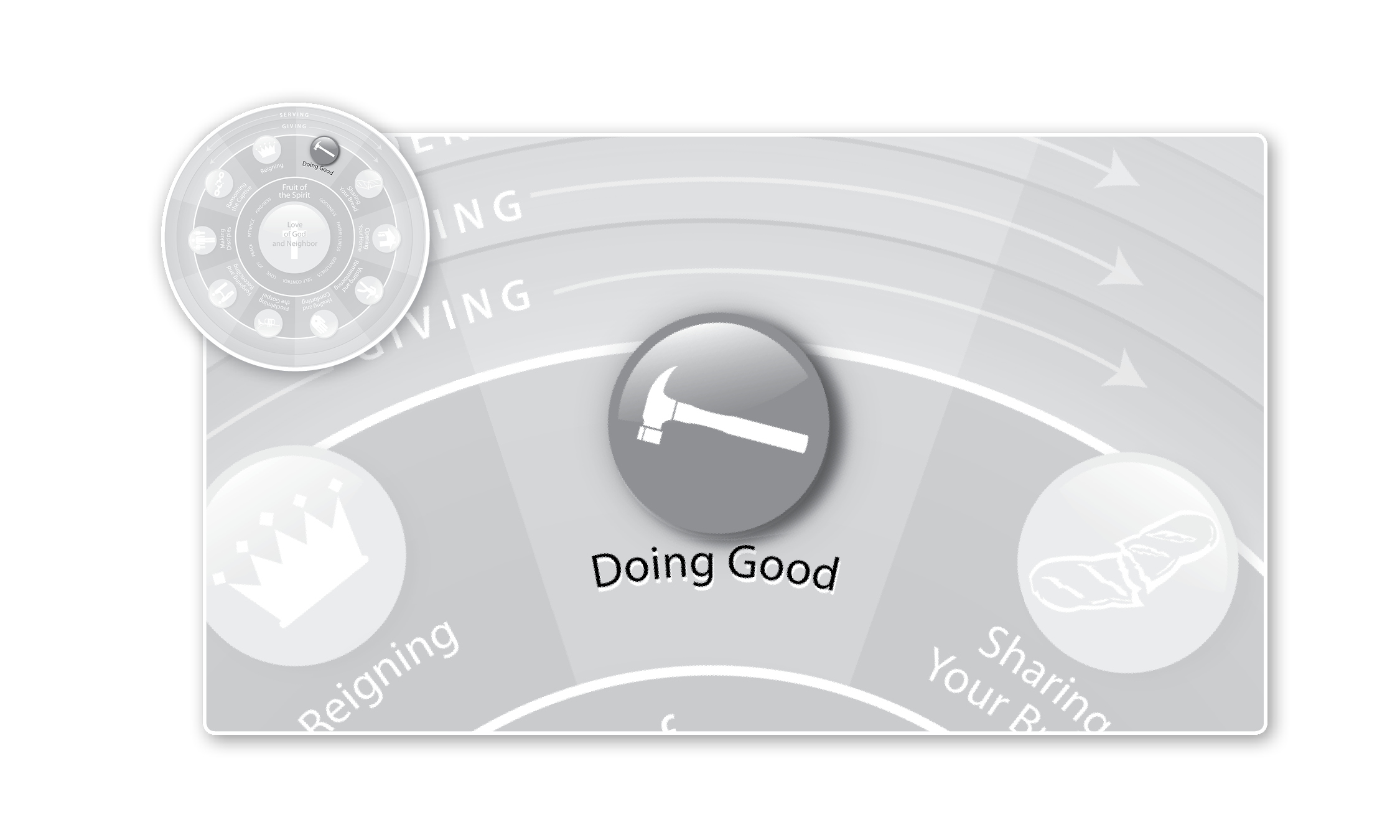
That’s why Ephesians 4:13 says that all Christians that are called to grow to full maturity in Christ.  St. John Chrysostom’s rhetorical question serves us well in this regard, “If another man prays, does it follow that you are not bound to pray?” Neither, then, does it follow that if another man does good, opens his home, proclaims the gospel, etc., we are no longer bound to the same.

A specialist knows how to do one kind of ministry and really wants to be left to do that one ministry. 

They might say, for example, “I am the drummer in the band. My ministry is to focus on drumming.” Or sometimes you’ll hear, “My ministry is preparing the meal after the service.  That’s my ministry.”

This is very common in the church today, but it is not biblical because Christ is not a specialist. Christ is a generalist and he trains his disciples to be generalists, too.

Jesus had 12 disciples, but guess what he never did?

He never divided them up into specialties. He does not say, “Andrew, you will cook the meal and John will do the evangelism and Peter will do the healing.” He trains them all to do evangelism and healing and each of the other works of mercy. And the reason why he trains them this way is so that each of them can serve as a picture or an image of Him.

Today, in science, we understand that the cells from any part of the body possess what is necessary to reproduce the whole body; from the cells of the ear we can reproduce the whole person.  So if we say that one Christian is only trained to be an eye and all they know is how to be an eye, that’s not biblical. Because even if I am serving in the church as an eye I need to know also how to be a foot or a hand or an eye depending on the needs of the body.

What negative results have you seen “specialist discipleship” produce in the Church?  What positive results have you seen?

Posted in Uncategorized | Tagged , , , , , , , , | Leave a comment

Peeps on Earth Goodwill to Men!

If you’ve been following the blog for any amount of time, you know that we have a well established rhythm of posting on Mondays, Wednesdays, and Fridays.  You also know, I hope, that I cherish this blog as a place to hash out ideas related to discipleship and the ways in which that plays out in various areas of life.

It’s for that reason that I hope you’ll pay close attention to an exception to that pattern.  I want to invite you to a part of spreading pure happiness to one of the darkest places on earth.

North Korea, as you may know, is known as the “hermit kingdom” for good reason.  It is intentionally exclusive of the outside world filtering news, religion, technology, etc.  The result is a population that is literally left in the dark (Google “North Korea at night” and look at the images that come up to see what I’m talking about).

For most of the year, our team in South Korea is busy launching balloons carrying things like Gospel fliers and Bibles, but this Christmas Eve, we’re going to launch something entirely different into the world’s most closed country.

Peeps.

Why, you ask?

The inspiration comes from an event that occurred almost a hundred years ago, during World War I, known as The Christmas Truce. During one of the most violent events in history, soldiers from England and Germany came out of their trenches to sing carols and play soccer by moonlight.  For one night, the war was put on hold in favor of humanity.

We believe that for one night, it’s possible to share simple joy with the people of North Korea. 

The rest of the year we’ll continue to send socks, medicine, flyers, and Bibles as balloon payloads. But on Christmas Eve, Peeps will fall on North Korea like snow along with other personal care items.

But we need your help!

Each Peep costs $1.00 to launch and with your participation, North Koreans will be able to share in the simple joy of marshmallow treats.

Click here to go to the Peeps page on the Seoul USA website and click on the “Sponsor Peeps” button to make your donation.


Posted in Uncategorized | 2 Comments

Hot Mess Discipleship

Part II of our series on Preparation

There are three phrases that describe how discipleship might look in any given church today:

Specialist. Generalist. Hot mess.

Let’s start with hot mess.  The highly esteemed urban dictionary defines hot mess as “a derogatory term describing a situation, behavior, appearance, etc. that is disastrously bad.”

Hot mess discipleship means no discipleship.

Actually, it’s worse than that. It’s the idea of church as a kind of Alcoholics Anonymous gathering—like a Sinners Anonymous. At AA people stand up and say, “Hi, my name is Such-And-Such and I’m an alcoholic.” In hot mess discipleship, the Christian shows up at church and it’s as if they say, “Hi, my name is Such-And-Such, and I’m a sinner. I was born a sinner, I’m a sinner now, and I’ll be a sinner when I die. Christ being in my life means I’m no different, but I am forgiven.”

It’s absolutely true that we’re sinners, but the Scripture’s identity of choice for us is saints. It’s how we get addressed in all the letters in the New Testament. “To the saints.” It doesn’t say “To the sinners” and that’s because it does make a difference that Christ lives in us.

We’re more than forgiven; we’re being transformed.

And the Scriptures lay out soldier imagery for us:

  • The Word of God is a two edged sword.
  • We put on the armor of God.
  • We take captive every thought.
  • We have work to do.

We don’t have time to wallow in our sin. Our calling is not to sin and then get forgiven. It’s to carry out the vocation of redeemed humanity: Mirroring the image of Christ to the world.  We’ll fall short and sin along the way, and when we do, we repent of it, confess it, receive his pardon, and get back in the fight.

We’re not just trophies of grace, old drunk uncles always needing to be picked up out of the gutter by our good nephew Jesus. We’re his mighty warriors. He has work for us to do. Grace-empowered work.  Supernatural work. But change is underway in us, and we’re not who we were yesterday.

In our next post, we’ll look at the very popular discipleship method of training specialists…and why we shouldn’t.

What other negative results does “hot mess discipleship” produce in the Church?

Posted in Uncategorized | Tagged , , , , , , , , | 6 Comments