Finding the Works of Mercy in the Lord’s Supper Story

Part XIII of our series on Preparation
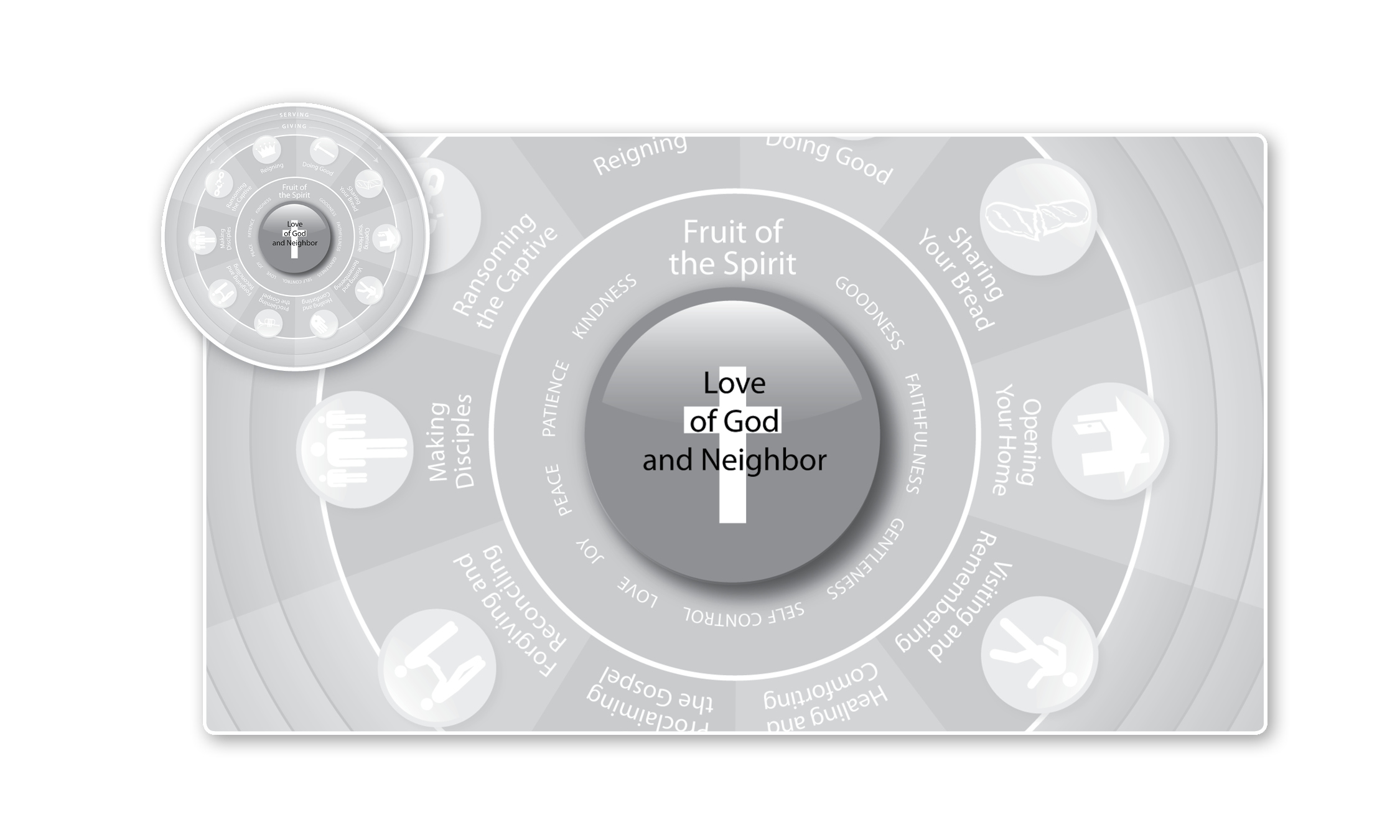
In our last post we talked about how the Lord’s Supper is extraordinary for many reasons, not the least of which is that in it we see Jesus delivering all ten of the Works of Mercy to humanity.

At the end of that post, I gave you a homework challenge: identify each of the Works of Mercy in the Lord’s Supper story, from the supper on through the crucifixion.

How’d you do?

There can certainly be more than one right answer, but let me at least share my list with you to stimulate your further search.

Jesus:

  • Does good to his enemies: 
    • Jesus washes the feet of and fed even Judas, who Jesus knows will betray him (John 6:70, ESV: “Jesus answered them, “Did I not choose you, the Twelve? And yet one of you is a devil.”)
  • Shares his bread: 
    • This happens in the communion meal itself.
  • Opens his home: 
    • Through the upper room, and also in John 14:2-4 when he says, “My Father’s house has many rooms; if that were not so, would I have told you that I am going there to prepare a place for you? And if I go and prepare a place for you, I will come back and take you to be with me that you also may be where I am.”
  • Visits and remembers:
    • See 1 Peter 3:19-20 (NIV): “After being made alive, he went and made proclamation to the imprisoned spirits— to those who were disobedient long ago when God waited patiently in the days of Noah while the ark was being built.”
    • Also Jesus visits the three sleeping disciples in the garden (Matthew 26:40).
  • Heals and comforts our bodies:
    • Luke 22:49-51 (NIV): “When Jesus’ followers saw what was going to happen, they said, ‘Lord, should we strike with our swords?’ And one of them struck the servant of the high priest, cutting off his right ear. But Jesus answered, ‘No more of this!’ And he touched the man’s ear and healed him.”
  • Proclaims the Gospel:
    • His words throughout this whole section of Scripture are the Gospel. Note especially Luke 22:22 (NIV): “The Son of Man will go as it has been decreed” and Matthew 27:62-64 (NIV), “The next day, the one after Preparation Day, the chief priests and the Pharisees went to Pilate. ‘Sir,’ they said, ‘we remember that while he was still alive that deceiver said, “After three days I will rise again.” So give the order for the tomb to be made secure until the third day. Otherwise, his disciples may come and steal the body and tell the people that he has been raised from the dead.’”
  • Forgives and reconciles:
    • Matthew 26:28 (NIV): “This is my blood of the covenant, which is poured out for many for the forgiveness of sins.”
  • Makes disciples:
    • John 13:12-15 (NIV): “When he had finished washing their feet, he put on his clothes and returned to his place. ‘Do you understand what I have done for you?’ he asked them. ‘You call me “Teacher” and “Lord,” and rightly so, for that is what I am. Now that I, your Lord and Teacher, have washed your feet, you also should wash one another’s feet. I have set you an example that you should do as I have done for you.’”
  • Ransoms our bodies from captivity:
    • Matthew 20:28 (NIV): “just as the Son of Man did not come to be served, but to serve, and to give his life as a ransom for many.”
  • Reigns over creation
    • John 12:32 (NIV): “But I, when I am lifted up from the earth, will draw all men to myself.”

Remember this as our month of Preparation draws to a close and we get ready to begin next week (and next year) to hear and do each of the Works of Mercy, starting with Doing Good:

Before we do unto others, let us always first hear how God in Christ has done unto us.
Posted in Uncategorized | Tagged , , , , , , | 1 Comment

Why The Lord’s Supper is More Extraordinary Than You Thought

Part XII of our series on Preparation

As we learned in our last post, Works of Mercy, absent being rooted in Works of Piety, result in acts of the flesh.  But when Works of Piety express themselves outwardly in Works of Mercy, the greatness of God is mirrored into the visible realm. And that’s very cool.

Christ himself modeled the Works of Piety throughout his ministry—this is the first half of the Great Commandments in Matthew 22:37, NIV, where Jesus said “‘Love the Lord your God with all your heart and with all your soul and with all your mind.’ This is the first and greatest commandment.”

And Christ passes on the Works of Mercy to humanity throughout his ministry—this is the second half of the Great Commandment, in Matthew 22:39, NIV, “And the second is like it: ‘Love your neighbor as yourself.’”

Now, here’s the key point for today: The Lord’s Supper is extraordinary for many reasons, and one of the reasons is that through it you can see Jesus delivering all ten of the Works of Mercy to humanity.

The Lord’s Supper is inaugurated through the Passover meal recorded in Matthew 26:26-29; Mark 14:17-25; Luke 22:7-22; and John 13:21-30, but it is then enacted—meaning, it’s brought  to life—through Jesus from the conclusion of the Passover meal on through the Crucifixion.

Remember what we’ve being saying throughout this series: before we even think about doing the word to someone else, we must first hear how it has been done to us, by Christ.  And where we can see him doing all ten of the Works of Mercy is in the section of Scripture from the Lord’s Supper on through the Crucifixion.

The form of the Lord’s Supper that the church has most often used is what Paul received and passed on in 1 Corinthians 11:23-26, which I received and now pass on to you to practice this week in your family worship time. It goes like this:

 For I received from the Lord what I also delivered to you, that he Lord Jesus on the night when he was betrayed took bread, and when he had given thanks, he broke it, and said, “This is my body which is for you. Do this in remembrance of me.” In the same way also he took the cup, after supper, saying, “This cup is the new covenant in my blood. Do this, as often as you drink it, in remembrance of me.” For as often as you eat this bread and drink the cup, you proclaim the Lord’s death until he comes.

I would encourage you to memorize this verse.  And as you do, I have a homework challenge for you: identify each of the ten Works of Mercy in the Lord’s Supper story, from the supper on through the crucifixion. Take your list of Works of Mercy (a list is in our last post) and ask yourself, “Where in the passion story do I see Jesus doing this Work of Mercy to others?”

Comment with your answers and next week we’ll compare answers!

Posted in Uncategorized | Tagged , , , , , , | 1 Comment

How Trying to Do Good Can Result in Bad

Part XI of our series on Preparation

We concluded our last post by noting the importance of the Works of Mercy in training our body.

But before we continue, we need to make one thing clear that so often gets muddied in today’s change-the-world Christian climate.

We are not called to originate the Works of Mercy. That would yield what Paul in Galatians 5:19-21, NIV, calls “the acts of the flesh”:

“The acts of the flesh are obvious: sexual immorality, impurity and debauchery;  idolatry and witchcraft; hatred, discord, jealousy, fits of rage, selfish ambition, dissensions, factions and envy; drunkenness, orgies, and the like. I warn you, as I did before, that those who live like this will not inherit the kingdom of God.”

Initially it is hard to imagine how focusing on trying to do good could lead to all these bad things.

But James 1:17, NIV, says, “Every good and perfect gift is from above, coming down from the Father of the heavenly lights, who does not change like shifting shadows.”

The root of trying to originate Works of Mercy (rather than pass on the ones we have received from Christ) is the Original Sin of Genesis 3:4: trying to be like God rather than carrying out our purpose of glorifying God by passing on what we have received from him.

We need to retrain our souls and spirits to receive and pass on good gifts, not to generate them. This is counterintuitive to the degenerate human mind.

When we “seek first his Kingdom and his righteousness” (that’s Matthew 6:33, NIV, which shows the body receiving from the soul and the soul receiving from the spirit, by the way), then our bodies receive all the good gifts they need. And our hearts are retrained to desire the good things God wants, and to desire to pass them to others in the way we have received them.

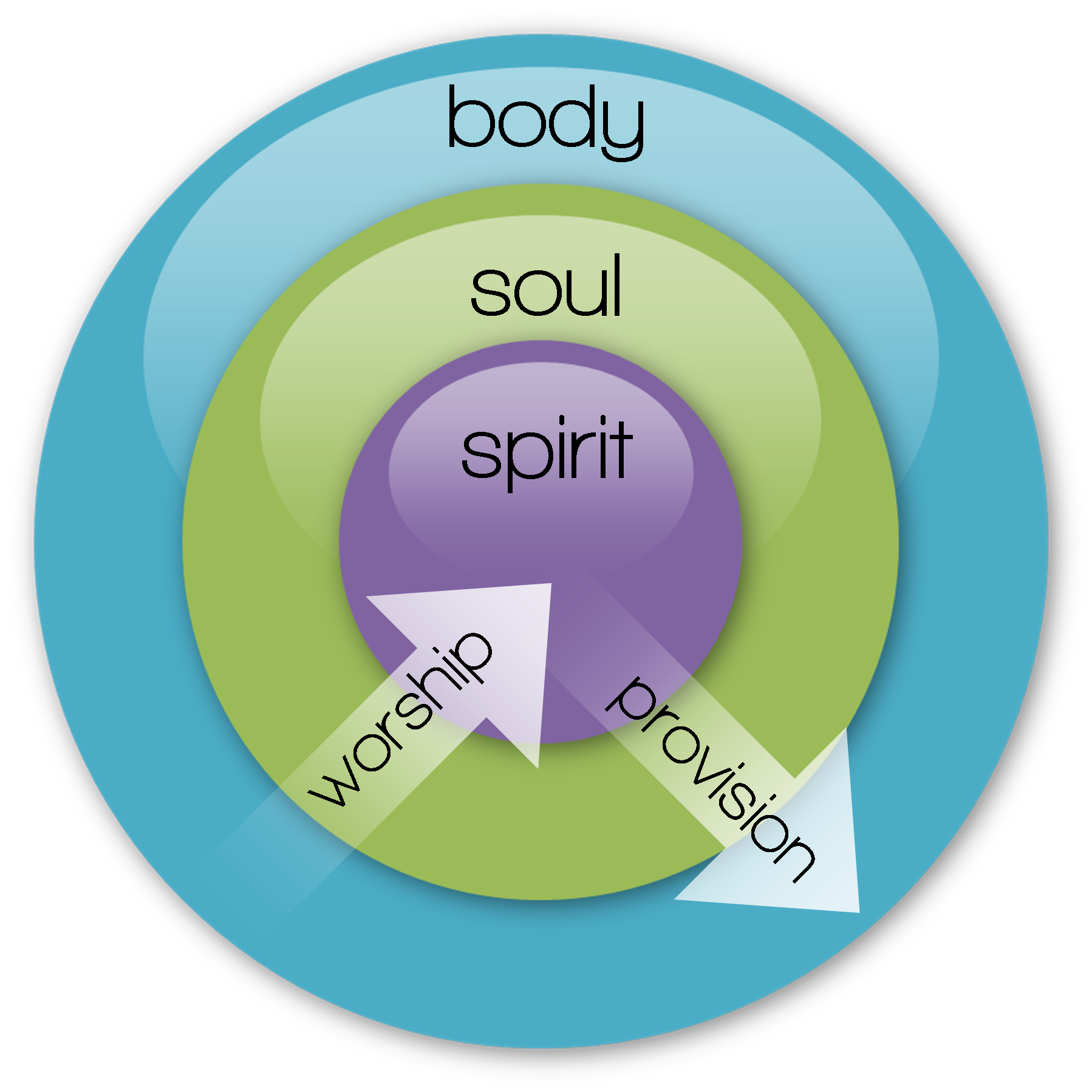
That means the body is the indispensable third part of the tripartite human form that mirrors God’s Trinitarian being:

  • body  – Christ, the visible image of the invisible God
  • soul – mind, will, and emotion in alignment with God’s will, passing things from spirit to body and from body to spirit, which corresponds with the Holy Spirit
  • spirit – the seat of the divine life unique to the human being, which corresponds to the Father

Notice how the proper relationship is for spirit to pass on to soul and soul to pass on to body (that’s our provision), and then for body to offer to soul and soul to offer to spirit (which is our worship). One is not above the other, contrary to the way we Greek-influenced Western types usually think about it, where we see body as lower and spirit as higher. But we’re modeled after the Trinity, so we need to derive our thinking about body, soul, and spirit from the relationships in the Trinity, not the other way around.

The Scripture makes clear that we are not to hurt ourselves or neglect our bodies, minds, will, or emotions. Instead, we are to receive and pass on the gifts for the soul and the body that God provides to us through the Holy Spirit. We’re to care equally for each of the three parts that compose us. That’s a message the church doesn’t share very often, unfortunately.

The Works of Piety are the good gifts for our soul that keep our mind, will, and emotions in proper relationship to our spirit (“hearing the Word”):

  • Searching the Scripture
  • Learning
  • Worshiping
  • Praying
  • Self-denial
  • Serving
  • Giving

The Works of Mercy are the good gifts for our body that keep it in proper relationship to our soul and spirit (“doing the Word”):

  • Doing good to your enemies
  • Sharing your bread
  • Opening your home
  • Visiting and remembering
  • Healing and comforting
  • Proclaiming the Gospel
  • Forgiving and reconciling
  • Making disciples
  • Ransoming the captive
  • Reigning

The Works of Piety and The Works of Mercy remind us that God’s grace is even greater than forgiveness—forgiveness is just one of many precious gifts he gives us so that we can accomplish our purpose of receiving and handing on to the visible realm all that he is and does in the invisible realm.

How does this shift in thinking keep good works from resulting in bad things?

Posted in Uncategorized | Tagged , , , , , , , , | 5 Comments