Russian courts rule that personal evangelism is an illegal form of church recruitment

In separate cases in May, courts in Russia’s far northeast Chukotka Autonomous Okrug fined two Christians for personally distributing Bibles and Christian books, ruling that the distributions constituted illegal church recruitment and not personal evangelism.
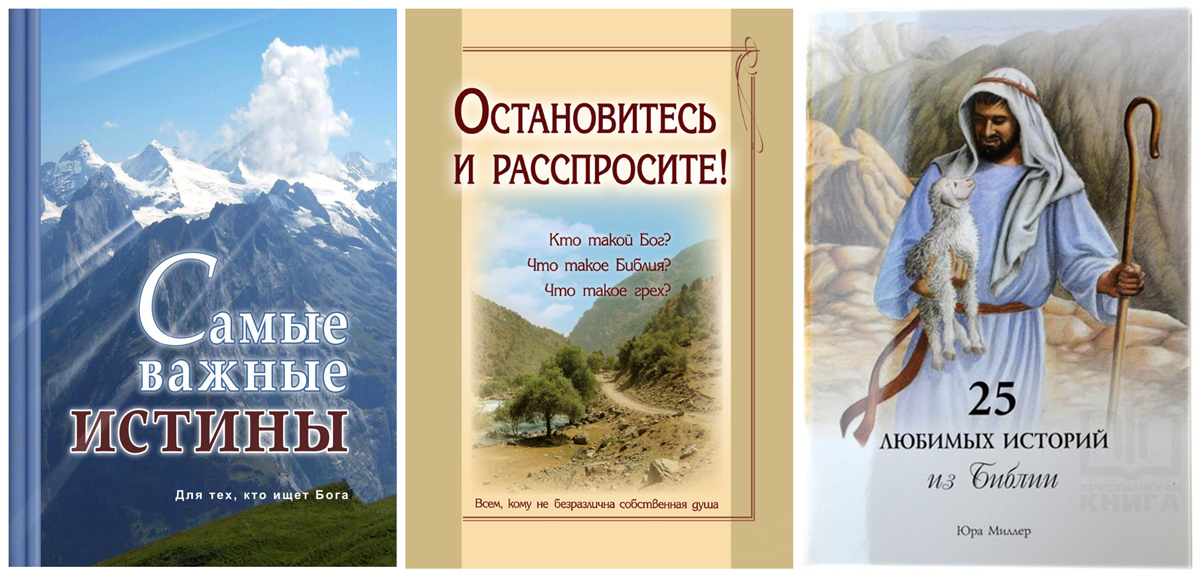
In separate cases in May, two Christians were fined for personally distributing the Christian books shown here, along with other Christian materials.

The two Christians, Ryshkov Mikhail Ivanovich from the easternmost Russian city of Anadyr and Kovtun Nikolai Alekseevich from the Arctic port town of Pevek, have each filed appeals.

According to Voice of the Martyrs Korea Representative Dr Hyun Sook Foley, the cases represent a new level of restriction on personal evangelistic activities for Russian Christians.

“This is the first time that Russian courts have ruled that individual Christians handing out Christian Bibles, books, and tracts in public is an illegal form of church recruitment,” says Representative Foley. “There are previous cases where courts have fined Christians for doing various Christian activities, but those rulings associated the offense with churches’ failure to register with the government. But in these two rulings, no mention is made of the registration status of the defendants’ churches. Instead, the courts criminalized the public distribution of Christian literature, ruling that it is not an act of personal evangelism.”

In the first case, Ryshkov Mikhail Ivanovich was fined for violating Article 24.2 of the Federal Law No. 125-FZ, “On Freedom of Conscience and on Religious Associations”. “On March 11 this year he and a group of friends distributed calendars with the title ‘What God Promised’ along with the Christian books ‘The Most Important Truths’ and ‘Stop and Ask’ and other Christian tracts in the city of Anadyr,” says Representative Foley. “No authorities stopped or interfered with them at that time, but six days later police came to the address shown on the materials and accused him of ‘distributing information about the doctrine of a religious organization among the inhabitants … in order to get new members’.”

Representative Foley says that in the Anadyr district court on May 18, Ryshkov Mikhail Ivanovich pled not guilty. “He explained that he had not distributed the materials to recruit people to his church but to lead people to salvation,” says Representative Foley. “He cited Article 28 of the Russian Constitution, which says that every citizen is guaranteed the freedom to spread their religious beliefs and act in accordance with them.”

According to Representative Foley, the court found Mikhail Ivanovich Ryshkov guilty and fined him 10,000 rubles (approximately 150,000 KRW).
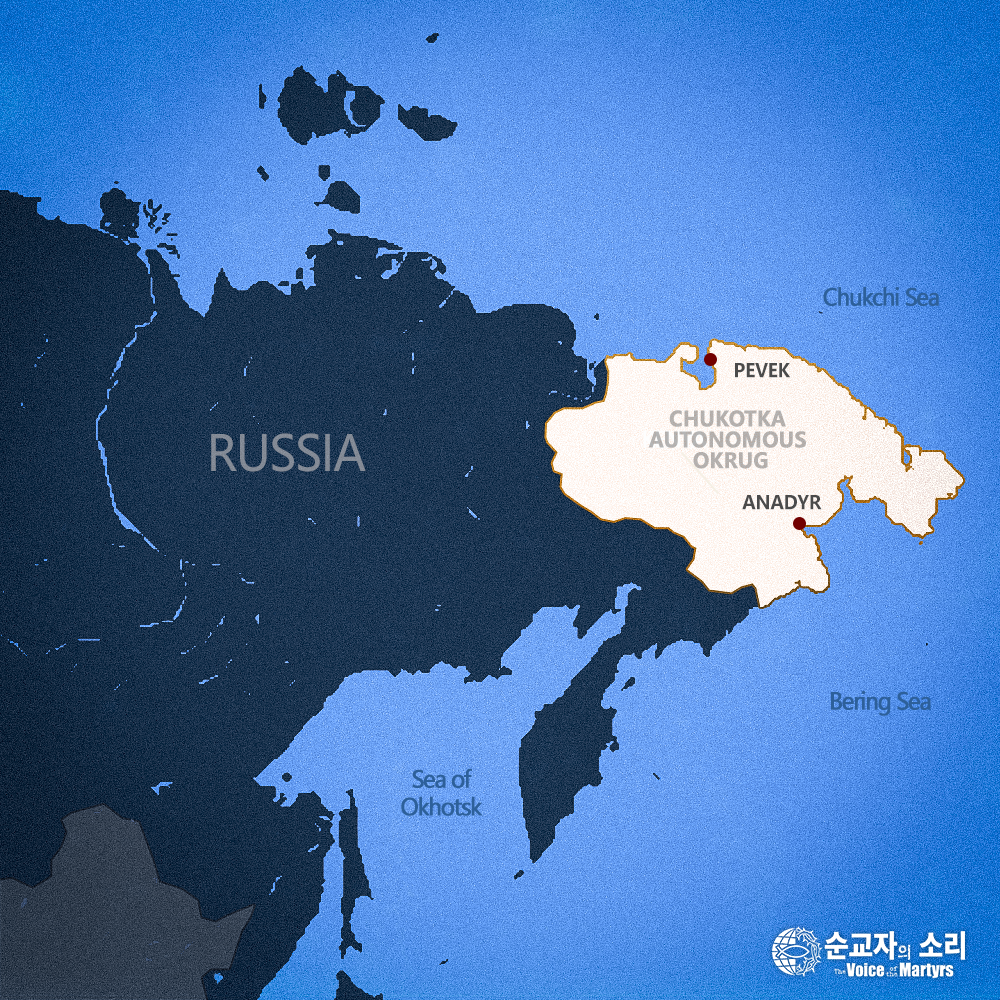
In the second case, Kovtun Nikolai Alekseevich handed out copies of a book called ‘25 Favorite Stories from the Bible’ while at a store in Pevek in March. According to Representative Foley, he also was charged under Article 24.2 of the Federal Law No. 125 -FZ, with authorities contending that distributing the Bibles was an illegal form of church recruitment.

“At the Chaunsky district court on May 31, 2023, Kovtun Nikolai Alekseevich pled not guilty,” says Representative Foley. “His defense was that the Bible is the word of God, not a church recruitment tool. It leads people to God, not just to church. He said that in distributing the Bible stories he was not acting on behalf of any religious organization but as a citizen of the Russian Federation who has the legal right to share his faith.” But according to Dr Foley, the court found him guilty and fined him 5,000 rubles (approximately 75,000 KRW).

Representative Foley says the cases illustrate the increasing difficulties facing evangelical Protestant believers in Russia. “The Russian Orthodox Church exercises strong spiritual as well as political and legal influence across all of Russia,” says Representative Foley. “Where evangelical Protestant practice is different than Russian Orthodox practice, there are growing difficulties for the evangelical practice. For example, in Russian Orthodoxy, evangelism and distribution of Christian literature would indeed be forms of building the church. But for evangelical Protestants, coming to faith in Christ and joining a specific church organization are separate matters. These court cases are just the latest examples showing Russian courts operating according to the Russian Orthodox understanding and criminalizing the Protestant one. It is a trend that Christians around the world should bring to the Lord in prayer.”

Representative Foley says Voice of the Martyrs Korea is also calling for prayers for the Christians and for the judges who will be involved as the two cases are reviewed in appeals courts.

Individuals interested in learning more about Voice of the Martyrs Korea’s work with evangelical Russian believers can visit https://vomkorea.com/en/project/russia-ministry/.
Posted in Russia | Tagged , , , , , , , , | Leave a comment

The US State Department’s 2022 NK Religious Freedom Report continues to “bury the lede”

The US State Department’s 2022 Report on International Religious Freedom was released last month. News of the report’s release appeared most commonly in headlines like this:

North Korea sentenced Christian toddler to life in a prison camp”–UPI

Toddler in North Korea ‘sentenced to life in prison after parents caught with Bible’”–Telegraph

North Korea sentenced a toddler to life after his parents were found with a Bible”—Times of India

The US State Department’s 2022 Report on International Religious Freedom.

Some articles noted that the toddler’s alleged imprisonment happened 14 years ago, in 2009. Most, however, omitted any mention of date. Typical was the Times of India report which wrote in a timeless present-tense, “[A] family along with a two year old has also been sentenced to life in a North Korean prison camp as his parents were found in possession of the Bible.”

No media report contained more than a few details about the toddler because the State Department report itself says little more: “One case involved the 2009 arrest of a family based on their religious practices and possession of a Bible. The entire family, including a two-year-old child, were given life sentences in political prison camps.” Presumably the State Department report says little more because the original 2021 Korea Future report from which the State Department cites the incident is itself a brief 61-word “case study”.

This is not to question the validity or importance of reports like those from Korea Future or the State Department. But there is more at issue here than media clickbait. How organs like the State Department report on NK religious issues lends itself to sensationalism, nudging readers closer to shocked, hopeless paralysis rather than informed, motivated action.

Media have a tendency to portray the State Department report as breaking news about North Korea. But the State Department itself makes no such claim. It acknowledges that the report is a selective literature review of previously published third-party reports considered by the US government to be credible and relevant. The report introduction says, “[T]he Department of State is not in a position to verify independently all information contained in the reports. To the extent possible, the reports use multiple sources to increase comprehensiveness and reduce potential for bias. The views of any particular source are not necessarily those of the United States government. The report is designed to spotlight examples of government and societal action that typify and illuminate issues reported in each country.”

What typifies and illuminates religion in North Korea? According to the State Department report, “Multiple sources indicated the situation had not fundamentally changed since publication of the 2014 UN Commission of Inquiry (COI) report on human rights in the DPRK.” The report cites a 2021 white paper by the Korea Institute for National Unification (KINU) that it is “practically impossible for North Korean people to practice religion.”

What the State Department annually portrays about religion in North Korea is that it remains in a steady state of bad. As the report says, “The government reportedly continued to execute, torture, arrest, and physically abuse individuals for their religious activities.” When it comes to religion in North Korea, it doesn’t matter if the 2-year old is now 14. It is simply timelessly bad in North Korea. There is little more to do than to add more of the same distressing anecdotes to the pile.

Careful readers of the State Department report, however, may find themselves asking: If there are indeed 100,000 to 400,000 Christians in North Korea, what do they do all day other than get beaten? If religious life is practically impossible for them, are they simply hunkering down and praying for regime change so they can once again be religious?

While the State Department’s report changes little from year to year, the State Department is mistaken that North Korean religious life is endlessly stuck in 2014. One of the reports the State Department does not cite is the 2020 White Paper on Religious Freedom by the Database Center for North Korean Human Rights, the latest update in a longitudinal study. As the 2020 paper details, 20 years ago virtually no one inside North Korea had seen a Bible with their own eyes. But by 2016, the number of those inside North Korea who had seen a Bible had jumped to nearly 8 percent. In the 2020 report, the Center says that number has continued to increase by 4 percent annually. More North Koreans may be reading the Bible today than at any other time in history.

And if roughly 1.6 million North Koreans have now seen a Bible, a KINU report estimates that 10 to 30%, or between 2 and 6 million, have listened to illegal foreign radio broadcasts. As the State Department knows from confidential US government reports, religious programs are among the most popular broadcasts inside North Korea, which is why the North Korean government has significantly increased its jamming efforts against them. Yet, even though listening to religious radio broadcasts is likely the most widespread religious activity among North Koreans, it receives essentially no mention in the State Department report.

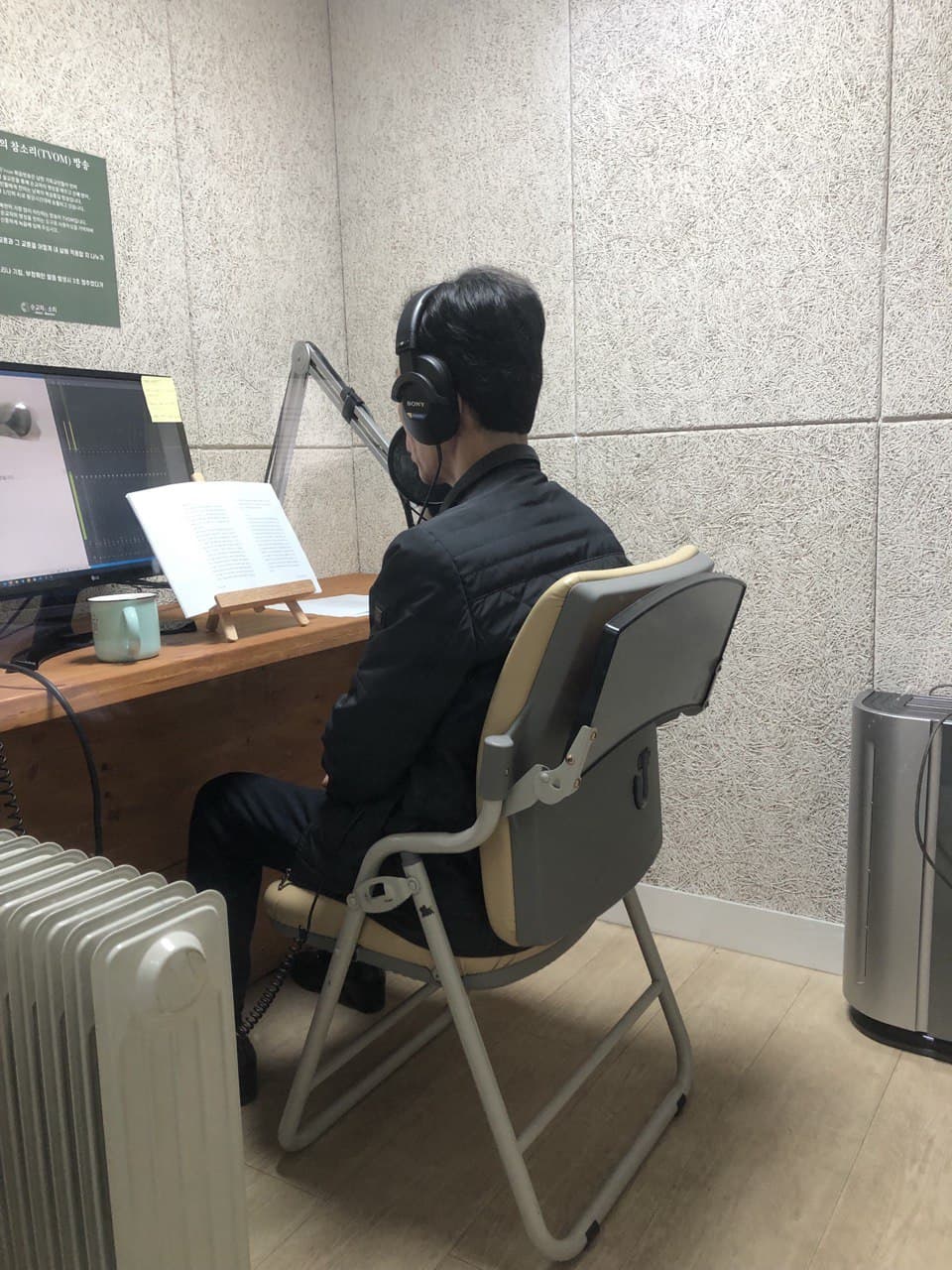
A North Korean defector records a radio broadcast at VOM Korea’s radio studio.

Religious life inside North Korea today is not the same as 2014, nor is it a practical impossibility. There is a massive popular information movement underway, much of it centered around religion. If religious life in North Korea was reducible to brief yearly anecdotes about beatings for Bibles, then the world could simply stand by, shake its collective head, and leave the matter to governments to sort out. But if faith is a dynamic, active, spreading force in North Korean daily life, then the State Department’s latest religious freedom report continues to bury the lede.

Posted in North Korea | Tagged , , , , , , | Leave a comment

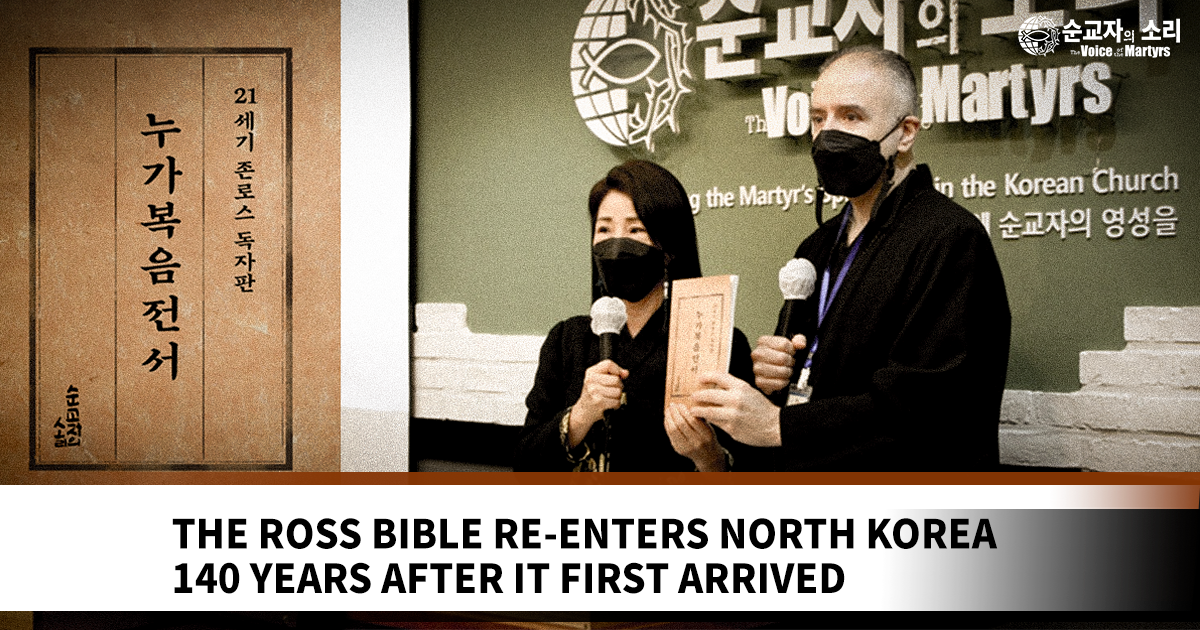
The Ross Bible re-enters North Korea 140 years after it first arrived!

In 1882, Koreans successfully smuggled the first ever Korean language version of the scriptures—in the form of the Gospel of Luke they had just translated with Missionary John Ross—from Moukden, China (today’s Shenyang) inside of what is today North Korea. Now 140 years later, according to persecution ministry Voice of the Martyrs Korea, Koreans have repeated the same feat—this time with copies of the ministry’s new John Ross Bible “Reader’s Edition” Gospel of Luke.

“In many ways, the situation today is the same as it was for John Ross and the first Korean Bible couriers,” says Voice of the Martyrs Korea Representative Dr Hyun Sook Foley. “The punishments for possessing a Bible or contacting a missionary are essentially the same as they were 140 years ago, namely, death. So the need for secrecy is the same today as it was for the first Korean Christians. But praise God, the power of the word of God remains the same as it did 140 years ago, too.”

Representative Foley says Voice of the Martyrs decided to disclose news of the re-entry of the Ross Bible into North Korea in order to challenge churches in Korea and globally to be involved in Bible-based ministry to North Koreans today.

“Christians outside of North Korea wrongly think that the only kinds of mission activity possible toward North Koreans today are things like teaching at North Korean universities, sending money for humanitarian aid through North Korean government-approved projects, or conducting training programs to plan for missions in the future when North Korea might ‘open’ to the gospel,” says Representative Foley. “But as the Apostle Paul wrote Timothy in 2 Timothy 2:9, ‘The word of God is not bound!’ The Bible is continuing to get inside North Korea today, and more North Koreans are reading it and being transformed by it today than at literally any other time in history.”

“We received confirmation that multiple copies of our Ross Bible Gospel of Luke entered North Korea this month and are in the hands of underground North Korean Christians, who are overjoyed to have them,” says Dr. Hyun Sook Foley, representative of Voice of the Martyrs Korea. She says that for security reasons related both to her organization and the recipients, the organization is keeping the exact details confidential. “It is now a criminal offense to bring a Bible into North Korea in any format—digital, print, or audio–from any country, including from here in South Korea,” says Representative Foley. She says the Ross Bible edition that entered North Korea intentionally has a different appearance than the one the ministry distributes in South Korea and elsewhere.

According to Representative Foley, independent surveys show that Bible-based ministry to North Koreans is continuing to increase the number of North Koreans who have seen a Bible inside of North Korea.

“The North Korean Human Rights Information Center, an independent data-gathering NGO, has been conducting an ongoing study where they found that in the year 2000, effectively 0% of people inside North Korea had ever seen a Bible with their own eyes,” says Representative Foley. “They have continued to update that study, and at the end of 2020 they determined that around 8% of people inside of North Korea have now seen a Bible with their own eyes.”

Representative Foley says Voice of the Martyrs Korea has distributed an average of 40,000 to 50,000 North Korean dialect Bibles a year for 20 years to North Korean citizens outside of South Korea, in print, audio, and digital formats using the Chosun Bible translation. She notes that the Bible is also read daily on Voice of the Martyrs Korea’s five shortwave radio broadcasts to North Korea. But she says the return of the Ross Bible to North Korea has special significance.

 “The Ross Bible is how the voice of Christ first came to ordinary Korean people, and in it Jesus and the other figures speak with a North Korean accent, since that was the accent of the translators,” says Representative Foley. “Ordinary North Korean people deserve to hear that original voice again today, and to experience the spiritual power of the original translation of the Bible into Korean.”

Dr. Foley notes that the Ross Bible was completed before the Korean language was standardized, so in its original form it is no longer readable by Koreans in either the north or the south. “Our new John Ross Bible ‘Reader’s Edition’ Gospel of Luke updates the text direction, word order, letters, grammar, and spelling so that modern readers can read it easily and understand it fully,” she says. “It retains the full original wording and adds simple notes to briefly and clearly explain unfamiliar vocabulary.”

The Ross Bible “Reader’s Edition” Gospel of Luke is available for purchase in Korea in the same size and shape as the original version. “It is a reader’s edition that ordinary Korean readers can understand. It is designed for easy, frequent reading and for tossing in your backpack to read on the subway, not for being displayed in a museum,” says Representative Foley. It is available for 10,000 KRW at www.vomkorea.com/store  or by phone at 02-2065-0703.

Representative Foley believes all Koreans should read the Ross Bible at least once.

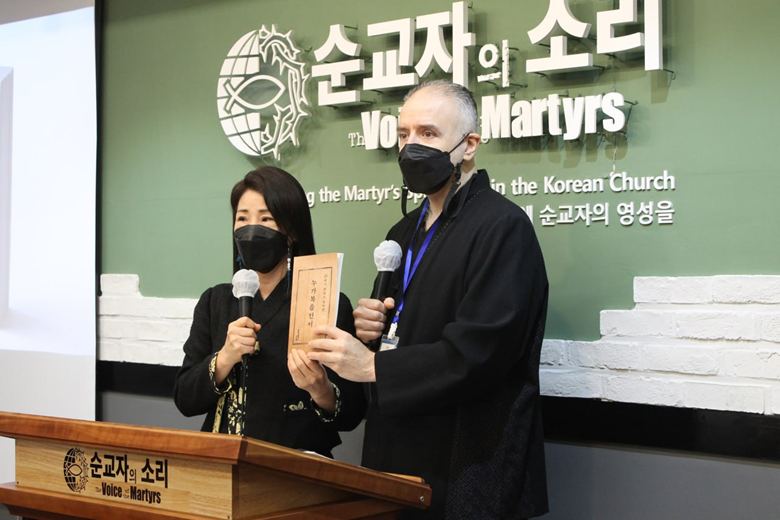
Dr. Hyun Sook Foley and Pastor Eric Foley, co-founders of Voice of the Martyrs Korea, display the ministry’s new Contemporary Reader’s Edition of the Ross Bible Gospel of John at a press conference in November 2022.

“The Ross Bible was for the first two decades of Korean Christianity the only hangul New Testament available to Koreans. It was the Bible of the Korean church during its formative period, and it left a permanent imprint on the Korean church in the form of a church that is Bible-centered and lay-driven. God used the Ross Bible powerfully to impart the saving knowledge of Jesus Christ to the first generation of Korean Christians even before missionaries arrived in Korea.”

The Ross Bible Reader’s Edition Gospel of Luke is the first of three Ross Bible versions Voice of the Martyrs Korea will be releasing over the next two years. The organization is currently working on a Luke/John/Acts trilogy edition for publication in mid-2023 and a full Ross New Testament “Contemporary Reader’s Edition” for publication in 2024. Representative Foley says that the organization intends to share these editions inside North Korea as well.

Individuals interested in learning more about Voice of the Martyrs Korea’s North Korean Bible ministry can visit https://vomkorea.com/en/northkorea/.

Posted in John Ross, North Korea | Tagged , , , , , , | 3 Comments