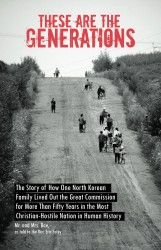
 First in a series of weekly posts by Mr. Bae, the co-author with Pastor Foley of These are the Generations, the story of third generation North Korean Christians. Mr. and Mrs. Bae and their children once enjoyed a prosperous existence in North Korean family, but their life was decimated following the North Korean government’s investigation of Mr. Bae on suspicion of Christian activity. Mr. Bae was held without charge in a North Korean jail for more than a year, but during that time his faith grew even as his health faltered.
Though Mr. Bae was ultimately miraculously released from prison without being charged, the Baes were reduced to the life of vagabonds by the stigma of his imprisonment. They lost their home, job, friends, and health but gained something infinitely more valuable: deep, unshakable faith in Christ. While continually on the move ahead of the authorities, they raised their children in the faith and led other family members and former friends to Christ.
In this series Mr. Bae will be sharing a part of his life story that is not told in his book. It is the story of what happened when he was released from prison, a time that almost no one realizes is actually the hardest time of all, and thus the time when God’s grace shines the brightest.
I would like to share today on the subject of what life is like for the believer who, after being imprisoned for his faith in a hostile nation, is released from prison and permitted to return to his home.
I would like to begin by having you ask me a question that no one has yet asked me since I started sharing the story of my life:
“Which is harder, Mr. Bae: Being held in prison for more than a year without being charged, or being released from prison and allowed to return to your home and family?”
That may sound like a strange question to you, since you will think it obvious that life in prison is a difficult trial and life after being released from prison is a sweet victory.
But in a hostile country, living a life of faith in prison is often a sweet victory and life after being released from prison is almost always the most difficult trial of all.
In prison, even amidst the torture and unspeakable deprivations, there is seemingly endless time to pray, as the days slip by into months and years.
You can remember the story of your life and repent of your sins.
You can sing the hymns of faith and recite the Scriptures of the Bible in your head.
And you can experience Christ’s visitation and grace in so many ways.
But when you are released from prison, you quickly realize that the imprisonment was only a prelude of the torture that the state intends to put you through.
Though the state has released you from your prison cell, they cannot afford to look weak. So as you leave one jail you enter another jail that is much bigger: The whole country.
Out in the open they can now imprison not only you but your whole family.
The torture that once only fell on you now falls on them as well, and that is much harder to witness.
You lose your home.
You and your family are forced to become wanderers.
The government wants to turn you into beggars, and to force your children to drop out of school.
They want to see your illnesses overtake you while no one steps forward to offer medicine.
They follow you from the moment you walk out of the prison door.
Because of this, no one will associate with you.
The government makes sure that your only purpose in surviving is to be a lesson to others never to resist the will of the state.
But the grace of God is greater still.
(To be continued next week…)








 Do the Word