

On September 3, 2003, Seoul USA officially became a nonprofit organization. On December 31, 2014, Seoul USA officially becomes a non-organization, as we complete the consolidation of all of our operations to Korea under our new name, Voice of the Martyrs Korea, dissolving our US corporation while retaining only our Korean NGO status.
As I wrote previously, this won’t change a lot about who we are or what we do. It does, however, provide an obvious opportunity for reflection and asking the question, “Above all else, what did we learn in these eleven years as Seoul USA?”
My own answer to that question comes from the scripture which I’ll be preaching at a gathering of North Korean defector Christians on Christmas Eve: Luke 2:10, wherein the angel appears to the shepherds and says,
Do not be afraid
It would not be untrue to say that for me the past eleven years at Seoul USA have primarily been spent learning that lesson.
Permit me to clarify a bit. I am neither risk-averse nor timid by nature. In fact, no one in history has ever used either of those words to describe me. Neither do I toss and turn in bed worrying about the future. I am cool under pressure and can’t recall ever panicking despite being in some very panic-worthy circumstances.
What I’ve learned in the past eleven years, however, is that it is people like that–people like me–who are actually the most fearful of all.
By this I don’t mean that I and others like me are hiding behind an outward facade of calm while inwardly we are actually shaking like leafs. Instead, what I mean is that we have built our lives and our characters to be shock-proof and self-sustaining, insulated against all the things that might hurt us or cause us pain. We have made a supreme effort, often without realizing it, to become our own saviors, not to mention the saviors of others–our children, our coworkers, and the large number of people we attract by virtue of being calmly confident in the face of the things that freak most people out.
Being cool, calm, collected, and competent is often praised. In the rare times that it is criticized, it is because at its ragged edges it can appear as arrogance, misplaced self-confidence, or pride. All those diagnoses are true, and yet they run the risk of missing the deeper problem attendant to this counterfeit fearlessness. It is the problem noted only long enough to be puzzling in Hebrews 2:14-15, where the author writes of Jesus:
Since the children have flesh and blood, he too shared in their humanity so that by his death he might break the power of him who holds the power of death—that is, the devil—and free those who all their lives were held in slavery by their fear of death.
What does it mean–what does it look like–to live your whole life in slavery to the fear of death?
Without meaning to be flip, I would say that it looks like Western civilization, and this is why it is so hard for us to spot this kind of fear. It looks like institutions and education and values and child-rearing practices all designed to give each of us as much ability as possible to stand in this world without falling. And back of that is what the writer of Hebrews identifies as fear of death.
In my case, I added to that the seemingly honorable wrinkle of serving the Lord. What it took me all of eleven years to realize fully is that serving the Lord often acts as a deterrent to being wholly dependent upon him–or, more accurately, to recognizing our total dependence upon him.
Here I don’t mean simply that we serve him out of fear or a desire to earn his favor. I think these are superficial problems that often mask a deeper issue, namely, the problem that somewhere along the line we got the idea that we possessed something of our own–some gift, some talent–that we could choose to offer to or withhold from him or to redirect to some other purpose. When we have such an idea, it skews our service. We can become petulant or angry at the Lord and at others when we feel like “our” gifts are being underutilized.
I had this experience during the past year, when changes in our staff meant I was spending a lot more time doing finance and administration work and a lot less time preaching and teaching, while other members of our staff assumed those responsibilities. At certain moments I would mope around Dr. Foley and the Lord about my changing role until one day it dawned on me: Whose preaching am I preaching? Whose teaching am I teaching? Whose accounting am I accounting? Whose administration am I administering?
It is at such moments that self-sufficiency and self-confidence are exposed as far more fear-laden than we could ever imagine. We are afraid that if we do not preach and teach (or whatever we think our primary “gift mix” is) that we will lose our identities (the ones we, not God, have built) and cease to exist (at least as according to the way we want to exist). Because of this, God is good when he makes preachers like me into accountants and teachers like me into administrators, whether temporarily or permanently. He did it to Nebuchadnezzar; why would he do it differently for us?
Over the 26 years of my ministry, at Seoul USA and before, I have heard so many people in ministry say, “I could go somewhere else and make a lot more money and get a lot less headaches than I do here.” This is a fear-laded comment. It overlooks that we are truly servants, and wherever he places us and whatever he asks us to do–or not do–is a privilege of the highest order, given to us only for our good, not to remedy some need the Lord has of us.
From my experiences over the last year came back to me the prayer from John Wesley’s covenant renewal service:
I am no longer my own, but thine.
Put me to what thou wilt, rant me with whom thou wilt;
put me to doing, put me to suffering;
let me be employed for thee or laid aside for thee,
exalted for thee or brought low for thee;
let me be full, let me be empty;
let me have all things, let me have nothing;
I freely and heartily yield all things to thy pleasure and disposal.
Alternately, I like Keith Miller’s formulation:
God, if there’s anything you want in this stinking soul, take it.
Christ sets us free from our needs for self-sufficiency, self-definition, self-satisfaction, and even self-knowledge because we can totally abandon ourselves to him in trust. To genuinely know him is to abandon ourselves to him. With the Apostle John we say,
Dear friends, now we are children of God, and what we will be has not yet been made known. But we know that when Christ appears, we shall be like him, for we shall see him as he is.
When we no longer fear, it is truly no matter whether we are preachers serving as accountants or accountants serving as preachers. It turns out that our stinking souls are actually eternal (everyone’s are, even the lost), and he is in the process of sanctifying them through every means necessary and possible.
As Seoul USA ends and VOM Korea begins, I feel a whole lot less of a need to try to control this process. This doesn’t mean that my work is decreasing or becoming more casual or slack; whatever I do, I do as unto the Lord. What has changed are the illusions of my identity, control, purpose, and even preference, which, praise God, are wasting away. I am no longer a preacher or a teacher or an accountant or an administrator.
I am simply his, and because of that I am no longer afraid.
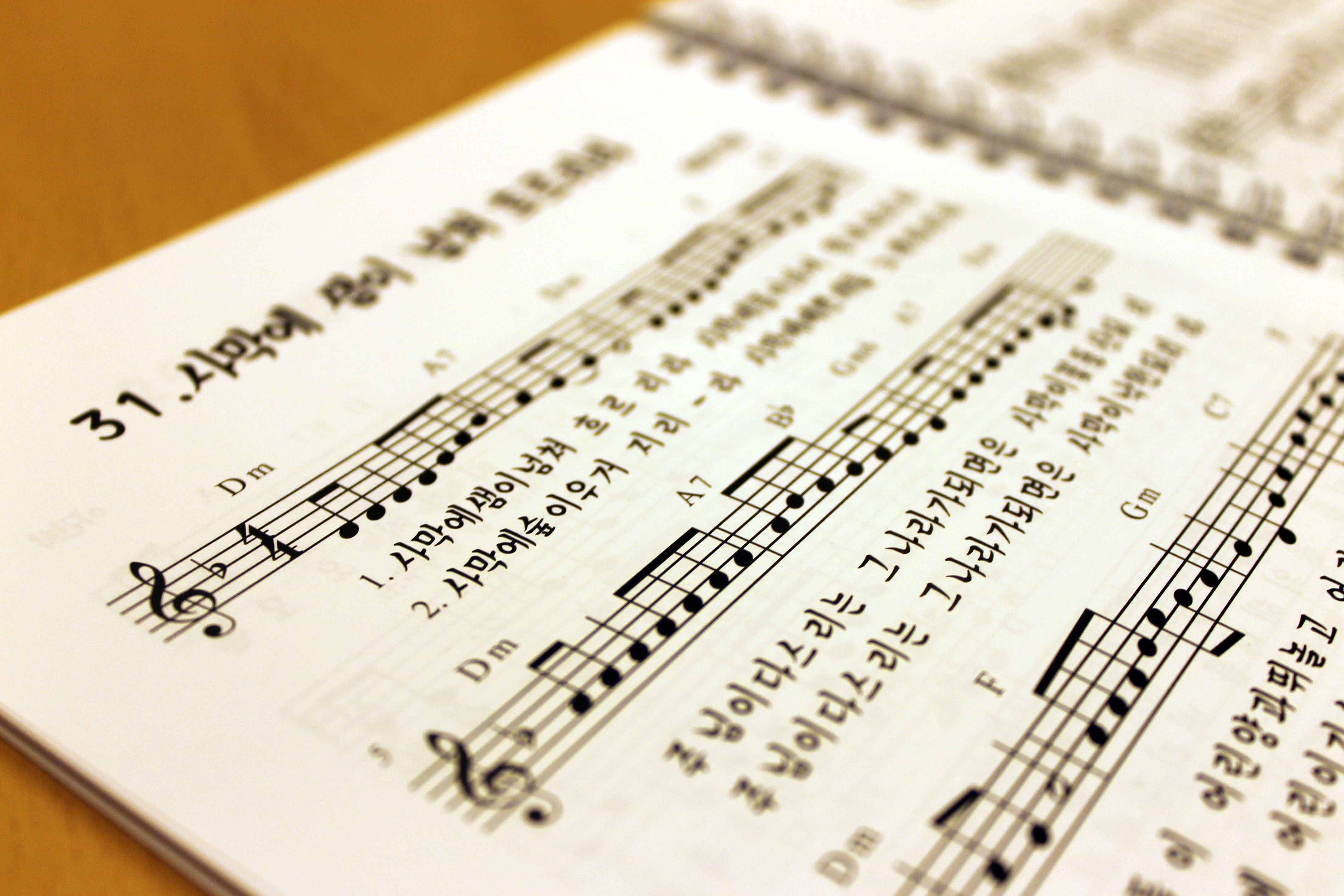 I’ve previously written about the North Korean hymnal we developed in cooperation with North Korean underground and defector Christians along with several of our Voice of the Martyrs sister ministries around the world (especially SDOK in the Netherlands).









 Do the Word