It’s Not A Platitude To Say That Prayer Is Key For North Korean Ministry

2014-12-06_18-150-0301_UU_Graduation_Ceremony_02Post by Pastor Tim – We asked many of you to pray for our first Underground University class of the year.  Here is what I e-mailed many of you,

I am on my way to Korea for the start of Underground University and Underground Technology.  Please pray for all of the new students this year.  Becoming a part of these programs is a huge undertaking of faith for them and along the way they experience the attack of the enemy – join with me in covering our brothers and sisters in prayer!

Please know that when we ask you to pray for something . . . it is not simply an obligatory, token North Korea prayer request. We ask for prayer . . . because it is something extremely important about which we know we need our brothers and sisters all over the world to pray. 

We saw this need so clearly on Saturday with two of our students.  One of our younger students was corrected during the class by an older student. But this younger UU student was terribly hurt and offended–so much so that she basically told us she was leaving UU. She couldn’t bear the shame and humiliation of being corrected by this older lady.

Do you understand what happened?  Before we’d even finished the first class, one of our students was ready to give up her missionary training.  A well-placed attack from the enemy had already beaten her up and left her feeling useless, hurt and shamed.  She was ready to throw in the towel.

Because of the disturbing background that defectors have, they are often much more emotionally sensitive than you or I might be, and they possess next to no skills for dealing with conflict. They almost always respond to conflict with anger and shouting.  And, as in the case of the younger UU student, they would rather run away, than respond to conflict in a Scriptural manner.

That’s why we ask you to pray. Because every week, we deal with students who are ready to give up, even though they have a strong calling to go into the ministry.

So, what happened on Saturday?

We were able to meet with both women. We helped the younger woman understand that God was using this experience to grow her.  If she simply ran away from UU, then God wouldn’t be able to teach her what she needed to learn.  We also helped her to understand that this was an attack from the enemy, in other words, she shouldn’t look to blame the other woman but understand that spiritual forces are at work.

We also helped her to understand that instead of only complaining to us, she need to humbly share her feelings with the older UU student who offended her.  Admittedly, this could be a little problematic, because it would not be far-fetched to envision a shouting match between these two ladies in the middle of our UU day. But when she shared her feelings with the older woman, the older woman humbly asked for her forgiveness.

Maybe it doesn’t sound like a big deal, but it’s a huge deal in NK ministry.  The Lord was at work in the heart of the older woman even before the younger woman approached her. Why?  Because the Lord is sovereign? Yes. And because we helped the younger woman to respond to conflict in a Biblical manner? Yes. But also because faithful men and women were praying for brand new UU students who were beginning their missionary training last week . . .

Posted in Forgiving and Reconciling, North Korea | Tagged , , | 5 Comments

God Of The Persecuted, Part II: Jesus Took Away Our Sins, Not Our Cross

Cross-FS


There’s a popular worship song that I always hope doesn’t get sung before I speak in churches and at conferences, since the lyrics stand in sharp contrast to my message. The chorus goes like this:

This is amazing grace
This is unfailing love
That You would take my place
That You would bear my cross
You lay down Your life
That I would be set free
Oh, Jesus, I sing for
All that You’ve done for me

The discordance comes from the song’s idea of a Jesus who suffers so that we will not have to–a Jesus who, in other words, came so that we could be set free to live lives unlike his. The song celebrates the idea that Jesus bore our crosses–an idea that is very different than Jesus’ own statement in Matthew 16:24,

Whoever wants to be my disciple must deny themselves and take up their cross and follow me.

Lest the meaning be unclear to us (or uncomfortably clear, as is more often the case), Peter restates it in 1 Peter 2:21,

For you have been called for this purpose, since Christ also suffered for you, leaving you an example for you to follow in His steps.

According to Peter, Jesus did not take up his cross so that we would not have to. He took up his cross so that we would choose to do so also. 

Our cross-carrying doesn’t save anyone, unlike Jesus’. But our cross-carrying echoes his, points to it, re-presents it, makes it more than a platitude when we say to our enemies, “Christ died for your sins.” Because when the words are accompanied by our cross-carrying actions, we are really saying, “Believe me when I tell–and show–you that Christ died for your sins, for there is no other explanation for my actions toward you who are persecuting me.”

This hardly leaves the rest of the world “free” and us Christians burdened. Christ’s death on the cross shows us that our definitions of “life, and life abudantly” have been warped by sin. That’s why in Matthew 16:25, the verse directly after Jesus summons us to carry our crosses, he says,

For whoever wants to save their life will lose it, but whoever loses their life for me will find it.

This is Part II of our series, God of the Persecuted: What The Lives Of Persecuted Believers Teach Us About The Nature Of God. (Click here to see Part I.) In Part II, what we’ve learned is that the existence of two millennia of martyrs shows that the cross is intended as a pattern for normal Christian living, not a punctiliar event that exempts us from the pattern. The cross sets us free not from carrying it but from a cross-less life, which, as Jesus says, is–no matter how it may appear–the essence of burden, the definition of lostness.

To turn the language of the worship song upside down, Jesus did not come to carry our cross or to set us free from laying down our lives. He came to show us that carrying our cross and laying down our lives are not only the appropriate response to but also the means of grace by which we come to experience God’s amazing grace in deeper and more amazing ways.

The writer of Hebrews phrases it like this, in Hebrews 11:32-40:

32 And what more shall I say? I do not have time to tell about Gideon, Barak,Samson and Jephthah, about David and Samuel and the prophets, 33 who through faith conquered kingdoms, administered justice, and gained what was promised; who shut the mouths of lions, 34 quenched the fury of the flames,and escaped the edge of the sword; whose weakness was turned to strength;and who became powerful in battle and routed foreign armies. 35 Women received back their dead, raised to life again. There were others who were tortured, refusing to be released so that they might gain an even better resurrection. 36 Some faced jeers and flogging, and even chains and imprisonment. 37 They were put to death by stoning;[e] they were sawed in two; they were killed by the sword. They went about in sheepskins and goatskins,destitute, persecuted and mistreated— 38 the world was not worthy of them. They wandered in deserts and mountains, living in caves and in holes in the ground.

39 These were all commended for their faith, yet none of them received what had been promised, 40 since God had planned something better for us so that only together with us would they be made perfect.

And then in Hebrews 12 he exhorts us to emulate them.


Posted in persecution, Uncategorized | Tagged , , | 5 Comments

The Story of Disgraced Christians Who Denied Christ

early christian martyr storiesPost by Pastor Tim – As I prepare to go to France (FYI – just a layover, no romantic Paris vacation for me), I was fascinated by the persecution that overtook the Christian communities in Lyons and Vienne in 177 AD.  It’s believed that Christianity came to this area through the evangelism of the churches in Asia.  Bryan Liftin, in his book Early Christian Martyr Stories said,

Faith in Jesus made the leap from the lands Paul and John had evangelized to a brand-new regions: a land of pagan Celtic tribes that had finally bowed the knee to the Roman Empire (pg. 71).

But we see that not only did a simple faith in Jesus make the leap from Asia, but also discipleship – Christians who were training for the heavenly contest – disciples who were fully prepared to give their lives for Jesus Christ.

Yet there were some, who in the words of Eusebius were “untrained and feeble” and who ended up shamefully denying Christ (Early Christian Martyrs Stories, pg. 72).

I half-expected that this would be the end of the story concerning the “untrained and feeble,” and that Eusebius would only focus on the heroic and victorious martyrs.  And while most of the account of the persecutions at Lyons and Vienne did focus on those martyrs who were trained and faithful, he devoted a few paragraphs to those who denied the Lord.

He starts off by noting how terrible it was for those who denied Christ.  He said that they were “dejected, ugly and full of disgrace.  Moreover, they were ridiculed by the pagans as despicable cowards (pg79).”  But what amazed me was not the shame that these people endured, but what happened next.

The deniers had been sent back to prison, but in God’s amazing plan they had not simply returned to rot in prison awaiting death.  Rather, God sent the faithful ones to intermingle with them in prison and restore them.

For through the martyrs, most of the deniers were reconceived and reimpregnated in the womb and restored to new life, learning at last how to confess.  Alive now and fortified, they came before the judgment seat so the governor could question them again.  And God, who does not desire the death of the sinner but shows favor to the repentant, made this moment sweet. (pg. 81)

Some of the Christians failed and denied the Lord.  They were perhaps dejected and full of disgrace because they knew the words of Jesus when he said, “Whoever denies me before men, I will also deny before my Father who is in heaven (Matthew 10:33).”

And yet, God didn’t allow their story to end at that point.  Some of them were ready to die for the Lord and others were not.  But even the ones who denied Christ were still shown incredible grace and mercy from the Lord.

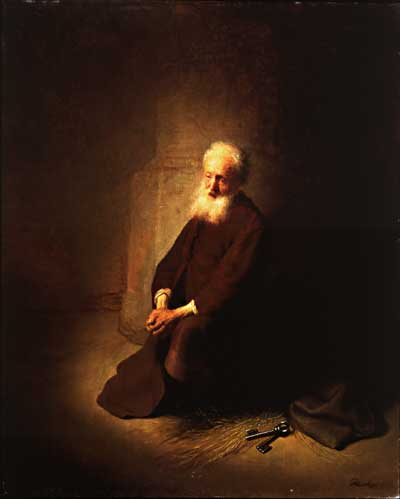
Pastor Foley has pointed out that martyrdom is repetition of the story of Christ’s suffering and death. But in the case of these French Christians, we not only see faithful Christians re-enacting the suffering and death of Christ, but also re-enacting the forgiveness and restoration of Peter as seen in John 21.  These Christians, who were nearing the point of death themselves, were still training failed Christians for martyrdom and assuring them of Christ’s forgiveness that was still available to them in their time of need.

Posted in persecution | Tagged , , , | 1 Comment