We Are Always In Greater Danger Of Becoming Lukewarm Than Of Being Martyred

Logo 071414One of the most common questions I receive from Christians in prosperous countries is, “How can we prepare for increasing persecution?” I actually hear this question more and more each year, perhaps due to reports which assert that persecution of Christians is increasing dramatically around the world.

(By the way, I am not persuaded of the rigor of the methodology and analysis of most of these reports; that, however, is a post for a different day. In the meantime, if you are interested in an alternative viewpoint done according to more traditional and rigorous standards of research, let me recommend the newly released Pew Research Report on Restrictions on Religion. It contends that “the share of countries with high or very high levels of social hostilities involving religion dropped from 33% in 2012 to 27% in 2013.” It also suggests that we vastly underrate the severity of restrictions being faced by Christians in countries like Russia, which is generally, and in my view regrettably and inaccurately, ranked very low on most other persecution lists.)

My reply to those who want to prepare for increasing future persecution in prosperous countries is to recognize that Christians living in prosperous countries are always in greater danger of becoming lukewarm than of being martyred. Thus, greater than the need to prepare for a future of persecution is for Christians in prosperous countries to repent from a present of lukewarm practice.

In this perspective I am saying nothing original. It is in fact Jesus himself who makes this point, in Revelation 3:15-19 (ESV), to the church in Laodicea. If we read carefully, past Jesus’ critique, we see that Jesus also offers the remedy:

I know your works; you are neither cold nor hot. Would that you were either cold or hot! So, because you are lukewarm, and neither hot nor cold, I will spit you out of my mouth. For you say, I am rich, I have prospered, and I need nothing, not realizing that you are wretched, pitiable, poor, blind, and naked. I counsel you to buy from me gold refined by the fire, so that you may be rich, and white garments so that you may clothe yourself and the shame of your nakedness may not be seen, and salve to anoint your eyes, so that you may see. Those I love, I reprove and discipline, so be zealous and repent.

Among Christians in prosperous countries, I do note the same attitude Jesus describes when I speak about persecuted believers in North Korea and other countries. Christians in prosperous countries assume that their role is to help their less fortunate brothers and sisters. Can we pray? Send money? Certainly there is something more we can do?

Jesus offers us another idea: Repent.

That is, we are called to repent of the attitude that we are rich, prosperous, and need nothing. We are so rich, we believe, that we have a surplus that we feel called to share with wretched, pitiable, poor, blind, and naked persecuted believers around the world. But, says Jesus, you are actually the wretched, pitiable, poor, blind, and naked ones.

Jesus’ solution? Buy from him gold refined in the fire. He is not explicit as to his meaning, but certainly back of his image here (as well as his next image of white robes) is to learn a faith and wisdom born of suffering. For me and for many, that wisdom has come from learning from persecuted brothers and sisters.

Merv Knight, historian of the Voice of the Martyrs movement and of its founder, the Rev. Richard Wurmbrand, noted Rev. Wurmbrand’s concern that the fall of the Soviet Union prompted so many Westerners to rush in in an effort to teach Russian Christians. “Why do you rush in to teach them?” Rev. Wurmbrand asked. “Why don’t you rush in to sit at their feet and learn from them?”

Thus, it turns out that preparing for persecution is one and the same thing as repenting of lukewarm practice. In both cases, our persecuted brothers and sisters are our teachers, not merely the recipients of our largesse.

Posted in martyr, North Korea, persecution | Tagged , , , , , , | 3 Comments

Recent North Korean Defector Christian – “I Don’t Know What A Prayer Request Is!”

KYH LonginglyEvery Saturday, a small group of new North Korean Christians meet together in our Underground Technology (UT) classes.  All of them attend an evangelical church–it’s a requirement for admission to UT–but most of the churches in Korea struggle to know how to disciple defectors. As a result, it’s frequently the case that defectors go to church without understanding even the basics of the Christian life. Over the past few years, we’ve found the UT program to be essential in their spiritual development and their basic survival in South Korea.  The below story, shared by my wife (Melissia Dillmuth) illustrates this well . . .

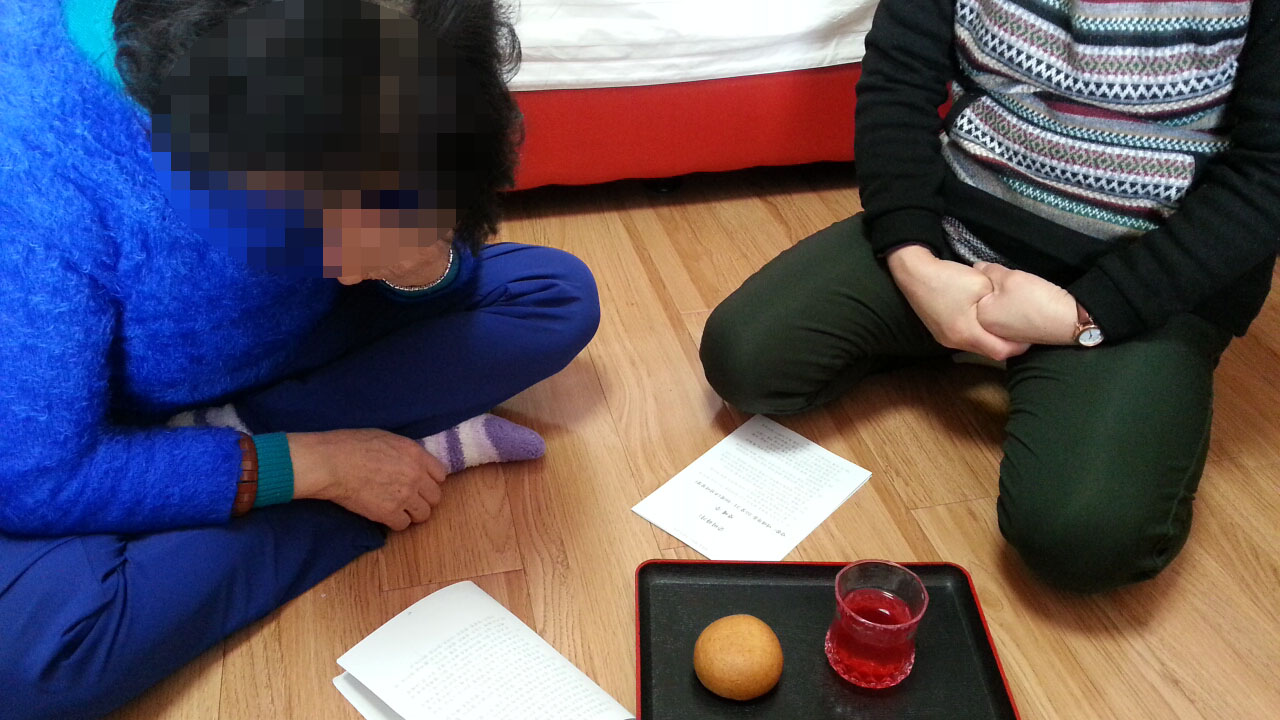
“I don’t know what a prayer request is…”replied KYH, a new UT student, when we asked him if he had any prayer requests to share with us. We were sitting on the floor in KYH’s small, 100 square foot apartment, munching on dried seaweed and fruit that he had prepared for us. Weekly visitation to students’ homes is an integral part of UT and provides the students with the opportunity to tell us more about their experiences. It also provides us with a one-on-one opportunity to encourage them with the word of God and prayer as many of them share their feelings of guilt, loneliness, fear or depression.

When we asked him about his background in NK, KYH quickly pulled out a map and longingly showed us where he calls “home.” He shared that unlike many others from his seaside village, he was able to provide well for his family as he had a job as a driver for the head of agriculture in his town. Others in his village struggled to survive as they were banned from the abundant supply of nearby fish by a wall that was built to keep them from catching the fish and then selling it to produce an income. He told us about his family and that he only came to SK because he was invited by his daughter who had defected earlier. His one hope is that one day North and South Korea will be unified that he may return to his home.

Our visitation with KYH and other students who have little or no biblical knowledge has confirmed our assurance of the timeliness and importance of UT. Many lost NK souls are wandering in SK, being deceived and pulled in by churches that pay for attendance, cults, schools that do not teach the word of God and money schemes. Unlike any other NK defector school for young Christians in SK, UT provides the students with solid, biblical training in an environment where they must also participate in facilitating their own spiritual growth. They do this through scripture memorization, prayer, homework and Works of Mercy on a weekly basis.

Struggles and spiritual attacks are very real for both UT students and staff alike, which confirm the great battle that is raging to thwart the work that God is doing through UT. After an initial commitment to UT, the cares of this world begin to crowd the work that God has begun to do in the hearts of the students and some are tempted to give up. “I feel lonely,” “I don’t have what it takes to be a missionary,” “I have to get a job because my family wants me to send money to them,” and “my health is not good,” are the reasons we are hearing from those who do not want to follow through with their training. The enemy is seeking to pluck the seed out of the heart into which it has been planted. This also confirms to us the great need for this training school!

Please commit to pray alongside the VOM Korea staff for these new NK believers who are a part of the UT program!

Posted in North Korea, Visiting and Remembering | Tagged , , | 2 Comments

Martyrs, Revelation, and the Stockdale Paradox: A Jesus Primer on Good Hope and Bad Hope

Logo 071414There is good Christian hope and bad Christian hope, alternatively known as real hope and false hope. The world–rightly–accuses Christians of trafficking in much false hope, and this is an unfortunate result of our not reading our own book which provides ample instruction in distinguishing between hopes we ought to have and hopes that will get us and others killed.

False hope: In this world you will not have much trouble.

Real hope: In this world you will have trouble. But take heart! I have overcome the world. (Jesus in John 16:33, NIV.)

We too often tend to regard and receive any sign of hope as a good thing, yet hope is often the deadliest emotion. This insight is at the heart of what is known as the Stockdale Paradox, named for Admiral James Stockdale, an eight-year POW in Vietnam. That Stockdale was a man of great hope there is no doubt:

I never doubted not only that I would get out, but also that I would prevail in the end and turn the experience into the defining event of my life, which, in retrospect, I would not trade.

But here is the paradox: Stockdale observed that a certain kind of hope actually poisoned many of his fellow prisoners:

They were the ones who said, “We’re going to be out by Christmas.” And Christmas would come, and Christmas would go. Then they’d say, “We’re going to be out by Easter.” And Easter would come, and Easter would go. And then Thanksgiving, and then it would be Christmas again. And they died of a broken heart.

The Lord not only gives real hope; equally, he banishes false hope. Consider this interaction between the Lord and the martyrs in Revelation 6:9-11 (NIV):

When he opened the fifth seal, I saw under the altar the souls of those who had been slain because of the word of God and the testimony they had maintained. They called out in a loud voice, “How long, Sovereign Lord, holy and true, until you judge the inhabitants of the earth and avenge our blood?” Then each of them was given a white robe, and they were told to wait a little longer, until the full number of their fellow servants, their brothers and sisters, were killed just as they had been.

Seeking to replace the narrative of Revelation with the numbers of various prophetic schemes is thus exposed as false hope: There is a reason the Lord does not reply to the martyrs with the assurance, “by Christmas” or “by Easter” or “on May 21, 2011.” As with Stockdale, the Lord offers real hope and only real hope: Martyrdom will go on only as long as necessary. It will be the defining event of the church in every generation that awaits his return, and the church will ultimately value it so much that it will not trade it for anything.

It is enough, says the Lord, to know that hope does not disappoint: Death in witness to the gospel will be neither senseless nor endless. But seeking to go beyond this–turning Revelation into a series of cosmic crossword puzzles to be decoded in order to produce Your Definitive Guide To The End Of The World–will only serve to weaken our faith.

Our quest for certainty and exactitude is often our undoing as believers. When the Lord does not return by Christmas, when our suffering does not end by Easter, what is exposed is that we have put our faith in the wrong place; we have hoped with counterfeit hope. If the Lord is ambiguous, he is ambiguous for our own good. Like Stockdale in the POW camp, the Lord knows what it takes to keep us alive and our head in the game here on earth: Certain knowledge of the outcome, combined with indeterminacy of the events that await us between now and then.

How long, O Lord? A little longer, but only as long as necessary.

Posted in martyr | Tagged , , | 1 Comment