
In Hebrews 7:28, the author says, “For the law appoints as high priests men who are weak; but the oath, which came after the law, appointed the Son, who has been made perfect forever.“
Let’s talk for a minute about that word “perfect”.
When we use that word in our everyday lives, we often use it to mean that something is ideal, flawless, faultless, sinless, having no problems. But that is not what the Greek word here means. It means something more like ‘brought to completion’, ‘functioning at full strength’, or ‘achieving the goal/purpose’.
So the author’s point here is not merely that the high priests were sinful but Jesus was sinless, though that is of course true. The author’s point is that neither the high priests (in Hebrews 7:28) nor the law (in Hebrews 7:19) could bring God’s plan/purpose to completion; but Christ has brought God’s plan/purpose to completion.
This is an absolutely essential point for Christians to understand, believe, and live according to: Christ has brought God’s plan/purpose to completion. Christ defeated his enemies on the cross. Christ established the new covenant in his blood. The gospel is the announcement of Christ’s victory. Christ presently holds all power and authority in heaven and on earth.
This is different than what many Christians understand, believe, and live according to. They wrongly see Christ’s death on the cross as “one more step” in God’s plan, which they think remains incomplete. Some wrongly believe that Christ will not triumph until his second coming. They wrongly believe that when Christ came the first time it was simply to pay the price for our sin, and that it is when he comes the second time that he will defeat his enemies and establish his kingdom. So these Christians live in perpetual uncertainty about whether the church is winning or losing at a particular moment. They continue to put their hopes wrongly in various “next steps” that they believe are necessary for God’s plan/purpose to be brought to completion. They believe that the work of the church is necessary to complete God’s plan. They believe that Christians must go out and protest against things and vote for certain things and pray for this and pray for that and give this much and do that much in order for God’s plan and purpose to move forward.
The picture that they have in their mind is the one that you find in the tract that shows us on one cliff and God on another cliff and a big gap between the cliffs that is labeled “sin”. Then the next picture shows a cross filling the gap, which represents Christ’s “perfect” sacrifice. The idea in the tract is that Christ dies for our sins, which then makes it possible for us to have a relationship with God. So now (this wrong thinking goes), God can love us and have a relationship with us, whereas before he could not. And now (this wrong thinking goes), we are one step closer to God’s plan/purpose being achieved, and now the church needs to do its work, and so we are the hands and feet of Jesus now that Jesus is no longer here, and God is going to guide us and give us power and wisdom and strength to complete our part of the work while he also works on completing his part of the work.
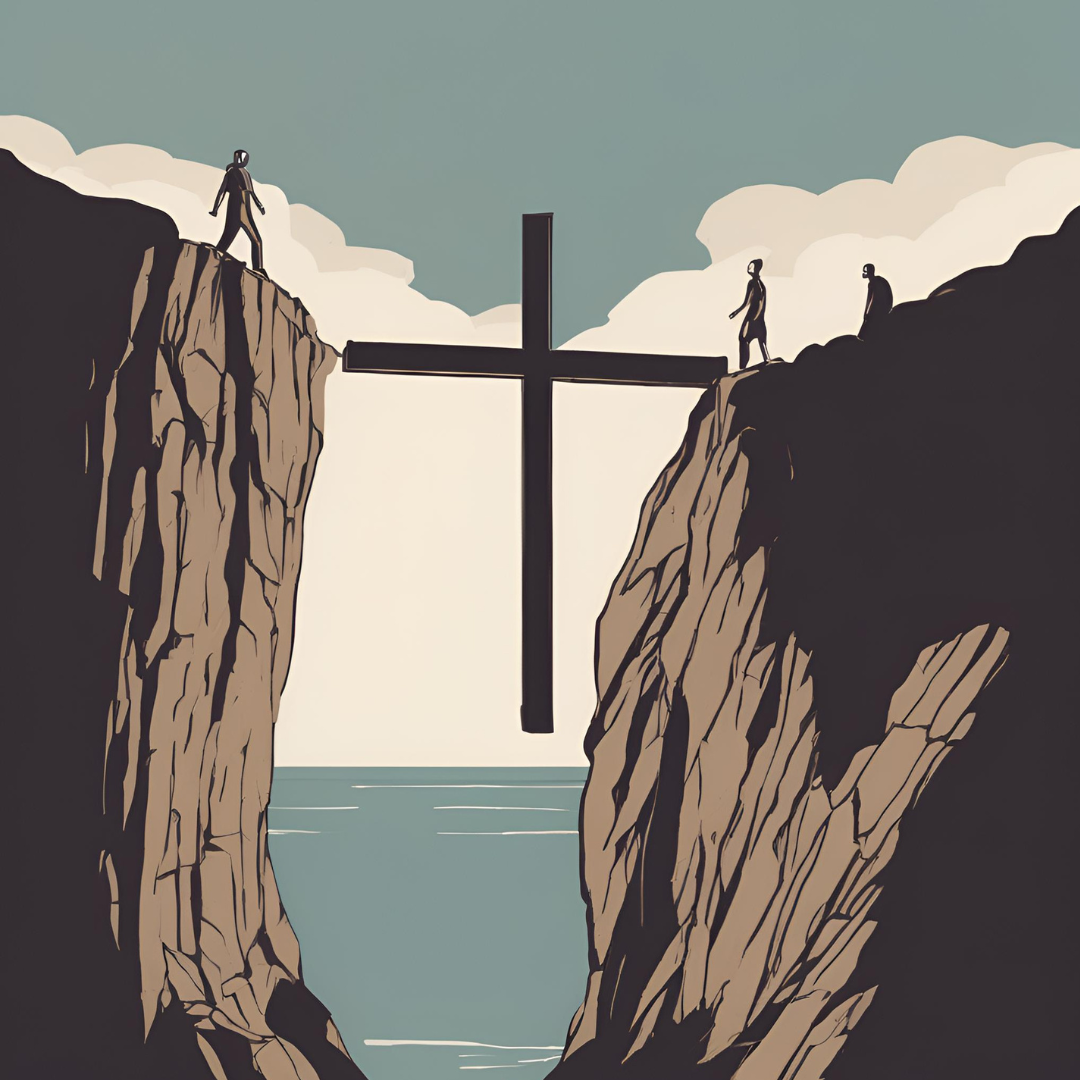
But this is not the gospel. It is not the teaching of scripture. It is based on a wrong understanding of the word “perfect”, and what makes it wrong is that it gives us a very small Jesus. This small Jesus (wrongly) is one more chapter in the story of God, and now we’re in another chapter, and everything in God’s plan depends on us doing our part in this new chapter.
This is neither the God of scripture nor the Christ of God. The Christ of God is perfect not only because he is sinless (which he is), but because only he can bring to completion the plan of God (which he has).
In scripture, bringing God’s plan and purpose to completion is not a team effort. It is a one-man job. And the only man capable of completing the job is the God-man, Jesus Christ.
When Christ ascends to heaven, he doesn’t leave the church to continue his work. Instead, he ascends so that his authority extends over all people and all places for all time. The work he once did only in one location and among one people—Israel—he now carries out everywhere. His church is not given the job of being his hands and feet. Instead, we are given the privilege of being his witnesses, which means that we announce his victory on the cross and his continuing rule as Lord over what Paul in Ephesians 6:12 calls “the rulers, against the authorities, against the powers of this dark world and against the spiritual forces of evil in the heavenly realms”.
The Christian message is that Christ holds all power and authority. It is not that nothing happens in the world unless the church does something (with God supplying the wisdom, strength, and power in response to the church’s request). It is that Christ is always active in the world, at all places and in all times. What the church does is to announce Christ’s activity in the world, not replace it, add to it, or complete it. Our job is to live in this present world according to his victory until he returns, and that victory is revealed to the world.
Until then, the world, because of its disbelief, will continue on its evil path. The world will continue to think there are many Lords who hold much power. But scripture shows us, as we just read in Ephesians 6:12, that no matter what all these supposed “Lords” do with their power, they ultimately can only accomplish Christ’s purpose, no matter what they intend to do. That’s because Christ has brought God’s plan/purpose to completion, which is to say perfection–a fact nothing can change, undo, or delay.







 Do the Word
Much of what this article says is very good. But I have reservations about some things. The author makes it sound as if praying for various needs, for the salvation of people, protection of Christ’s servants etc. is not needed. But there are many places in the NT which do clearly tell us to pray at all times in all various situations. Yes, one hundred percent we are to declare and announce the victory of our ascended Lord, but by his grace He also allows us to be co-laborers with him. 1.Cor. 3:9 Yes, indeed it is HIS Work and what we do is HIM living in us doing it. ( if it is of any value at all)
Thanks for your good thoughts here, Anita. I certainly agree with what you have shared about prayer. It’s the nature of blog posts that it is never quite possible to include all that needs to be said. And rather than to add a quick caveat about prayer which could easily be misunderstood or defeat the purpose of the whole piece, I elected to focus exclusively on Christ’s direct action here because I think that is a teaching that is seriously deficient, if not absent, in the church these days. Even as regards prayer, sadly, much Christian prayer today takes the form of asking God to transfer his unique divine attributes to us so that we can accomplish his work ourselves, rather than asking him to do what only he can do on our behalf. So we (wrongly, in my opinion), “God, give me strength/power/patience/wisdom so I can deal with this situation”, rather than “God, please deal with this situation as you have promised according to your character and nature.” We moderns are uncomfortable with this because it makes us feel passive and dependent. But such feelings are a good correction for us! The other thing I am cautious about is the tendency to always attribute Christ’s work to him doing it through us. In scripture he calls us his witnesses, not his hands and feet. We are to testify that he has gone ahead of us; we are to call attention to his actions and to testify that what is happening is according to his word. This is the church’s primary role, not its secondary one. It is true that all people and things serve Christ, whether they want or intend to or not. But primarily he works directly, according to scripture. And through prayer, we petition him so to work directly in our lives and the lives of others. Scripture says that the same Lord who taught and ministered in Galilee has been raised up so that he now teaches and ministers in this same way to all people and places. He is active in the world, not only in our hearts. His ascension extends the sphere of his direct activity; it does not limit it, nor does it mark a change so that he now primarily works through intermediaries. As scripture says, there is only one mediator between God and man: Christ Jesus.
Thanks for being a part of the conversation!