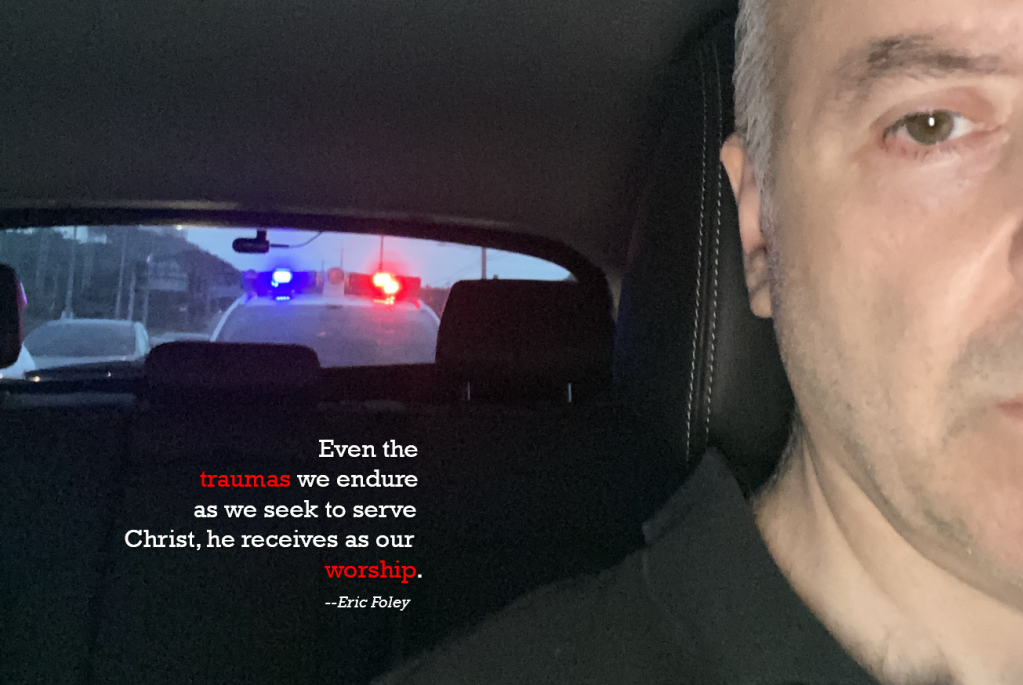
Martyrs: Not bold or noble, but foolish and weak

The way of the cross is the essential context for a biblical understanding of martyrdom. We wrongly associate martyrdom with bold and noble action on the part of the martyr: We think of the martyr as enduring persecution and torture, defending the faith, giving his life for Christ. This sounds praiseworthy and causes us to honor the martyr for his self-sacrifice. We imagine Christ appreciatively acknowledging the martyr as the martyr enters heaven triumphantly, with Christ proclaiming, “Well done, good and faithful servant.”[i]

In scripture, however, the emphasis in martyrdom is not on the martyr’s action but God’s. The martyr is not portrayed as standing up for God or defending the faith, because neither God nor the faith needs to be defended. Instead, the martyr is made a martyr by placing his life in God’s hands. The martyr’s only hope in life and death is that God will act according to God’s promises. This means that the martyr will often appear passive, not active, from the standpoint of the world. The martyr’s actions may even appear cowardly, not noble, according to the world’s standards. With patient endurance, the martyr awaits deliverance at God’s hands, in God’s way, according to God’s promises. Because God’s promises are often hidden under the opposite, the martyr is left to look weak and foolish in the eyes of all observers. As the Apostle Paul wrote, “For it seems to me that God has displayed us apostles at the end of the procession, like prisoners appointed for death. We have become a spectacle to the whole world, to angels as well as to men. We are fools for Christ, but you are wise in Christ. We are weak, but you are strong. You are honored, but we are dishonored.”[ii]

Jesus is the exemplar. On the way to the cross he looks weak and powerless in the eyes of observers, even his followers. He does not look noble. He looks foolish. The gospel writers do not hide this, nor do they emphasize Christ’s heroic endurance. Instead, they emphasize his trust in his Father. The gospel writers show him living out the words of Isaiah 53:7: “He was oppressed and afflicted, yet he did not open his mouth; he was led like a lamb to the slaughter, and as a sheep before its shearers is silent, so he did not open his mouth.” He does not struggle with his persecutors but with his Father. We overhear him in Luke 22:42 saying to his Father, “Father, if you are willing, take this cup from me; yet not my will, but yours be done.” On the cross he addresses his Father, not his followers, when he asks, “Why have you forsaken me?” He understands his followers’ absence but not his Father’s. Yet even his final words are words of trust: “Father, into your hands I commit my spirit.”[iii]

In the same way, the martyr commits his spirit into God’s hands, trusting in God’s promises over the forces that futilely seek to overpower us each moment. Christ does not praise martyrs for boldness or sacrifice on his behalf. He commends our simple trust in him.

Martyrdom is thus not bold action for God but rather simple trust in God and his promises. We do not sacrifice ourselves for Christ. Christ prepares us as a sacrifice. Paul writes in Romans 8:36, “As it is written: ‘For your sake we face death all day long; we are considered as sheep to be slaughtered.’” Paul is not complaining. He does not mean that we are badly outnumbered and outmanned by our enemies. Rather, like sheep, our purpose is to be slaughtered. The slaughter is not a tragedy but the purpose for which sheep are born and raised. Christ, the good shepherd, oversees the process from start to finish. He knows the right time for our sacrifice. He determines when and how, and who participates. No part of it happens without his command, consent, and control.

That is why in Romans 12:1, Paul does not urge us to sacrifice ourselves for Christ but instead to present ourselves for sacrifice. To whom are we presenting ourselves? To Christ, who is the one who prepares us for sacrifice, and who prepares others, even our persecutors, for their role in the process. The Father used many people to participate in the sacrifice of Christ on the cross. In the same way, Christ uses many people to participate in us being sacrificed. But ultimately, just as all things concerning Christ’s death were in the hands of the Father, all things concerning our death are in the hands of Christ. The life that is sacrificed in us is his, not our own. Our own life was put to death for sin on the cross, slain by his word. Now it is his laid-down life that lives in us, and it lives for the purpose of being laid-down again and again. When it is laid down through us, it is not a sacrifice for sin. As the writer of Hebrews tells us, Christ’s sacrifice for sin was “once for all”.[iv] But sacrifice is not only for sin. It is for praise,[v] for doing good and sharing with others,[vi] and for sharing in his holiness.[vii] These sacrifices will never end. They are pleasing to God.[viii]  The Apostle Paul says that when we present ourselves to Christ to be used by him as this kind of living sacrifice, God is well-pleased.[ix]

John 3:16 declares that the Father loves the world and thus gives his Son. The Son does not sacrifice himself for the world. He places himself in the Father’s hands, so that the Father may use him as the Father sees fit. In the same way, the Son loves the world and gives his church. The church does not sacrifice itself, whether for Christ or the world. The church simply places itself in the Son’s hands, for the Son to use as he sees fit. The martyr’s role is not to sacrifice himself but to trust in the promises of God. It is up to God, not us, to determine the meaning and purpose of each moment of our lives. This is why, as John notes, “what we will be has not yet been revealed. We know that when Christ appears, we will be like Him, for we will see Him as He is.”[x]  Our role is to place ourselves in God’s hands by trusting in his promises, no matter the cost.

In 1563, a book was published that went on to become the most popular book on martyrdom in Christian history. John Foxe’s Acts and Monuments of the Christian Church (commonly called “Foxe’s Book of Martyrs”) tells the stories of martyrs from the beginning of Christianity on up to Foxe’s present time. The book is extraordinary for many reasons. Perhaps what is most extraordinary is how ordinary the martyrs are. In previous books of martyrs, martyrs are portrayed as possessing supernatural strength of both body and soul. They taunt their persecutors and laugh as their bodies are burned. But in Foxe’s book, nearly all the martyrs whose stories are told are very ordinary laypeople living very ordinary Christian lives. They are apprehended and interrogated for simple acts of faithfulness, like reading the Bible and praying the Lord’s Prayer in English. As they face interrogation and torture, they at times even show weakness.

Over the past 18 years, we have had 36 members of our Voice of the Martyrs Korea team whose lives have ended in martyrdom. These 36 were not our boldest preachers. They were not known for their self-control or pain tolerance. They were not especially altruistic or self-sacrificing. They were certainly not our most astute theologians. But what they did have in common was a notable awareness of their own weaknesses. They were not simply humble; they were openly suspicious of themselves. Thus, they were quick to turn outside of themselves and to depend on God, even in little things. Having been suspicious of themselves in little things, it was natural for them to be suspicious of themselves in big things and to trust God instead of themselves in those moments also. In other words, they were martyred long before they laid their bodies down the final time.


[i] Cf.  Matthew 25:23.

[ii] 1 Corinthians 4:9-10.

[iii] Luke 23:46.

[iv] Cf. Hebrews 10:10.

[v] Cf. Hebrews 13:15.

[vi] Cf. Hebrews 13:16.

[vii] Cf.  Hebrews 12:10.

[viii] Cf. Hebrews 13:16.

[ix] Cf. Romans 12:2.

[x] 1 John 3:2.

[xi] Woolf, 1995, pp. 249-250.

[xii] Ibid, p. 255.

Posted in martyr | Tagged , , , , , , | 5 Comments

India: Police blame stoning death of 16-year old Christian on pastor-father’s “sorcery”

Police in Odisha State, India this week claimed that the June death by stoning of a 16-year old boy was caused not by his conversion to Christianity but by suspicions that the boy’s father, a pastor, was a sorcerer who allegedly caused the deaths of 16 villagers.

The claim is the latest turn in a case that has drawn the attention of Christians globally. Voice of the Martyrs Korea is one of several international Christian organizations that is raising concern over the police report and the rising level of anti-Christian violence in the area.

Odisha State, formerly known as Orissa, has long been a hotbed of anti-Christian violence. Twelve years ago 100 Christians were killed and 300 churches destroyed as the result of a public campaign to strengthen Hindu nationalism and raise suspicions against Christians. Most of those committing acts of violence were either never arrested by police or they were acquitted by the courts.

Now police are attempting to blame the death of Samaru Madkami on baseless suspicions about his father rather than admitting that anti-Christian violence is on the rise again. It is important for the general public, and especially for Christians around the world, to be aware of this pattern of blame shifting because it can rapidly escalate to the level of violence against Christians that happened in Odisha twelve years ago.

Voice of the Martyrs Korea has been working in partnership with a local Indian Christian NGO to provide financial aid and general support for Samaru’s family and two other related Christian families who were forced to flee from their village due to Samaru’s death. The families are frightened to return home three months after the attack and have been resettled in another location for their safety. Voice of the Martyrs Korea also helps Voice of the Martyrs Canada to support 23 orphans in Odisha State whose parents were victims of the earlier wave of violence against Christians.

Bishop Dr P.R. Parichha, the President of the Odisha State chapter of the All India Christian Council, was the one who had requested a police investigation into the death of Mr Madkami. Dr. Parichha told Christian Solidarity Worldwide, a Christian human rights organization based in the UK, “While the Deputy Inspector General of Police has acknowledged in his response letter that Samaru was brutally murdered, I am disappointed with their opinion that the death of the minor was a result of vengeance for sorcery. The Madkami family do not practice such things. His father is a pastor. Why weren’t the cases of the 16 people who died ever reported to the police or the matter investigated sooner? What proof is there? There are so many gaps in the claim by the accused persons. It is unfounded, biased and misleading. The police should not deviate from the root cause of the murder of Samaru.”

As reported by Voice of the Martyrs Korea in June, Samaru Madkami, a 16-year-old boy from Kendukuda village, Malkangiri district, Odisha, India, was crushed to death with stones by Hindu militants on June 4, 2020 in response to his conversion to Christianity.

Voice of the Martyrs Korea donors provided sufficient funds to care for the family of Samaru through the end of the year, in addition to aiding with the care of 23 Christian orphans in Odisha State. Individuals interested in helping Voice of the Martyrs Korea meet the needs of other families of Christian martyrs and prisoners throughout the world can make a donation to VOMK’s Families of Martyrs/Families of Prisoners (FOM/FOP) fund at www.vomkorea.com/en/donate or via electronic transfer to

국민은행 463501-01-243303

예금주: (사)순교자의소리

Please include the name “FOM/FOP” on the donation.

Posted in India, persecution | Tagged , , , , | Leave a comment

Notes to myself during this ongoing police investigation

This week I am scheduled to appear at the police station for my fourth day of investigation on charges related to our balloon launching work. I have decided not to make any public comment on the investigation while it is underway. But since it has now been one month since I began appearing at the police station for these weekly sessions, I wanted to share with you a little of what the Lord has been teaching me through this time. I hope the following notes may be helpful as you also seek to be a faithful witness to the Lord wherever he sends you this week.

The world and everything in it would cease to exist if God did not give it the gift of life moment by moment. Biblically, each moment of life originates directly from God. He creates each moment ex nihilo (from nothing) and fulfills within each moment his promise to work all things in that moment together for the good of those he loves and calls.

We must first be receivers of God’s good gifts before we can be givers of anything. That is true not only of the good things we give but even the bad things we give, like persecution or disobedience. That is because evil is not a raw material obtainable from some other source. There is one source for all things, God the Father. Everything that he gives is good, and he gives to everyone. Evil is always the wrong use of God’s good gifts.

Even when God’s good gifts are used in ways that seem to threaten or thwart God’s promises, God’s will is always accomplished. In fact, it is the glory of God that he fulfills his promises especially through the actions of the very people and circumstances which seem to endanger his promises the most. This includes our persecutors and enemies, as well as secular authorities. His will is always done because each moment emerges directly from his hands, shaped precisely according to his promises that are guaranteed.

This is why we never need fear any exercise of power against us. Power ultimately does not serve the purpose of the one wielding it. It serves the purpose of its original source and its end. The Lord Jesus is the source and end of all power. Accepting this reality fundamentally changes how we view the authorities and our persecutors and enemies. It removes the fear, anger, despair, defiance, or weakness we might otherwise feel in their presence.

How do we hear God’s word of promise addressing us moment by moment? Can this happen only in the moments we are reading the Bible? Does it come only through direct spiritual revelation in moments of intense prayer?

No. We are to hear his word of promise in each moment as its unfolds into the world. The promises of God are plainly recorded in scripture. But the world is the scroll on which the fulfillment of every promise is “written”. That writing occurs continually, because the promises of God are the structure of reality in which we live and move and have our being. We are to “read” the reality we see as the moment by moment unfolding of the promises written in scripture. We do not receive the future from the hands of persecutors, friends, enemies, scientists, police investigators, or governments. We have only to do with Christ, who gives us the future through the hands of all these people, and a multitude more. But it remains only ever Christ’s future, Christ’s good and personal gift to us, and it unfolds exactly according to his promises.

Biblically, there is no mystery about what will happen in the future. We know what will happen, because it has been made plain to us in the scripture. As to when each of God’s promises will be fulfilled, and how, the scripture does not reveal. These are matters requiring our humility and trust in God. We are given only the plain promises of God, not advance knowledge of the time or the way in which God will fulfill them. We are not called to supplement the plain promises of God with personal supernatural revelation or clever interpretations of scripture in order to fill in details sufficient to persuade ourselves or others to believe. We are called simply to remember that scripture and history show that God hides his promises under the opposite and fulfills them when and how we least expect.

From the moment the world was created, the future has always been defined as “the fulfillment of the promises of God”. The mystery is not what will happen, or how, or when, but who we ourselves will become as God’s promises unfold. As the Talmud puts it, “All is in the hands of heaven except the fear of heaven.” In other words, the future is not the mystery; the future is God’s guaranteed gift. The mystery is how each of us will respond to that gift when it comes to us each moment. The Apostle John says it like this: “Dear friends, now we are children of God, and what we will be has not yet been made known. But we know that when he appears, we shall be like him, for we shall see him as he is.” It is this revealing of the children of God, not the revealing of the future, that has all of creation waiting in eager expectation.

God’s promises do not show up only when we pay attention to them. God’s promises do not apply only to the people who believe in them. All people we encounter at every moment are God’s servants, accomplishing his purpose, bringing his word to pass. All power in heaven and earth has been given to the Lord Jesus, and he uses it to work all things together for the good of those he loves and calls.

Some of the people we encounter are God’s willing servants. Others are his unwilling or unwitting servants. They insist to us that our future is in their hands, not God’s. With Pilate, these unwitting, unwilling servants of God say to us, “Don’t you realize I have power either to free you or to crucify you?” But with Jesus, we are to respond, “You would have no power over me if it were not given to you from above.” We have to do only with the Master, who is shaping us and all of creation moment by moment through the unfolding of his promises according to his providence.

Posted in martyr | Tagged , , , , , , | Leave a comment