Transformational Giving seeks transformation, not attention

Attention for our companies–that’s what David Meerman Scott recently wrote that we all are seeking.

Not so, we replied this week, noting yesterday that Transformational Giving is focused on the champion, not the company (or, in our case, the nonprofit).

Today we focus on the first word in David Meerman Scott’s wish list–Attention–and we contend that what Transformational Giving seeks is something entirely different.

Rather than seeking attention for the company, Transformational Giving seeks transformation for the champion.

Transformational Giving principle #8 (see here for the whole TG Ten list) says, ‘Giving is not the process but rather the result of the process of the champion being comprehensively coached to advance the cause effectively within his or her sphere of influence.’

In traditional marketing/fund raising/sales/public relations, the goal is to generate attention that leads to sales. In Transformational Giving, the goal is individual transformation.

That is,  the champion of the cause (who is a reflection of the organization, not its representative, by the way) facilitates transformation  in those within his or her sphere of influence who witness the change.

Is it really so far-fetched?

World Vision has already been measuring it.

The Bible commends it as how change happens.

And history demonstrates it’s how Christianity spread in the first place.

Jim Daly, President and CEO of Focus on the Family, offered a vivid reminder of this at the commencement ceremony for Colorado Christian University this past weekend. (My wife was receiving her Master’s degree in Counseling at the ceremony, so I was grateful to get good blog fodder at the same time that I was taking in a seminal moment in the life of our family. Go, Mrs. Foley!)

Daly noted that the early church spread so quickly because during plagues, the early church moved in (to feed last meals to dying patients) just as everyone else was moving out. And as men and women in the ancient world tossed their female and handicapped babies in the river, church members fished them out and raised them as their own.

It might be possible to contend that, in so doing, Christians were doing what David Meerman Scott classifies as ‘earning attention’, and that that attention was indeed attention ‘for the company’, the church.

Much more natural, however, would be Paul’s explanation from 2 Corinthians 3:2, in which he himself turned the traditional notion of marketing on its ear:

You yourselves are our letter, written on our hearts, known and read by everybody.

Transformational Giving doesn’t equip representatives and supporters with brochures. It equips them to be brochures–living brochures–that transform even in the watching.

Attention, in other words, is the poor man’s substitute for transformation.
Posted in Uncategorized | Leave a comment

Attention must be paid…to the champion, not the organization

We’re commenting throughout this week on David Meerman Scott’s claim that the ultimate goal we all seek is ‘attention for our company’. In yesterday’s post, I raised the questions: Is attention for our company the goal of Transformational Giving? Is TG simply another way to achieve the standard marketing goal?

You’ve already undoubtedly guessed that I intend to answer in the negative, but what may surprise you is that the ‘no’ is multifaceted, comprehensive, and emphatic.

Today, let me begin with the second part of David Meerman Scott’s formulation of the phrase ‘attention for our company’ and demonstrate why Transformational Giving is not focused ‘for our company’ at all.

One of the key themes I’m teaching in the day-long TG seminars this month is that fundraising is an inadequate way to describe the biblical framework for giving because it introduces a Kingdom ‘nonentity’–the nonprofit organization–and seeks to make it the locus of God’s activity.

Saying that the nonprofit is a Kingdom nonentity does not mean that nonprofits are unimportant or unnecessary. Far from it!

It does mean, however, that–in the biblical framework–institutions grow God’s people and then ultimately become unnecessary, because God’s people reach their full stature in Christ. (Contrast this with the traditional development framework in which God’s people grow institutions; and then God’s people become unnecessary, except for as human ATM machines who support the work of the nonprofit.)

This explains why John the Baptist says he must become less, so that Christ can become more…and why Jesus offers this scathing offhand in Luke 21:5-6 about the most central institution in his own time, the Jewish temple, which he knew was about to give way to an eternal, living temple:

Some of his disciples were remarking about how the temple was adorned with beautiful stones and with gifts dedicated to God. But Jesus said, ‘As for what you see here, the time will come when not one stone will be left on another; every one of them will be thrown down.’

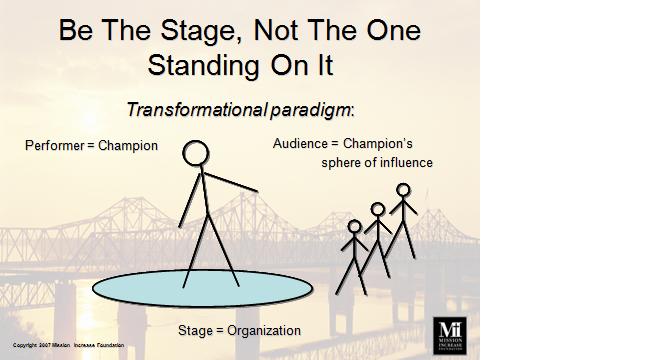
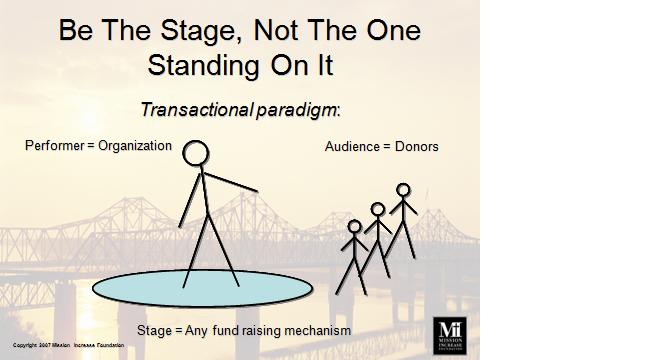
The contrast between traditional development’s focus ‘for our organization’ and Transformational Giving’s focus ‘for the champion’ can best be seen in these two slides drawn from the seminar, which contrast the roles of performer, audience, and stage in each framework.

In the traditional framework, the nonprofit is on the stage, attempting to achieve David Meerman Scott’s dream of achieving attention for itself:

The nonprofit calls attention to itself

The nonprofit calls attention to itself

In the Transformational Giving framework, however, notice the shift:

And the focus of attention is...

And the focus of attention is...

In Transformational Giving, the nonprofit is the convening mechanism, the stage, the platform for the champion’s activity and growth…

…but not the focus of the attention.

More tomorrow.

Posted in Uncategorized | 3 Comments

Your attention, please?

David Meerman Scott hit up with a fascinating post on his blog on Friday in which he contended that what we all really want is attention paid to our companies. He suggests that attention comes in four flavors:

  1. Buying attention, which he calls advertising
  2. Begging for attention, which he calls public relations
  3. Bugging people one at a time for attention, which he calls sales
  4. Earning attention, which he says is still acquiring a name but which he sees as the great good.

No doubt that Meerman Scott is right that the above four dimensions comprehend the history of marketing, advertising, public relations, sales, and all such disciplines.

But do they comprehend Transformational Giving?

In other words, is Transformational Giving simply another way to gain attention?

And if so, how would we square that with:

  • Luke 14:11, where Jesus says, ‘For everyone who exalts himself will be humbled, and he who humbles himself will be exalted’?
  • Matthew 6:3, where Jesus says, ‘But when you give to the needy, do not let your left hand know what your right hand is doing’?
  • Luke 5:14 and its dozens of cognate passages, where Jesus instructs his followers, ‘Tell no one’?
  • John 3:30, where John the Baptist says of himself in relation to Jesus, ‘He must become greater; I must become less’?

This week in the blog, as we travel to do seminars in Arizona and Colorado, we focus on the question of the goal and purpose of Transformational Giving and ask, from a scriptural standpoint related to Christian nonprofit organizations:

Is it attention we’re after?

Or is it something else?

And if so, what?

This is a great time for you to ‘post up’ with a comment to this blog and share your thoughts.

Should be a stimulating week!

Posted in Uncategorized | 3 Comments