Your attention, please?

David Meerman Scott hit up with a fascinating post on his blog on Friday in which he contended that what we all really want is attention paid to our companies. He suggests that attention comes in four flavors:

  1. Buying attention, which he calls advertising
  2. Begging for attention, which he calls public relations
  3. Bugging people one at a time for attention, which he calls sales
  4. Earning attention, which he says is still acquiring a name but which he sees as the great good.

No doubt that Meerman Scott is right that the above four dimensions comprehend the history of marketing, advertising, public relations, sales, and all such disciplines.

But do they comprehend Transformational Giving?

In other words, is Transformational Giving simply another way to gain attention?

And if so, how would we square that with:

  • Luke 14:11, where Jesus says, ‘For everyone who exalts himself will be humbled, and he who humbles himself will be exalted’?
  • Matthew 6:3, where Jesus says, ‘But when you give to the needy, do not let your left hand know what your right hand is doing’?
  • Luke 5:14 and its dozens of cognate passages, where Jesus instructs his followers, ‘Tell no one’?
  • John 3:30, where John the Baptist says of himself in relation to Jesus, ‘He must become greater; I must become less’?

This week in the blog, as we travel to do seminars in Arizona and Colorado, we focus on the question of the goal and purpose of Transformational Giving and ask, from a scriptural standpoint related to Christian nonprofit organizations:

Is it attention we’re after?

Or is it something else?

And if so, what?

This is a great time for you to ‘post up’ with a comment to this blog and share your thoughts.

Should be a stimulating week!

Posted in Uncategorized | 3 Comments

Champions come in P, E, and O flavors

Good times today as the Transformational Giving seminar express rolled through Portland. (Still time to sign up for next week’s day-long whistle stops in Phoenix and Colorado Springs, as well as the dates in SFO and LAX the week following.)

In Portland today I was finally able to work in a clarification I’ve been wanting to make since we did the Major Donor workshops in March, namely:

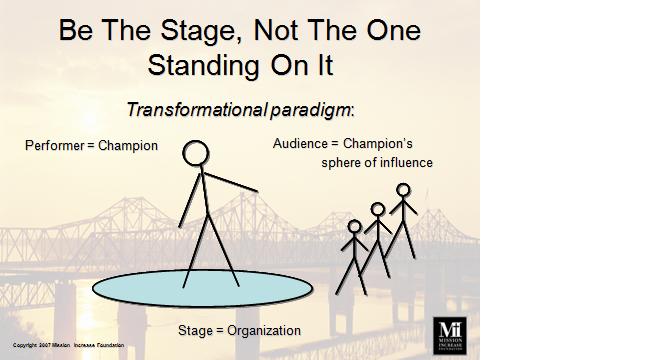
The word ‘Champion’ does not only refer to Owners. It refers to anyone on the P/E/O grid, including Participants and Engaged folks as well.

‘Owner’, in other words, is not synonymous with ‘Champion’. ‘Champion’ is a much broader term that designates the nature , character, and intent of the relationship we have with an individual.

The term that contrasts with ‘Champion’…is ‘Donor’.

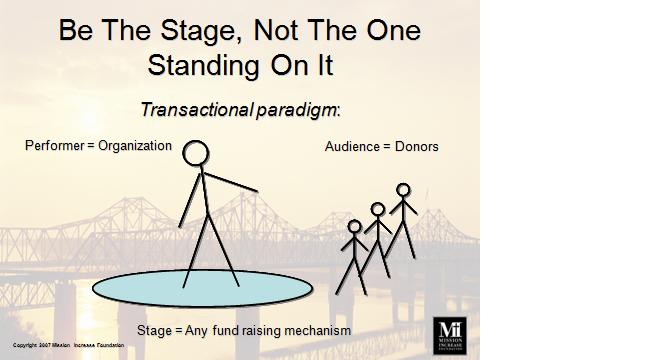
When we call someone a ‘Donor’, we are living in a transactional fundraising universe in which the donation transaction is the central focus and the defining characteristic of the individual in relation to the nonprofit.

When we call someone a ‘Champion’, we are maintaining fidelity to the scripture’s revelation of reality, wherein the central thing goin’ on around us is God’s work in actively shaping His people in the image of His Son.

Our role in that process?

Coaching the Champion in relation to the Kingdom cause for which God is holding us both accountable in our spheres of influence.

When we orient ourselves to God’s people and purpose in this way, we recognize three distinct levels of Champion maturity. In each case, the cause is being championed, but in a very different way:

  • Participants are Champions who advance the cause through project-based involvement.
  • Engaged people are Champions who advance the cause through  ongoing, covenantal lifestyle changes and commitments.
  • Owners are champions who advance the cause by seeing it as their responsibility to spread the cause and equip new Champions within their sphere of influence.

In each level of maturity the Champion may be extremely committed and passionate. What varies from P to E to O is not the degree of commitment or passion but rather the kind of championing the individual is doing in relation to the cause.

We talk about this at much greater length in the Coach Your Champions book and in the seminar; however, the piece I’ve never  clarified well is that the term ‘Champion’ applies at all levels of the P/E/O process, not just when the dial says ‘O’.

Thanks, Portland, for bringing that out!

Posted in Uncategorized | 6 Comments

Signature Participation Projects are like kimchi

I had a great time with the gang in attendance at the transformational Giving seminar in Washington Wednesday. Always I alternate back and forth between believing we present too much in a single seminar and wishing that the whole thing were actually four days long with time for breakout sessions, Q & A, and labs where we could coach ministries on how to develop maps with champions (the area I sense is alawys the greatest challenge for ministries and the area where they’are most tempted to cut corners because it’s the most different from traditional fundraising.)

The piece that was the most fun to share today came when we were taking about developing a Signature Participation Project, or SPP.

As we’ve talked about previously in this blog, a Signature Participation Project is a short-term, high-touch, high-yield project that is understandable without reference to the ministry itself but which draws the participant into wanting to grow deeper into the cause, ideally to engagement through the ministry.

All good SPP’s are synecdochic–that is, by participating inthe project, an individual gets to ‘taste’ something of the ministry’s cause as a whole. The root word is synecdoche, which means using the part of something to refer to the whole (like ‘all hands on deck’) or the whole of something to refer to a part (like ‘I got stopped by the police’, by which I don’t mean that 357 Colorado State Troopers pulled me over but rather that a single police officer tagged me for going 105).

(OK. Not really. I think that was one of the Baldwin brothers. But you get the point.)

It’s often a tough concept to grasp, but it’s extremely important. It’s part of why we recommend to ministries not to do golf scrambles or auctions or jog-a-thons: they’re not synecdochic. When you participate in a golf scramble, nothing about golfing gives you a taste of the cause as a whole. Even giving away a brochure about your organization at the golf scramble, or having your Executive Director give a speech at the golf scramble, or having one of your clients give a testimony at the golf scramble, doesn’t make the experience synecdochic (unless, perhaps, you run a golf ministry).

You can imagine that the concept, which is challenging to explain in English, is even harder to explain through a translator in Korea. That’s why I was so delighted to receive one of the best explanations I’ve ever received of the concept from a Korean attendee at the seminar.

The quintessential Korean food, much maligned by Westerners, is kimchi–typically pickled cabbage with red pepper paste, though there are hundreds of varieties.

Koreans have a practice where, upon entering a restaurant, they sample the kimchi, which is always served first as part of the array of side dishes that precede the main course in a Korean meal. If the kimchi is good, then it is a certainty that the main course will be good. But if the kimchi is bad, the meal is guaranteed to be worse.

A ministry’s SPP is like kimchi. If a champion samples it and it’s delicious, the champion should then know that the main course of engagement with the cause through the ministry will be even more satisfying.

If your kimchi tastes like every other restaurants’ kimchi, why eat there?

Likewise, some ministries make the mistake of creating SPPs that are not only understandable without deeper reference to the cause but are completely satisfying without deeper reference to the cause.

Big mistake.

That’s like making kimchi the main course. And, as much as I like kimchi, I would never eat it as the heart of any meal.

Child sponsorship organizations struggle with this (folks liking child sponsorship so much that they never move on to deeper engagement with the cause.) Operation Christmas Child’s shoebox project has to address this. Rescue missions doing big Thanksgiving dinners hit this full on. Rather than whet people’s appetites for deeper engagement, they sate those appetites–and champions remain at a much lower level of maturity than God intends.

So as you prepare your SPP, keep kimchi in mind. It makes a great side dish–and your overall cooking will be judged by it–but it makes a pretty miserable main course.

Thanks for a great day, Seattle.

Posted in Uncategorized | 7 Comments