“Sell your possessions and give to the poor”

If you google “Did Jesus command Christians to sell their possessions and give to the poor?”, you will find many pastors preaching about how Jesus only gave this specific command to the rich, young ruler and not to Christians in general and that Christians in general should give 10% of their income to the church.

But if you look at Luke 12:22-33, we can see that Jesus told his disciples to sell their possessions and give to the poor. Pastors who preach on this scripture say that this was a specific command to the twelve apostles and not to everyone and that Christians in general should give 10% of their income to the church.

But if you look at Acts 2:45, we can see that over three thousand of the early disciples sold their property and possessions to give to the poor. Pastors who preach on this scripture say that this was a practice of the early church, but not for all Christians and that Christians in general should give 10% of their income to the church.

But we cannot pick and choose which scriptures do and do not apply to today based on if we are comfortable with them or not. For example, we would never say that Jesus’ command “do not worry about your life, what you will eat; or about your body, what you will wear” only applied to the twelve apostles. Of course it applies to today—and it is in the same sermon where Jesus called on his disciples to sell their possessions!

Later on, in Luke 18, when Jesus addresses the rich young ruler, he simply gives the same command to the rich young ruler that he gave to his disciples in Luke 12. And when the disciples were shocked at Jesus’ command to the rich young ruler, Jesus didn’t afterwards tell his apostles, “Don’t worry. This was not a command for all disciples, but just for the rich young ruler”.

These days, many Christians are concerned about the sexual revolution. Christians readily agree with Paul’s command in 1 Corinthians 6:15 that we should not unite the members of Christ with a prostitute. But they are confident that we should unite the members of Christ with money, despite Jesus’ statement that “you cannot serve both God and money” (Matthew 6:24). Instead, they quote 1 Timothy 6:10, saying that money is not evil, but the love of money is the root of evil. They claim that money is a good thing that is necessary for ministry, and that people can do more ministry with more money.

But, in the same passage, Paul tells Timothy, “As for the rich in this present age, charge them not to be haughty, nor to set their hopes on the uncertainty of riches, but on God, who richly provides us with everything to enjoy.” The wealth of this age is not an ingredient for building the kingdom of God. This means that rich people can let go of what they have in order to receive the wealth of the age to come, which God has freely given in the kingdom of his Son.

Jesus said, “Again I tell you, it is easier for a camel to go through the eye of a needle than for someone who is rich to enter the kingdom of God.” (Matthew 19:24). Many pastors try to explain this away by saying that there used to be a gate to Jerusalem called “the Eye of the Needle” that was very small so that camels who wanted to pass through had to get on their knees. So, if rich people want to get into heaven, all they have to do is be humble like kneeling camels.

But this sermon illustration is completely untrue. We know from archaeology and history that there was no such gate. But we know even more surely that Jesus was not referring to a certain gate or the humility of rich people by the next few verses.

“When the disciples heard this, they were greatly astonished and asked, “Who then can be saved?” Jesus looked at them and said, “With man this is impossible, but with God all things are possible.” (Matthew 19:25-26)

The main issue is that the kingdom of God is not built from the wealth of the present age. It is a gift from God. All that we have to do is to receive it, proclaim it to God’s enemies, and share and enjoy it with all who receive the mercy of God in Christ.

That is why Jesus is never focused on the percentage of money which you are giving to the church. Jesus said, “For where your treasure is, there your heart will be also.” (Luke 12:34). So, if you are giving 10% to the church and 90% to yourself, it means that 10% of your heart is with the church and 90% is with yourself. Even if you give 51% to the church, your heart is still divided.

And note that Jesus never directs his disciples to give “to the church”. He always directs them to give “to the poor”. Paul gives the reason in 1 Timothy 6:17: God “richly provides us with everything to enjoy”, from the riches of the age to come which has already begun in the reign of Christ. In this “present age” money is necessary to accomplish things. But all that is necessary in the Kingdom of God is God.

Therefore, accumulating money in the present age to use it for whatever you want to use it for makes no sense. As Paul said in Colossians 3:2-3 “Set your minds on things above, not on earthly things. For you died, and your life is now hidden with Christ in God” (Colossians 3:2-3).

When Jesus says “Sell your possessions and give to the poor. Provide purses for yourselves that will not wear out, a treasure in heaven that will never fail, where no thief comes near and no moth destroys”, he is not saying “Sell your possessions and make a lot of money to use for ministry.” Instead, he is saying, “You do not need money to do ministry. Get rid of your money so you can do ministry.”

Jesus said, “Do not be afraid, little flock, for your Father has been pleased to give you the kingdom.” God has already given us the Kingdom. We cannot increase the Kingdom with our money. We can only receive it, proclaim it, live according to it, and pass it along to share and enjoy with others.

That is why rich churches and rich people have no advantage over poor churches and poor people when it comes to doing ministry in the Kingdom of God. Rich churches cannot do more ministry than poor churches. Rich people cannot do more ministry than poor people. They may be able to do more things. But doing more things and doing more ministry are completely different matters. In fact, thinking that you are doing more for God with your money is arrogant (1 Timothy 6:17)

What does Jesus mean by “storing up treasure in heaven”? Does it mean that whatever you donate in this present age turns into treasure that you can redeem when you go to heaven? No, because you are not going to heaven when you die. Our life is in Christ, and we live wherever he is and, right now, he is in heaven (Colossians 3:1-4).

Then what is “treasure in heaven”? Treasure in heaven comes from living according to the Kingdom while you are still here in this present age. This is why Jesus tells us not to worry about what we eat or wear in the present age; God provides these things to his servants. He just does it in totally different ways than the ways that people generally acquire things in this present age.

People who live according to this present age’s resources (including many churches and Christians), they cannot understand this. As a result of this, they do not trust God. What they trust is that money is necessary to do ministry. But people from the Kingdom age know that God always provides for his work in ways that we cannot imagine or understand. And we can always trust the Lord.

When we live today according to the wealth of the coming Kingdom, which God provides in his way, in His time, for His purpose, we are actually storing up treasure for ourselves in the Kingdom to come. It is a reward for our trust in Him in this age. It is not a spiritual wire transfer of money from this age to the age to come. The currencies are completely different.

That is what Jesus is sharing in Luke 12. Jesus is not focused on money. He is not focused on how much you should give or wear. He is focused on this Kingdom, which he says the Father has been pleased to give to us. He is telling us not to be afraid. Even though he is sending us out into the world with no wealth from this present age and we may be persecuted, imprisoned, or killed, we do not need to worry because God always provides for his servants from the wealth of the age to come.

The way that God provides for us looks different from the way money provides for us.

And note here that we are talking about God providing for his servants. When someone appealed to Jesus to arbitrate between he and his brother, Jesus replied, “Man, who appointed me a judge or an arbiter between you?” (Luke 12:13-14). Jesus has no interest in the wealth of the present age. He calls you away from your plans, goals, money, birth families, etc. When we are baptized into Christ’s death, our branch is cut off from this world’s tree. And Christ’s plan and purpose become our plan and purpose. His way of life becomes our way of life. In fact, His life becomes our life.

Jesus did not bless Peter, Andrew, James, and John’s fishing business. He called them away from it. He did not call Matthew to become a more honest tax collector. He called Matthew away from his tax collecting. In the same way, Christ calls us away from our purposes and goals in order to become his servants and carry out his purposes and goals.

What is Jesus’ purpose? Jesus’ purpose is to bring His Father’s offer of mercy to his enemies at the end of the age before Jesus comes back to judge the world. So, he sends us to his enemies with his terms and offer for them to surrender.

This is basic about the Christian life, but most Christians miss this. Jesus is not making a promise that, if you believe in Him, he will fix all your problems in the present age for a 10% tithe-commission.

You died to this present age when you were baptized into Christ’s death. He called you out of this age without taking you out of this world. You are living at the dawn of the Kingdom of God while you are still here. The deal is not “Give me 10% and I will bless your life.” The deal is “Sell all you have and come, follow me. I provide everything my servants need for the work I call them to do.”

Notice, Jesus does not say, “Sell all you have and become poor”. He says, “Sell all you have and come follow me.” This doesn’t mean decreasing the amount of your possessions. Because we have died, nothing we have belongs to us anymore. It doesn’t make sense for us to accumulate more possessions or more money for ourselves. So we do what Jesus says in Luke 6:30:

“Give to everyone who asks you, and if anyone takes what belongs to you, do not demand it back.” (Luke 6:30).

We give without demanding back because everything we have is a gift from God.

Jesus’ command to sell our possessions is a call to a one-time decision that changes our relationship to the wealth of this age.

Christians fulfill this command in a variety of ways. Zacchaeus gave back to other what he had stolen to them. The disciples just walked away from everything he had. Pastor Trevor sold everything he owned at a McDonalds parking lot over a matter of days. Dr. Foley and I sold everything we had and put the money in this ministry.

That doesn’t mean that you wander around in caves like a homeless beggar. In fact, the Apostle Paul had a rule in his churches:

“For even when we were with you, we gave you this rule: ‘The one who is unwilling to work shall not eat.’” (2 Thessalonians 3:10).

Neither did Jesus live like a monk or a beggar.

It means that instead of settling down, you go where he sends you. You accept what he gives you without holding onto it tightly. You use it joyfully. But you do not own it. You let all things, including money, pass through your hands as philanthropy for others.

The Kingdom of God is not given to us as a possession. It is given to us to enjoy and share and pass on to others.

There is an old Jewish saying that, “In heaven, no one has any elbows.” It means that nobody can feed themselves there. Instead, you feed others and others feed you. But we experience that life now because, as Paul says, “We have already died.” We don’t need our elbows anymore because we are serving each other. And God always provides more than enough for us to serve each other with. And he teaches his servants to be content with whatever he provides whenever he provides it.

Even at times when he does not seem to be providing much of anything to us, we are still content because we know that whatever he provides is whatever we need to do what he asks us to do as his servants.

“I have learned the secret of being content in any and every situation, whether well fed or hungry, whether living in plenty or in want. I can do all this through him who gives me strength.” (Philippians 4:12-13).

These are profound truths, and I would hope that you think on them deeply and act on them. But I have a feeling that the main question you will have in your mind at this point is, “So are you saying that we should not tithe to our church?”

My response is two questions?

  1. “Why are you only giving away 10% of your money? What are you keeping the rest for? Do you really think it belongs to you?”
  2. “Why are you only giving to your church?”

In the Old Testament, where the “tithe” comes from, the Israelites gave 10% of their crops to support the temple and the ministers. But Christians are in the New Covenant, not the Old, and all of us are ministers of the New Covenant. Just like Christ, we don’t only give 10% and we don’t only receive 10%. We give away all we have. Not only our money, but our purposes and plans we used to have for our lives. We give those all away. And then we follow Christ. And we serve him as he directs us according to his plans and purposes using his resources and not our own. He provides us more than tithes. He has already entrusted the Kingdom to us. The whole thing! That is why he says, “Don’t be afraid”.

Of course, give to your church, give to Christian ministries. But don’t do it because God needs the money. The Kingdom of God is never short on money. Give because holding onto the wealth of this present age keeps us from receiving the Kingdom which God has given to us freely through His Son.

God graciously accepts what you give, and he recycles it for His purpose. But he is not willing to receive only a 10% commission from you. He wants you to leave behind the wealth of this age and how it works in order to receive the true wealth that belongs only to the age to come. He has given it to us now, because the new creation has dawned in the reign of Christ. In the Lord’s hands, there is no difference between 5 loaves and 5,000 loaves.

Remember also that everything we have said today about rich people applies to rich churches also. The only difference is that the amount of accountability which Christ will demand from rich Christians is higher than what he will demand from poor Christians. Remember in the book of Revelation that the Lord called a rich church to sell all it had in the present age and to buy from him what can’t be bought with any amount of money in the present age.

There are things that only poor churches can buy. And being rich should never be a qualification to become an elder in Christ’s church.

Our own experience at Voice of the Martyrs Korea is that among our donors, it is the Christians and churches who are not rich in this age who are the most generous, and the Christians and churches who are rich in this age who are the least generous. There are a few exceptions (just like there were some generous rich folks in Jesus’ ministry), but sadly not many. The kingdom just does not make sense to the rich.

But let’s leave aside these matters for today.

Because now we have an appointment at the Lord’s Table. Here it is God’s good pleasure to continually give us the kingdom. It looks like only bread and juice in this present age, but through it he provides us our daily bread from the age to come, and the promise that he will provide what we need to do the work he gives us to do, until that day when he returns, bringing with him the age to come in all its fullness.

Posted in Bible, Bible Study | Tagged , , , , , , , , , , , , | Leave a comment

“You have died…”

In Colossians 3, Paul brings together everything that he has taught in Colossians 1 and 2 and gives us the great “If-then” transition to everyday application.

“If then you have been raised with Christ, seek the things that are above, where Christ is, seated at the right hand of God. Set your minds on things that are above, not on things that are on earth. For you have died, and your life is hidden with Christ in God. When Christ who is your life appears, then you also will appear with him in glory.” (Colossians 3:1-4)

These days, people like to preach the gospel as follows:

  1. Christ died for my sins
  2. So I am forgiven by God
  3. Now God will give me a joyful, peaceful life
  4. And I will go to heaven when I die.

But this is not a good summary of the gospel at all. In fact, it is distorted for many reasons. This distorted gospel makes it sounds like a change happened to Christ, but no change happened to us except for our status with God.

But in Colossians 3 we see that we “have died” and “have been raised with Christ”. Christ’s death for our sins becomes effective for us when we die by entering Christ’s death through baptism. The gospel is not only about a change that happened to Jesus but about a change that happens to us.

Many Christians think that Paul is speaking metaphorically when he says that we died and were raised, as if Paul were saying, “The Christian life is like moving from death to life”. But Paul is not speaking metaphorically here. He is saying that we actually enter into Christ’s death through our baptism.
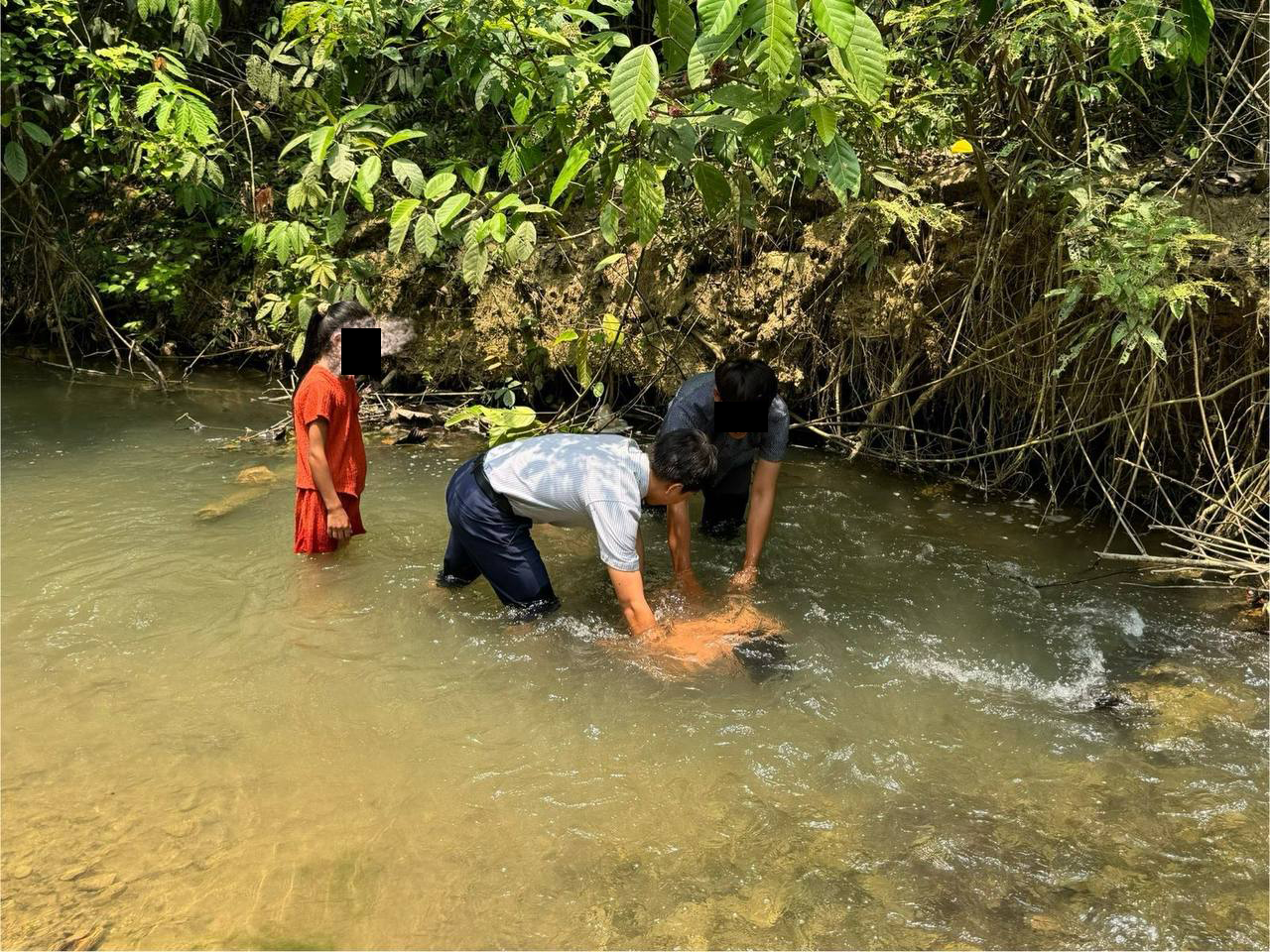
A VOM Korea partner baptizes a new Christian in Laos.

When Christ was crucified and died, this present creation lost all connection to him. It lost any power or control over him that it may have had. It can do nothing to him. It is completely impotent in relation to him.

“He disarmed the rulers and authorities and put them to open shame, by triumphing over them in him.” (Colossians 2:15)

This means that nothing in this creation has any power related to Christ at all. He is presently already Lord over everything in this present creation. He has triumphed over it. He is in complete control of everything that happens in this creation. It is easy for him to do anything he wants. He does it with a single word, without a struggle.

When Christians today hear this, they think “Yes, this is why I believe he will give me a joyful, peaceful life now. Then I will go to heaven when I die.”

But remember, Paul said in Colossians 3:3, “You have died”.

There are only two statuses available to humans with regard to their relationship with Christ and the world. Either they are alive to the world and dead to Christ or dead to the world and alive to Christ. There is no being alive to the world and alive to Christ.

That is why a Christian cannot talk about having a joyful, peaceful life now and going to heaven when they die. They are already dead.

You may be thinking, “But I am still here. I am still alive in this world. How can I be dead to it?”

“For you have died, and your life is hidden with Christ in God. When Christ who is your life appears, then you also will appear with him in glory.” (Colossians 3:3-4)

When you were baptized, you died. You officially forfeited your life which you knew you would lose anyway when the wrath of God comes upon the world.

Thus, this present creation has also lost all connection to you. It lost any power or connection to you that it had. It can do nothing to you. It cannot even give any benefit to you. It is completely impotent in relation to you.

When you were baptized, you didn’t receive a promise that your sins are forgiven, you will live a good life, and then you will die. Instead, you died. And you became alive to Christ. His life is the only life that exists outside of the present creation. He gives this life to you.

This is not a metaphor. You no longer have an existence separate from Christ. Your existence ended in the waters of baptism. You have literally been made a part of His life. Your current life is presently hidden with Christ in God. This is the only life you have.

But you will of course say, “But I am still here…”

I think a picture will help us understand this. An old-time theologian, L.S. Thornton, provides a good picture. Thornton said that, when we hear something like, “Your life is hidden with Christ in God”, we usually think of our life like a pebble that will be put into a box, Christ. That is why we get confused. Our pebble still seems to be here, on the earth, and not yet in the box.

Thornton said that a pebble in a box is not the right picture. Instead, we are a branch on a tree. Through baptism we have been cut off from the world’s tree and grafted onto Christ’s.

When we heard the word “body” we tend to think of a “body” as everything from our skin inward. But “body” is an outward, connection word. Biblically, “body” is what connects us to that which is outside of us.

One way to think about this is to think of yourself as covered with sticky stuff. Because you are covered with sticky stuff, you are always stuck to something. It is not possible for you to exist unstuck, just floating around independently. Whatever you are stuck to is what you are drawing your life from. That is how the Bible talks.

For example, when Isaiah prophesies the death of Christ in Isaiah 58, he says this: “he was cut off out of the land of the living” (Isaiah 53:8).

If someone is “cut off” from the land of the living, what do they stick to? They stick to their ancestors in the land of the dead.

That is why the Bible describes Abraham’s death like this:

“Abraham breathed his last and died in a good old age, an old man and full of years, and was gathered to his people.” (Genesis 25:8)

In scripture the body and the soul are always stuck together. In various forms of paganism, they are separated at death. The separation of body and soul is not a Christian or biblical way of thinking. It is certainly not a Hebrew way of thinking.

The Hebrew way of thinking sees your body and soul as distinguishable but not separable. They are like parts of a branch. The body is like the wood and the soul is like the leaves.

The Bible always asks the question “What tree are you attached to?”. Are you attached to this world, or to Christ?

“But our citizenship is in heaven, and from it we await a Savior, the Lord Jesus Christ,” (Philippians 3:20)

“When Christ who is your life appears, then you also will appear with him in glory.” (Colossians 3:4)

Paul did not say “we are waiting until we go to our savior in heaven”, or “when you die, you will appear with him in glory”. Paul speaks of Christ coming here again to bring the wrath of God on the old creation and bring the new heavens and new earth with him.

What does it mean to “appear with him in glory”? It means that your body will be changed into a glorious body like Christ’s resurrected body. That is the only Christian hope.

I am going to tell you something absolutely true from a biblical perspective: nothing actually changes when you die on this earth. The death-transition happens at our baptism. At our baptism, the branch of our life is cut off from the tree of this present creation and grafted into Christ. It isn’t that we “go to Christ” when we die. We are already with him. Our life is in him.

When the physical bodies finally stop working, what happens is that all of our five senses stop receiving input and our brain stops. But our life in Christ remains unchanged from what it was in this lifetime. That life in Christ cannot be touched, altered, or ended by this creation or anything that happens in this creation. It continues just as it has in this lifetime.

In our present day-to-day lives, we are so focused on this creation that, most of the time, we live with very little awareness of being in Christ. But, one day, when our physical body dies, everything else will fall away and only our life in Christ will remain.

“Yes, we are of good courage, and we would rather be away from the body and at home with the Lord.” (2 Corinthians 5:8)

Yet it is important to remember that our location does not change when our body dies, but when we are baptized.

“If then you have been raised with Christ, seek the things that are above, where Christ is, seated at the right hand of God. Set your minds on things that are above, not on things that are on earth.” (Colossians 3:1-2)

Paul is not recommending that we go to a prayer mountain, lock ourselves in a prayer closet, or fast for long periods of time. The goal is not to reduce our sensory inputs in order to see heavenly visions.

“If with Christ you died to the elemental spirits of the world, why, as if you were still alive in the world, do you submit to regulations— “Do not handle, Do not taste, Do not touch” (referring to things that all perish as they are used)—according to human precepts and teachings? These have indeed an appearance of wisdom in promoting self-made religion and asceticism and severity to the body, but they are of no value in stopping the indulgence of the flesh.” (Colossians 2:20-23)

You cannot come to a greater awareness of Christ by “turning down the volume” on the world. It doesn’t work to try to change what you eat, look at, or do. That sounds like the right answer, but it never works. We all know this from our own experience of trying to overcome sin that way.

Since we are branches, the solution is not to somehow be less connected to the world. The solution is to come to understand that our branch has already been cut off from the world and has already been grafted onto Christ. Because Christ is a good tree, he is already providing us with the nourishment we need every day.

“Put on then, as God’s chosen ones, holy and beloved, compassionate hearts, kindness, humility, meekness, and patience, bearing with one another and, if one has a complaint against another, forgiving each other; as the Lord has forgiven you, so you also must forgive. And above all these put on love, which binds everything together in perfect harmony.” (Colossians 3:12-14)

Paul is not saying, “Be more holy, be more compassionate, be more kind, be more humble…” This would be impossible for us to produce from the nutrients that the world provides us. Instead, these are gifts that Christ gives us. These gifts come from him and originate in him. He is the tree that produces these things and we are the branch whom he supplies these things to. This is why Paul says to “put on” these things and clothe ourselves with them. We don’t have to produce these things, we just receive them.

Unfortunately, the world continues to reject that Jesus is Lord. So, when you are baptized, it doesn’t change anything about the way the world deals with you. The world doesn’t think you are dead. Your family does not think you are dead. Your country does not think you are dead. If you say, “I am dead,” your family will think you are crazy and irresponsible. The world and everything in it will continue to insist that your branch is still attached to the tree of the world. Your country, society, family, and other worldly bodies will continue to try to provide you with worldly “nutrition” which the world has provided to you and everyone in the world so far.

“Put to death therefore what is earthly in you: sexual immorality, impurity, passion, evil desire, and covetousness, which is idolatry. On account of these the wrath of God is coming. In these you too once walked, when you were living in them. But now you must put them all away: anger, wrath, malice, slander, and obscene talk from your mouth. Do not lie to one another, seeing that you have put off the old self with its practices” (Colossians 3:5-9)

Paul is not saying, “turn the volume down on the world”. He has already explained that that strategy does not work. Paul is saying, “Let the dead dog die. Even though the world does not accept it, your life is already cut off from the world and grafted onto Christ. Therefore, the nutrients that the world was sending you cannot force their way into you anymore. You belong to Christ, no matter what the world says. Christ, not the world, is your life.”

The first Christian martyrs, when they were arrested and interrogated, were asked, “What is your name?” They answered, simply, “I am a Christian”. This is our full identity. The world, your family, and the country will disagree with that. But it is still true.

The world has already put a lot of worldly nutrients into you. Since you are baptized, it can no longer force any new ones in, but what do you do with the ones that area already inside of you? Let those things die. Now that your branch has been cut off from the world and attached to Christ, those things that are inside you will be surrounded by the nutrients which Christ sends and will be destroyed just like white blood cells destroy viruses.

To us, those worldly viruses feel really powerful. In fact, they seem undefeatable. The white blood cells that come to us from Christ (compassion, kindness, humility, patience), seem so weak by comparison. But that is just the world’s illusion trying to mislead you.

Remember, Christ defeated the world and everything in it through the cross. The cross looks like weakness, but it has made all the powers of this world impotent.

A good picture to keep in mind in this regard is the story of Jesus asleep in the boat during the storm. The disciples were terrified, but Christ was not. So, when they woke him up, he called the storm with a few words. Which is more powerful, the storm or a few words of Christ?

“and have put on the new self, which is being renewed in knowledge after the image of its creator. Here there is not Greek and Jew, circumcised and uncircumcised, barbarian, Scythian, slave, free; but Christ is all, and in all.” (Colossians 3:10-11)

The way to overcome the world is to recognize that the powers of the world have no power over us. When we try to turn their volume down, we are treating them like they still have power over us, which they do not. Instead, we are being renewed in knowledge after the image of its creator. Christ is that image.

The more we listen to him and the more he reveals himself to us in his word, this is what renews us in his image. This is what gradually makes our branch more like the tree.

Even though our branch is already cut off from the world, Christ does not take us out of the world. This is because it is his world; he has already defeated all of the enemies in it. We do not need to be afraid of them. He is just giving these enemies a time of mercy in which they can surrender to him and receive his grace, just like you received his grace. The Lord will surely come back soon and transform this world—and us!

So when the world tries to give you the nutrients for sin, don’t receive them into yourself as nutrients! Instead, bring everything to the Lord. Worship him. First, always receive the nutrients he wants to give you. Then next, ask him to show you how to use for his glory whatever it is the world was trying to give you. He’ll show you how to do that.

That’s why worship services conclude not with you speaking with a counselor about your problems and the “storms” in your life but by us all coming to the Lord’s Table. We come to focus on Christ, our life. We come to hear his words. We come to let him reveal himself to us. We come to receive these nutrients, from his tree to our branch. Everything else will fall away.

In the end, there will only be us with Christ.

Posted in Bible | Tagged , , , , , , , , , | Leave a comment

Faith, hope, and love–What do they really mean?

“Faith”, “hope”, and “love” are important biblical words which we tend to understand only vaguely. We define them according to modern definitions, not biblical definitions. We think of “faith”, “hope”, and “love” as feelings or psychological states:

We think of “faith” as “believing in something you don’t see”.

We think of “hope” as a kind of optimism that things will turn out well.

We think of “love” as an emotional attachment to another person or thing.

But in scripture, “faith”, “hope”, and “love” are objective realities. They are real things that do not change based on what we are experiencing or feeling.

Many pastors preach “You need to have more faith, hope, and love!” So, Christians feel bad about not having enough “faith”, “hope”, and “love”. As a result, they work harder to exert their wills to do better in these areas.

But “faith”, “hope”, and “love” are gifts from God that do not change. They are part of the “easy yoke” of the Lord, which he gives to us.

“Come to me, all who labor and are heavy laden, and I will give you rest. Take my yoke upon you, and learn from me, for I am gentle and lowly in heart, and you will find rest for your souls. For my yoke is easy, and my burden is light.” (Matthew 11:28-30)

Throughout scripture and Christian history, “faith”, “hope”, and “love” are the basic Christian virtues, the main gifts from the Lord upon which the Christian witness is founded.

 In Luke 18:8, Jesus asks, “When the Son of Man comes, will he find faith on earth?” He does not ask, “When the Son of Man comes, will he find Christian values on earth?” Jesus is concerned with whether we are stewarding the gifts of “faith”, “hope”, and “love” he has given us.

“Now, brothers and sisters, I want to remind you of the gospel I preached to you, which you received and on which you have taken your stand. By this gospel you are saved, if you hold firmly to the word I preached to you. Otherwise, you have believed in vain.” (1 Corinthians 15:1-2)

What is true of the gospel is true of “faith”, “hope”, and “love”. They are things that the Lord has given to us, which we steward carefully.

“We always thank God, the Father of our Lord Jesus Christ, when we pray for you, since we heard of your faith in Christ Jesus and of the love that you have for all the saints, because of the hope laid up for you in heaven. Of this you have heard before in the word of the truth, the gospel,” (Colossians 1:3-5)

We should note here that receiving “faith”, “hope”, and “love” is connected with hearing the gospel. And, interestingly, here hope and love do not come from faith, but faith and love come from hope.

Paul says that hope is “laid up for you in heaven”. But Paul is not talking about rewards we get when we die. Paul tells us in Titus 2:13 what he means by hope:

 “…while we wait for the blessed hope—the appearing of the glory of our great God and Savior, Jesus Christ,” (Titus 2:13)

There is only one “hope” that the New Testament talks about: the return of the Lord Jesus Christ. To say that this “hope” is stored up in heaven is to say that Jesus is currently enthroned and reigning in heaven but will come again soon to judge the living and the dead. It is the same as what Paul says in Colossians 3:1-4:

“If then you have been raised with Christ, seek the things that are above, where Christ is, seated at the right hand of God. Set your minds on things that are above, not on things that are on earth. For you have died, and your life is hidden with Christ in God. When Christ who is your life appears, then you also will appear with him in glory.” (Colossians 3:1-4)

Scripturally, our hope is not that we will go to heaven when we die. Our hope is always in Christ’s soon return. Even if we die before he returns, he will take us to himself and bring him with when he comes again to bring the new heavens and new earth.

If “hope” is hope in Christ’s return, and “faith” and “love” come from hope, we cannot have faith or love if we omit Christ’s return from our proclamation of the gospel.

This is why, in the Gospels, Jesus’ main activity on earth was not telling people that God loves them, that he would die for their sins, or that heaven is a great place to live after dying. Jesus main activity was to preach about the day of the Lord, the judgment, hell, the eternal destruction of God’s enemies, the bodily resurrection of the righteous, and the new heavens and new earth. 

Jesus comes with a final offer of mercy before that judgment and seals that offer of mercy in His own blood. He gives the disciples the gift of Himself and the promise of His return in the Lord’s Supper and tells them to watch for Him.

Hope in Jesus’ return is the anchor of the Christian life. It is what holds everything else in place. When other people do wrong to us, we don’t take revenge on them. Instead, we anchor ourselves in the blessed hope, knowing that at Christ’s return every wrong that was done against us will be made right.

When we are ill, we pray for healing. But we never lose hope even when we are not healed because we know that, on the day of the return of the Lord, that…

“in a flash, in the twinkling of an eye, at the last trumpet. For the trumpet will sound, the dead will be raised imperishable, and we will be changed. For the perishable must clothe itself with the imperishable, and the mortal with immortality.” (1 Corinthians 15:52-53).

If this is hope, then what is faith?

Hebrews 11:1 tells us.

“Now faith is confidence in what we hope for and assurance about what we do not see.” (Hebrews 11:1)

Faith is the substance of hope. Most of the things that we will receive when hope is realized are things that we do not have now. But some things we do receive now. Scripture calls these a “deposit” or “guarantee”. They are gifts of faith–the substance of hope.

When we are baptized in Christ in faith, we receive the forgiveness of sins, the Holy Spirit, the direct teaching of Christ, relationship with the Father, and much more…even though such things are still “unseen” to us. 

“And you also were included in Christ when you heard the message of truth, the gospel of your salvation. When you believed, you were marked in him with a seal, the promised Holy Spirit, who is a deposit guaranteeing our inheritance until the redemption of those who are God’s possession—to the praise of his glory.” (Ephesians 1:13-14)

“Faith” is a deposit on our future “hope”. This is why “hope” comes before “faith” and why “faith” grows from “hope”. “Faith” is the part of “hope” that we get to receive and hold tightly to in this lifetime.

Paul says that “love” is also rooted in “hope”. “Love” is our using the gifts we receive in “faith” to the benefit of other members of Christ’s body.

In the story of Simon Magus in Acts 8, a magician named Simon tried to give money to the apostles so that he could have the gift of giving other people the Holy Spirit through the laying on of hands. He was trying to use the gift of faith for his own benefit. This is not “love”. “Love” is when we use the gifts of “faith” for other believers.

 Now we understand “faith”, “hope”, and “love”, and why “faith” and “love” spring forth from “hope”.

The Lord’s Supper is the gift of faith that we receive in this present age as a deposit—a guarantee—of our invitation to the wedding supper of the Lamb that will happen at Christ’s return, which is our “blessed hope”.

In 1 Corinthians 11:20-21, Paul rebukes the Corinthian church, saying: “When you come together, it is not the Lord’s Supper you eat, for as you eat, each of you goes ahead without waiting for anybody else. One remains hungry, another gets drunk.”

When we eat the Lord’s Supper focused only on our own needs and benefits, we are like Simon the magician: we do not have love. So as you partake of the Lord’s Supper, pray for the person who is in front of you in the line. Pray that as they receive the Lord’s Supper, that the Lord anchors them into the blessed hope of his return. Pray that they receive the fullness of the gifts of faith available to us believers in this lifetime, including the blessings of this bread and cup.

That is the prayer that comes from true Christian love.

Posted in Bible, Uncategorized | Tagged , , , , , , , , | 1 Comment