Traces of North Korean Underground Church Detectable in Defectors’ Recollections

North Korean defector Ms. KMS (name withheld for security reasons) recalls her first exposure to Christianity, which occurred while she was still living in North Korea. “In 2002 I was arrested and brought to North Korean police,” she says. “Many people were interrogated at the same time. A young woman next to me was closing her eyes, folding her hands, and praying to God. The police yelled, ‘You dog, you are praying!’ They beat her and sent her to a prison camp. I knew she was praying because my mom had told me that people eventually pray to God when they are in trouble.”

Experiences like Ms. KMS’ are shared by approximately one third of North Korean defectors enrolled in Voice of the Martyrs Korea’s discipleship training schools, yet many defectors do not initially realize they encountered underground Christians. When defectors are asked questions like, “Do you think there is an underground church in North Korea?”, they typically answer, “No.” But when they are asked whether they recall seeing anyone in North Korea pray, sing a hymn, share a Bible story, use the Christian name for God, or even possess a Bible or other Christian artifact, many will answer, “Yes.” Then they begin to realize they encountered traces of the North Korean underground church, even within their own family.

North Korean defectors often do not realize they were exposed to underground Christians inside of North Korea because they have been conditioned to think of “church” according to the South Korean model. The two most frequent associations for the word “church” among South Korean Christians are church buildings and pastors. North Korea certainly has neither of these. So, many South Korean Christians and North Korean defectors conclude, “Therefore, there must be no church in North Korea.”

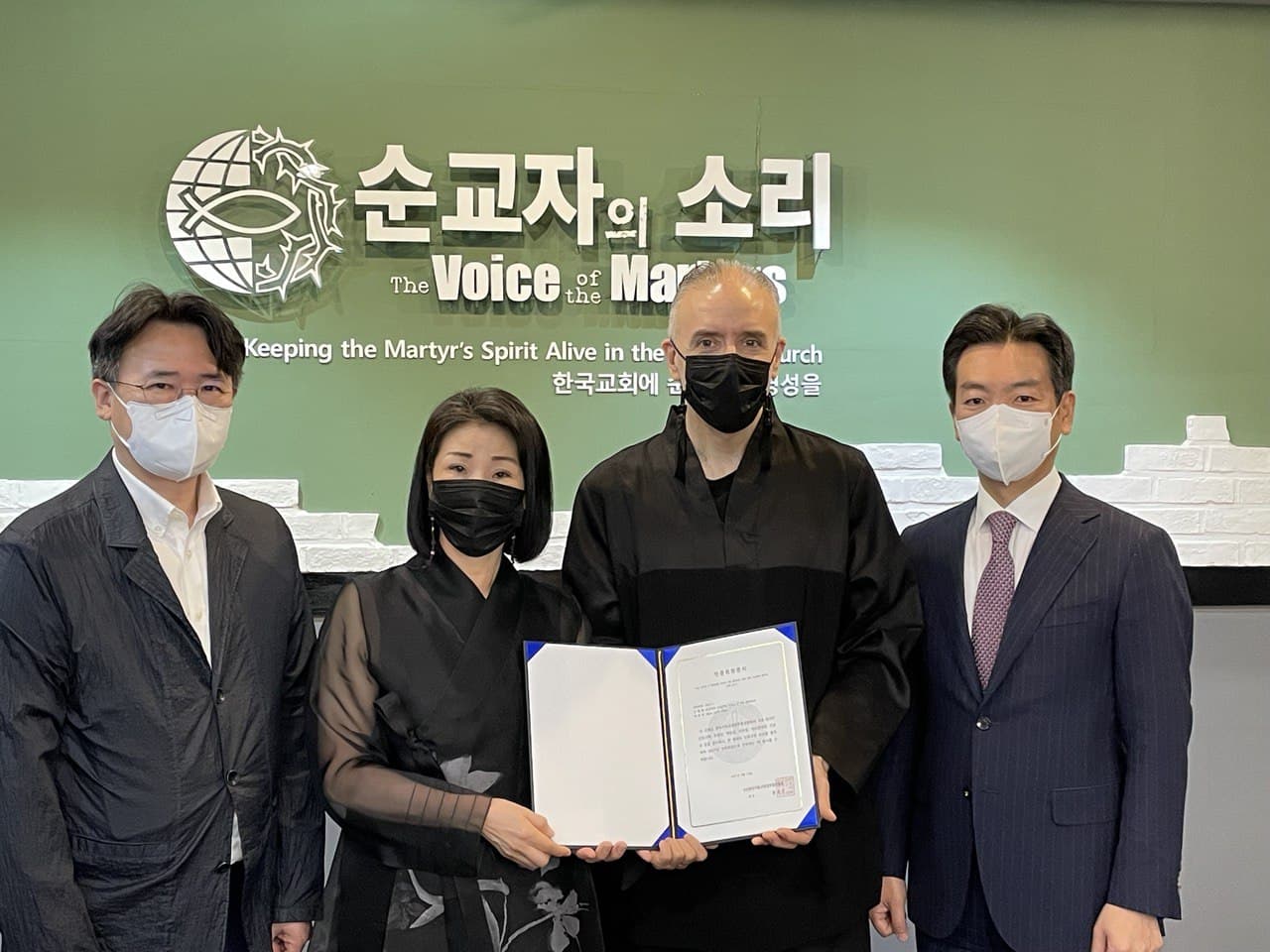
North Korean defector Mrs. SYA, a June 2021 graduate of Voice of the Martyrs Korea’s Underground Technology training program (center), surrounded by Voice of the Martyrs Korea founders Pastor Eric Foley and the Dr. Hyun Sook Foley. Mrs. SYA first encountered Christianity in North Korea when her neighbors were allegedly taken away for their faith. 

Other studies are also confirming what Voice of the Martyrs Korea hears from its students: A growing number of North Koreans are being exposed to Christianity while still inside of North Korea. The North Korean Human Rights Database, an independent data-gathering NGO, has been conducting an ongoing study where they found that in the year 2000, effectively 0% of people inside North Korea had ever seen a Bible with their own eyes. They have continued to update that study, and at the end of 2020 they determined that around 8% of people inside of North Korea have now seen a Bible with their own eyes. In a different study released in June, the Center for the Study of Global Christianity (CSGC) at Gordon-Conwell Theological Seminary estimated that more than 6% of North Koreans inside North Korea have had personal contact with a Christian.

But it is the detailed interviews with North Korean defectors that reveal the most important information about the source and characteristics of the Christian faith inside North Korea. Most of the North Korean Christians our defector students met inside of North Korea didn’t become Christian as a result of South Korean missionaries or through the North Korean government’s purported “state churches”. They became Christian because of other North Koreans.

Consider the example of Mrs. YEJ (name withheld), a North Korean defector enrolled in a Voice of the Martyrs Korea training program, whose mother was an underground Christian. “My mother believed in God, and, as she was dying when I was thirteen, gave me a silver or iron cross,” says Mrs. YEJ. “Because I was so young at the time, I didn’t even know what it was. My mother told me to bury it in the ground because I would die if someone found it, so I wrapped it in paper and buried it under a persimmon tree at night.” Mrs. YEJ says that she never heard anything more about the cross or about Jesus. “I only remember that I often saw my mother murmuring in front of water or food in the room. Sometimes I saw her make the sign of the cross. But, at the time, I didn’t understand what my mother was doing, so I figured she must just be upset.”

A June 2021 graduate of Voice of the Martyrs Korea’s Underground Technology discipleship training program for North Korean defectors, Mrs. SYA (name withheld), says she witnessed some of her neighbors being taken away by security guards when she was still living inside North Korea. She was told by other neighbors that it was because they were members of the underground church. Mrs. SYA said she did not know much about God when she saw the underground Christians being taken. But what she did know is that she would be in trouble if she ever believed in God.

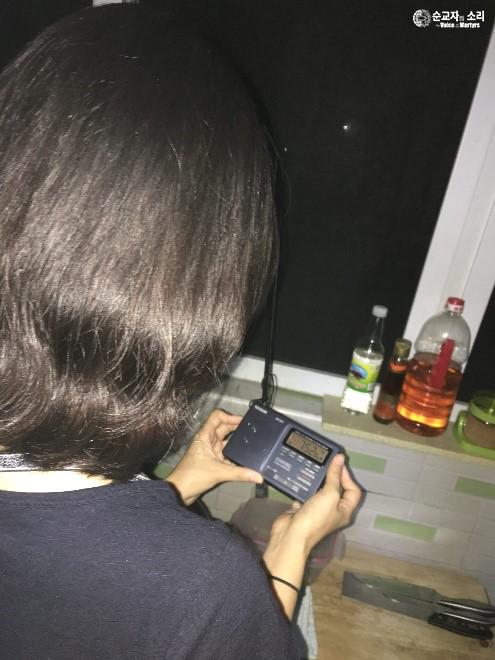
Mrs. SYA’s eldest son defected from North Korea to China when he was young. At the time, she told her son to never to believe in God. Later, Mrs. SYA also defected from North Korea and lived in China. Her son would call her every Saturday and tell her to believe in God and go to church. He also sent her praise music tapes. Whenever she listened to the tapes, her heart felt at peace. Sometimes, she would stay up all night and listen to the tapes over and over. After this, she began to attend church.

I had the opportunity to write These are the Generations, a book on North Korean underground Christianity, together with a third generation North Korean underground Christian husband and wife who have since defected to South Korea. Through the book, we can see how different the North Korean and South Korean models of church are. In the North, there are no church buildings and no pastors, yet the underground church there continues to endure and even grow and thrive, perhaps at a higher rate of growth than the South Korean church, which has been in numeric decline since the 1990s.

These are the Generations by Pastor Eric Foley.

Recording, studying, and publishing these traces of the North Korean underground church experienced by North Korean defectors should be the basis for North Korean mission, now and in the future. South Korean Churches and mission groups are raising funds and preparing to plant South Korean-style churches inside North Korea if and when North Korea opens, and they are increasingly drawing North Korean defector pastors into that way of thinking. That is unfortunate because it overlooks the reality that God has already planted a unique and beautiful church in North Korea, one that has endured the harshest conditions in history and continued to grow.

Pastor Richard Wurmbrand, the founder of Voice of the Martyrs, said that when the Soviet Union collapsed, he was grieved to see so many pastors rush into Russia from the outside in order to plant Western-style churches. He said that instead, these pastors should have rushed in to sit at the feet of the Russian pastors who had survived communism and the Soviet gulags in order to learn how to plant a church capable of surviving under any conditions. We should have the same thinking about North Korea.

Voice of the Martyrs Korea joins international human rights groups and government analysts in estimating a current population of around 100,000 Christians inside of North Korea. While some of these converted due to South Korean missionaries and radio broadcasts and Bible balloon launches from South Korea, what we can see from the testimonies of the North Korean defectors enrolled in our Voice of the Martyrs Korea training programs is that most of the Christians they met in North Korea did not learn Christianity from pastors or in church buildings. They learned it underground. We have a lot to learn from following the traces of these underground North Korean Christians.

More information about Voice of the Martyrs Korea’s North Korea ministry and its training programs for North Korean defectors is available at https://vomkorea.com/project/northkorea/.


Posted in North Korea, North Korean defector | Tagged , , , , , | 4 Comments

What Aleksandr Solzhenitsyn can teach Yeonmi Park (and us) about freedom

North Korean defector and Columbia University student Yeonmi Park drew considerable media attention for her comments earlier this month equating academic freedom at America’s Ivy League schools to North Korea. “”I expected that I was paying this fortune, all this time and energy, to learn how to think,” she said. “But they are forcing you to think the way they want you to think. I realized, wow, this is insane. I thought America was different but I saw so many similarities to what I saw in North Korea that I started worrying.” Conservative commentators Sean Hannity and Mike Huckabee urged Park to go on a bus tour of U.S. colleges to share her warning.

Ms. Park customarily speaks in hyperbole in her public comments and usually attracts interest from media outlets where those kind of dramatic comments capture headlines. Yet beyond the hyperbole, Ms. Park’s comments recall those of another dissident from a communist country who spoke at another Ivy League school 43 years ago this month:

The American Intelligentsia lost its nerve and as a consequence thereof danger has come much closer to the United States. But there is no awareness of this…. 

How has this unfavorable relation of forces come about? How did the West decline from its triumphal march to its present sickness?

But this dissident, Aleksandr Solzhenitsyn, did not go on in that same speech to contend for a bus tour urging college students to fight “cancel culture” and reclaim the freedoms that once made the country great. In fact, Solzhenitsyn went on in that speech to anger his hearers by claiming that if one looked back to the root, to the very fountainhead, of Western liberty one would find not a greatness to reclaim but rather a fundamental mistake necessitating repentance:

Have there been fatal turns and losses of direction in [the West’s] development? It does not seem so. The West kept advancing socially in accordance with its proclaimed intentions, with the help of brilliant technological progress. And all of a sudden it found itself in its present state of weakness.

This means that the mistake must be at the root, at the very basis of human thinking in the past centuries. I refer to the prevailing Western view of the world which was first born during the Renaissance and found its political expression from the period of the Enlightenment. It became the basis for government and social science and could be defined as rationalistic humanism or humanistic autonomy: the proclaimed and enforced autonomy of man from any higher force above him. It could also be called anthropocentricity, with man seen as the center of everything that exists.

The problem, to borrow an image from another dissident, is not that sand has encrusted the West’s foundation of rock and needs a thorough sandblasting to return it to its pristine beauty. Rather, the West’s rock-encrusted foundation has revealed itself, after the wind of centuries, to be fundamentally sand, and a new foundation is required.

As the reaction to Solzhenitsyn and Yeonmi Park show, this kind of talk is not received well in the West. We descendants of the Enlightenment will readily admit that freedom has seen better days, and these days we are eager to debate what and who are responsible for the decline and how to restore the glory we are certain existed in a Western golden age. But to admit that the Enlightenment project itself–what Solzhenitsyn calls “the very basis of human thinking in the past centuries”–is a colossal misstep, not a promising advance, and that what is required of us is repentance, not recovery, and that the worst of our problems rests not in the encroachment of our ideological opponents but in the very best thoughts and practices that we and our ideological heroes have mustered, this is a level of self-examination and humility that eludes our fallen human nature. Self-protection and pride leads us to mock Solzhenitsyn and Park: “If things are so bad here, why don’t you go back to where you came from?”

But by far the most common response exhibited by dissidents who come to the West and recognize its shortcomings is not to “go back” but instead to commit suicide. North Korean defectors have a suicide rate three times that of South Koreans. The rate of suicidal thoughts is also tragically higher.

The lifetime prevalence of suicidal ideation (28.3%), suicide plans (13.3%), and suicide attempts (17.3%) among NKDs are reported to be higher than the rates reported in a nationwide sample of SKNs (suicidal ideation: 15.4%, suicide plans: 3.0%, and suicide attempts: 2.4%). Moreover, the rates of suicidal thoughts and behaviors (suicidal ideation, suicidal plans, or suicide attempts) among NKDs are much higher (31.3%) than the nationwide prevalence in the Republic of Korea, Western countries, and Asian countries, which range from 0.9 to 15.9%.

Furthermore, severe depression, anxiety, PTSD, or somatization symptoms in NKDs have been found to be negatively correlated with their overall satisfaction with living in the Republic of Korea. Thus, a strategy that focuses on relieving psychiatric symptoms in traumatized refugees may help them to adapt to their new environment.

Three agencies ― the Settlement Support Center for North Korean Refugees (Hanawon), the Korea Hana Foundation (KHF) and the Korea Suicide Prevention Center (KSPC)–have joined together to create a suicide prevention program for North Korean defectors. Paik Jong Woo, the director of the KSPC, says, “During their escape, those defecting from the North are often exposed to traumatic events, and even in South Korea, many of them have difficulties adjusting to the new culture.”

But Paik also admits that “mental health professionals in South Korea did not possess a full understanding of the defectors’ circumstances”.

Is it possible that the difficulties may not be in them but rather in us?

That is, is it possible that dissidents from Communist countries–like North Korean Yeonmi Park and Russian Aleksandr Solzhenitsyn–may be the canaries in the Enlightenment coal mine? Those who stake their lives on the claim “Give me liberty or give me death” may be the first to recognize that freedom the way it has been explained and bequeathed to us by our Enlightenment forefathers is not capable of sustaining life, nor of providing a particularly rewarding meaning to it. As Solzhenitsyn himself recognized in his Harvard speech, the problem is not that freedom once could sustain us but now has decayed. The problem is that the seed of autonomy that looked so promising when it was planted centuries ago is, now that it is in full blossom, bearing fruit that is not so different from other ideologies after all.

The solution for the West, as Solzenitsyn could tell Yeonmi Park, Sean Hannity, and Mike Huckabee, is not a finger-pointing, heritage reclaiming bus tour. Neither is the solution for North Korean defectors and other dissidents a suicide prevention program of cultural adjustment.

Instead, the solution is to recognize it is freedom in Christ, not freedom of religion nor political freedom nor academic freedom, that alone sets us free, indeed. Christianity does not require an Enlightenment operating system on which to run. In fact, as one recent study showed, Christianity may actually be hampered, not strengthened, in Enlightenment cultures that privilege Christianity in their founding ethos. The same study contended that persecution of Christianity may be more conducive to its growth than privilege.

In short, religious and other freedoms neither preserve Christianity nor pave the way for its growth. This does not mean that they are bad. But it does mean that we Christians are not reliant on them, nor are we called to defend such freedoms as articles of our faith. Instead, we are called to articulate the difference between freedom in Christ and freedom the way the world gives (and restrains, and takes away). At minimum, we are called not to confuse these two concepts of freedom, or to trust in their inherent compatibility.

We can no longer say (if we ever could) that living in societies that exhibit Enlightenment-rooted freedoms is of course always better than living in societies where such freedoms are lacking. This is not because we suspect that another -ism or -ology could do or has done better. It is because we know that Christianity engages another, wholly other, dimension of freedom–one that cannot be diminished or enhanced by any instantiation of freedom this world can offer. After all, when Satan shows Jesus “all the kingdoms of the world and their splendor” and says to him, ” “All this I will give you, if you will bow down and worship me”, freedom-enhancing democracies are not excluded from the offer.

On a personal note, I would observe that among the most free people I have ever met are North Korean underground Christians. Despite living under rule that is generally tyrannical and specifically hostile to Christians, they rarely exhibit suicidal ideations. By contrast, some of the least free people I have ever met are former North Korean underground Christians who have escaped to South Korea. Mr. Bae, my co-author for the book, These are the Generations, a chronicle of three generations of underground Christians in North Korea, has remarked to me on several occasions that he remembers his time in prison in North Korea wistfully. “Back then I could focus on God all day, and he was very close to me,” he once told me. “But here in South Korea, there is so little time for God. I must apply all my time and energy to earning money for my family.” He told me that at times he wishes he was back in a prison in North Korea suffering for his faith.

I do not urge Mr Bae to undertake a campus tour decrying South Korea’s slide into socialism. I do not urge him to sign up for care from South Korea’s anti-suicide coalition. Instead, I affirm that by Christian standards he has spoken sensibly. But I tell him that the solution is neither to go back to a North Korean prison or to end his life. The solution is to recognize that it is often more difficult to be faithful to Christ in a society founded on Enlightenment freedoms than it is to serve Christ in a failed state. But Christ calls us to serve as his faithful witnesses wherever we find ourselves. And wherever that is, he is there with us, and he will be always, even unto the end of the age.

Posted in North Korea, North Korean defector, religious freedom | Tagged , , , , , , , , , , , , , , , , , , | 6 Comments

Gaza’s only Protestant church, damaged in latest Israel/Hamas conflict, carries on

The building of Gaza’s only Protestant church sustained minor damage in the latest round of fighting between Israel and Hamas, but the one dozen remaining congregation members are continuing the church’s sizeable outreach ministries despite the risk.

The Lord is miraculously preserving a witness for himself in Gaza—that is the only possible explanation for the continued survival of Gaza Baptist Church. There are now fewer than 1,100 Christians living in Gaza amidst 2 million Muslim Palestinians. There is one Catholic church, one Orthodox church, and one Protestant Church: Gaza Baptist.

The church was founded in 1954 by Southern Baptist missionaries. Hanna Massad, who converted from Greek Orthodoxy to the Baptist faith in his youth, became the church’s first Gazan-born pastor, in 1987. The church grew to around 200 members by the early 2000’s and were meeting in a six-story building, which they still use. But in 2007, Hamas took over the Gaza Strip, and Christians became subject to the severe religious restrictions of Hamas and the Islamic Jihad. Christians began to flee the territory. Pastor Massad himself was forced to relocate to the United States due to a series of violent attacks on the church’s building and members. A church-related bookstore, the only Christian bookstore in Gaza, was firebombed. Rami Ayyad, one of the church leaders, who also served as the bookstore’s manager, was martyred in an execution-style killing.

Today only about a dozen church members have been able to remain in Gaza, but Pastor Massad leads a weekly worship service via Zoom Conference call that brings together the local Gaza group with Gazan Christians who have been forced to flee from the territory. Each week the Zoom call strengthens the remaining local believers by keeping them connected in worship with the church’s ‘diaspora’ population in Australia, Europe, America, and across the Middle East.

The local church members continue to have an impact on Gaza that is far larger than their number. The church operates a school called the Lighthouse School, through which they make a tremendous Christian witness to the community. In 2006 they opened a library for the community, containing many Christian books. They distribute food and other aid to families in need, both Christian and Muslim. They help widows and orphans. There is even a support group for widows, which is run by the widow of martyr Rami Ayyad.

Voice of the Martyrs organizations worldwide have supported the church and its various ministries since 2007, when persecution intensified. Persecution of Christians in Gaza goes back to the time of the Roman empire, yet the Lord has never in history left himself without a witness in that region. But the fewer the believers that have been able to remain and survive, the more important it is for us to care for them. Most recently, Voice of the Martyrs Korea provided funding for the widows’ support group led by Pauline Ayyad. Now, as the church repairs its building from the latest round of conflict and as it continues its outreaches in these difficult times, we are inviting Christians around the world to join us in standing with them once again. So Voice of the Martyrs Korea is designating the donations to our Families and Martyrs and Prisoners fund on through the end of June for Gaza Baptist Church and all of its associated outreach ministries.

Those who are interested in helping the Christians in Gaza can make their donation at www.vomkorea.com/en/donation or give via electronic transfer to:

국민은행 (KB Bank) 463501-01-243303

예금주 (Account holder): (사)순교자의소리

Please include the phrase “FOM” on the donation (for “Families of Martyrs”).

Posted in Middle East | Tagged , , , , , , , | 1 Comment