Somewhere around 1920, Robert Frost wrote:
Two roads diverged in a yellow wood,
and sorry I could not travel both
And be one traveler , long I stood
And looked down one as far as I could
To where it bent in the undergrowth…
Somewhere around April of this year, I stood in a yellow wood looking down two paths as well. My own yellow wood for the last twenty-some years has been the question, “How can we get people to give?” And for twenty years I’ve followed a well-traveled path that has given answers like “through direct mail,” or “at a banquet,” or “by wearing a sandwich board while tweeting in the middle of a flash mob using compelling, impactful, and emotionally cathartic storytelling quantifying the social capital market valuation of one’s nonprofit.”
…Then took the other, as just as fair,
And having perhaps the better claim,
Because it was grassy and wanted wear;
Though as for that the passing there
Had worn them really about the same…
But over the three year life of this blog I’ve noticed myself becoming less and less interested in those kinds of tool-and-technique answers, and less and less possessed of the fundraiser’s inveterate faith that they still “work” (and, well, less and less convinced that that kind of “working” is morally acceptable anyway, teetering as it does–constantly–on a precipice of manipulation).
Please don’t misunderstand. I’m still as keenly interested as ever–perhaps even more so–in the question, “How do we get people to give?” I’m just keenly convicted that the better (and far more profoundly biblical) answer is one that begins, “By helping them to become more giving people.”
…And both that morning equally lay
In leaves no step had trodden black.
Oh, I kept the first for another day!
Yet knowing how way leads on to way,
I doubted if I should ever come back…
Writing a book and planting a church in 2011 have made me especially conscious that the answer, “By helping them to become more giving people,” is actually provisional and incomplete. It yields to an eminently more fascinating–and eminently more biblical–reply:
We help people to give by helping people to become fully formed in Christ, by the power of the Holy Spirit, since financial giving is but one of several characteristics that arises proportionally to other equally important characteristics in the mature believer. It cannot–must not–be separated out for special attention and appreciation and concern if our concerns are truly for the same things with which God concerns himself in us.
With that as the lodestar, I opted to purge this blogroll and my personal RSS feed and my del.icio.us bookmarks of the sites devoted to providing tips and tricks on how nonprofits can write better thank you receipts and achieve greater success in loading up on foundation dollars. I decided to let this blog burst its banks and leap joyfully to where it’s been surging anyway, which is to the confluence of three streams–the Christian nonprofit, the church, and the individual Christian.
In short, I have concluded that helping Christians grow to full maturity in Christ ought to be the purpose of every church and Christian nonprofit that desires not only to stay in the will of God but also to stay in business.
So I plan to write only posts that Christian nonprofits and churches and individual believers can make sense of and act upon together–posts that churches and nonprofits wouldn’t be embarrassed to be caught reading if ordinary Christians showed up and looked over their shoulders at their computer screens. Posts where individual Christians drive the discussion and the process at least as much as Christian institutions do. Posts that individual Christians find personally as valuable and practical and stretching as the institutions that should be helping them to grow to fullness in Christ, but all too often do not.
If you’re a nonprofit or a church and that seems less practical to you than, say, a post on how to boost the average gift at your next fundraising banquet, that’s only because the strangeness–and jaw-dropping beauty–of this new world of joint discipleship into which God is ushering us and our institutions still hasn’t yet registered fully with us yet. So even if what we’re really after is just to grow our nonprofit’s budget, tips on how to write better thank you receipt letters just aren’t–aren’t–going to get us there anymore.
On the old site we used the tag line, “From Today On, Heads, Hearts, and Hands Come Attached to Donations.” But what we’ve been convicted of over the last three years is that there’s more that comes attached to heads, hearts, and hands than donations–far more–and that when we segment donations out for special consideration and downplay or disregard everything else, we work stubbornly and naively against the process of whole life development and growth in which the Holy Spirit is engaged in the life of each Christian.
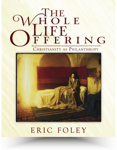
So from today on, we recognize that heads, hearts, and hands come attached not to donations but rather to bodies–bodies that are to be prepared and presented as living sacrifices, holy and acceptable to God. That’s what a whole life offering is, and it’s a whole new way to think about the joined-at-the-hip relationship God intends for churches, Christian nonprofits, and individual believers.
Whole life offerings are what we’re going to talk about henceforth on this site–specifically, how churches, Christian nonprofits, and individual believers can partner together with the Holy Spirit to prepare and present to God believers maturing comprehensively in Christ, not just in their wallets and in our pet causes.
So that’s what’s up with the new look/name of the blog today.
…I shall be telling this with a sigh
Somewhere ages and ages hence:
Two roads diverged in a wood, and I–
I took the road less traveled by,
And that has made all the difference.





 Do the Word