
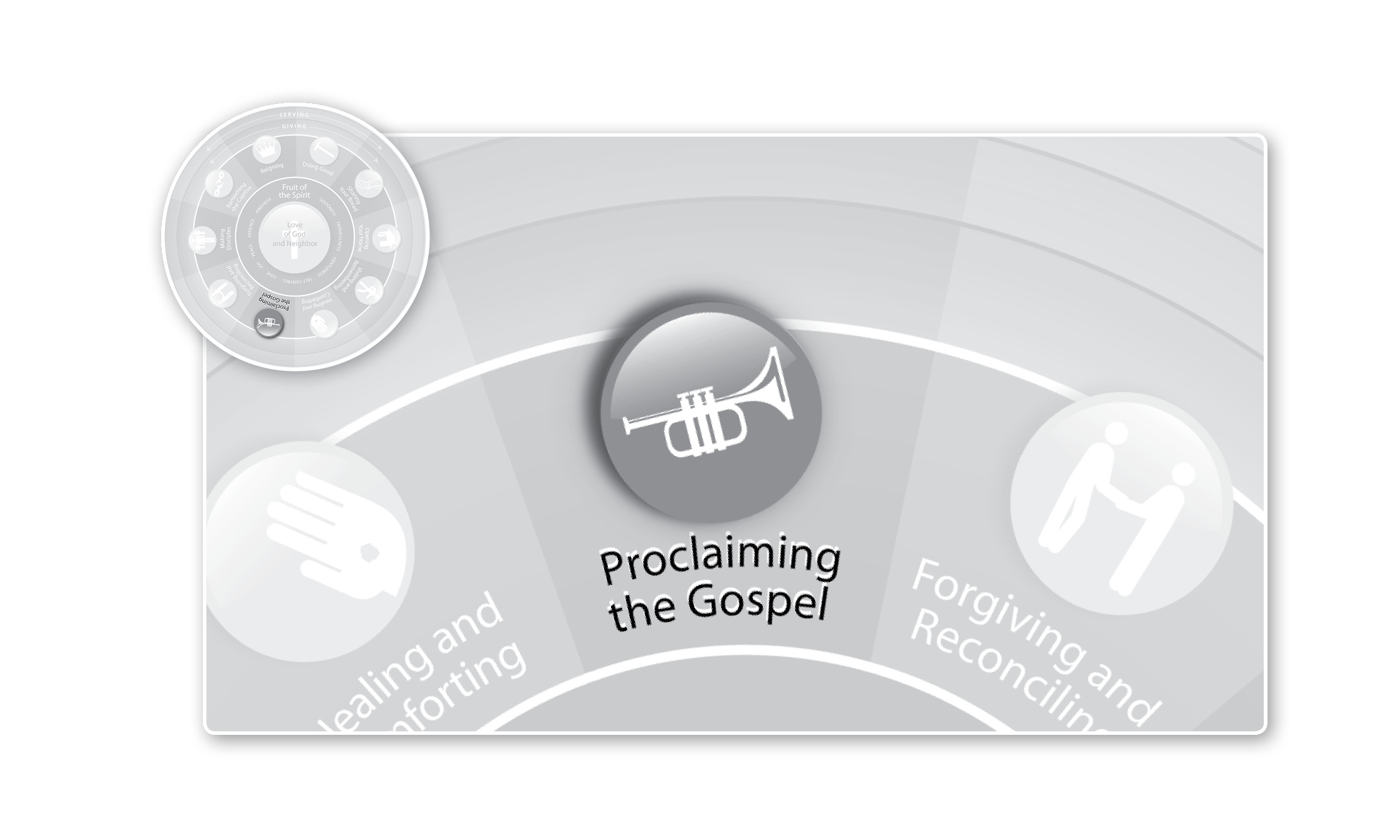
Proclaiming the Gospel, Part II: A Gospel Is Not A Testimony, Not A Bible Story, Not A Sermon, Not Even An Offer Of Salvation

In contrast to the Roman Road understanding of proclaiming the gospel that we talked about in our previous post, consider the definition of gospel which comes from Paul in 1 Corinthians 15:3-8. Paul describes what he shares as “of first importance.”

Isn’t it interesting what he considers of first importance? 

Hint: it’s not us, not even our eternal destiny. That doesn’t even get mentioned, interestingly. Our sin is definitely still in the picture, but it’s no longer the focus. Take a look:

3For I delivered to you as of first importance what I also received: that Christ died for our sins in accordance with the Scriptures, 4that he was buried, that he was raised on the third day in accordance with the Scriptures, 5and that he appeared to Cephas, then to the twelve. 6Then he appeared to more than five hundred brothers at one time, most of whom are still alive, though some have fallen asleep. 7Then he appeared to James, then to all the apostles. 8Last of all, as to one untimely born, he appeared also to me.

This proclamation of the gospel in 1 Corinthians 15:3-8 has a lot in common with the other proclamations of the gospel throughout Scripture. Let’s consider a few of the key features of these gospel proclamations:

First of all, 1 Corinthians 15:3-8 really is a gospel. A gospel is a very unique type of statement. If you say, “Hey, I have a joke I’d like to tell you,” and then you instead proceed to recite a love poem, you may do a very good job reciting a love poem, but it’s important to note that you didn’t tell a joke.

In the same way, one of the things we must get straight when we proclaim the gospel is what a gospel is. A gospel is not a testimony, not a creative retelling of the main themes of the Bible story, not a sermon, and not an offer of salvation—though it may (and likely will) lead to all of those things. As Steve Schaefer describes it in his fantastic book, Living in the Overlap:

Gospel literally means “good news.” When a triumphant army headed home from battle, it would send a herald to run ahead and announce the good news (or gospel) of victory. The gospel is the victorious proclamation that Jesus has defeated the Evil One; that the kingdom of God has arrived in Jesus’ ministry, his sacrificial death, his resurrection, and his ascension to God’s right hand; and that we can begin to experience the kingdom’s blessings now even though we still await its fullness (pp. 44-45).

Sometimes it’s helpful to take a look at what a gospel proclamation looks like in general—i.e., when it’s not a proclamation of the Christian gospel. You can see one in 2 Samuel 18, when gospel messengers are sent out as runners to take the news to David that his army has defeated the army of his traitorous son, Absalom:

19Then Ahimaaz the son of Zadok said, “Let me run and carry news to the king that the LORD has delivered him from the hand of his enemies.” 20And Joab said to him, “You are not to carry news today. You may carry news another day, but today you shall carry no news, because the king’s son is dead.” 21Then Joab said to the Cushite, “Go, tell the king what you have seen.” The Cushite bowed before Joab, and ran. 22Then Ahimaaz the son of Zadok said again to Joab, “Come what may, let me also run after the Cushite.” And Joab said, “Why will you run, my son, seeing that you will have no reward for the news?” 23“Come what may,” he said, “I will run.” So he said to him, “Run.” Then Ahimaaz ran by the way of the plain, and outran the Cushite.

24Now David was sitting between the two gates, and the watchman went up to the roof of the gate by the wall, and when he lifted up his eyes and looked, he saw a man running alone. 25The watchman called out and told the king. And the king said, “If he is alone, there is news in his mouth.” And he drew nearer and nearer. 26The watchman saw another man running. And the watchman called to the gate and said, “See, another man running alone!” The king said, “He also brings news.” 27The watchman said, “I think the running of the first is like the running of Ahimaaz the son of Zadok.” And the king said, “He is a good man and comes with good news.”

28Then Ahimaaz cried out to the king, “All is well.” And he bowed before the king with his face to the earth and said, “Blessed be the LORD your God, who has delivered up the men who raised their hand against my lord the king.” 29And the king said, “Is it well with the young man Absalom?” Ahimaaz answered, “When Joab sent the king’s servant, your servant, I saw a great commotion, but I do not know what it was.” 30And the king said, “Turn aside and stand here.” So he turned aside and stood still. 

Here’s a second point about the gospel: As you can see from the story in 2 Samuel, the gospel is not a statement about the recipient. It’s a statement about the victor in the battle. In the case of 1 Corinthians 15, that’s Jesus. That’s a big difference from most evangelistic approaches, which are often statements about us (like the Roman Road) or which begin with statements like, “In order to understand the good news, you first have to begin with the bad.” With the gospel, we always begin with Jesus. The gospel is the announcement of his triumph—nothing more, nothing less.

Third, our response to the gospel is very important…but it isn’t a part of the gospel. Our response to the gospel is, well, our response to the gospel. That seems like a trivial point, but as we’ll see, it actually turns out to be quite significant. That’s because by God’s design, the response of the hearer to the gospel is actually the first step into discipleship…or the rejection of discipleship altogether.When it comes to the Christian life, there aren’t two steps—accepting Christ through the gospel and then accepting a subsequent offer of discipleship in a follow-up by the evangelist (like, “If you accepted Christ tonight, stop by our welcome center on the way out. We have a free gift for you.”). As Steve Schaefer notes in Living in the Overlap, “Jesus did not simply call people to accept a free gift called salvation; he also called them to embrace a costly lifestyle called discipleship” (p. 107). Or as Schaefer asks alternatively, “Is evangelism about getting people into heaven, or turning people into disciples?” (p. 109).

When the gospel is proclaimed, the response of the hearer tells you a lot. A repentant hearer is easy to spot: Take a look at Acts 2, when after Peter preaches the gospel, the Jews listening to him say, “Brothers, what shall we do?” They are requesting to be taught; that is, discipled.

In contrast, the stoning of Stephen in Acts 7, the “We will hear you again another day” of the Athenians in response to Paul in Acts 17, the “stand aside” of David in 2 Samuel—these are rejections of the gospel and thus tantamount to the spurning of discipleship. When the gospel is properly proclaimed, hearers respond either by saying, “Disciple me” or “Get out of my house”. There’s no “I’m happy to receive the free gift, now get out of my house” option!

Fourth, there is that phrase, “according to the Scriptures,” which appears twice in Paul’s gospel proclamation in 1 Corinthians 15:3-8. It’s the only phrase that appears twice, in fact. The gospel is not Genesis 1-2-3-Romans (i.e., creation-fall-redemption); it encompasses the full scope of the Scripture, addressing every hope and every promise of God. Forgiveness of individual sin is no small part of that, but it’s not the whole of it, either. According to Schaefer’s count, it’s one of eighteen seemingly permanent features of the universe that were fundamentally altered by the life, death, and resurrection of Christ.

And don’t miss the key point: His life, death, and resurrection and not our own are the organizing principle of Scripture and of the gospel.

Think of it like an earthquake. An earthquake occurs along one fault line. But this earthquake occurred along eighteen fault lines simultaneously. When we ignore seventeen of those fault lines and focus only on the one—the forgiveness of individual sin—we give the hearer the wrong impression that everything else in the world has stayed the same except that. Which is why many people hear the gospel and even accept it but see no need for fundamental change in their lives. In fact, they are led to believe that their acceptance of the gospel should make living their present life more manageable and satisfying. The ground has shifted fundamentally in every way…but we not only forgot to tell them that; we failed to notice the other seventeen giant earthquakes ourselves.

The main reason why is that we fail to notice how Christ first performed this Work of Mercy of proclaiming the gospel to us. It’s to that that we’ll turn our attention in our next post.

You can catch my whole message on Proclaiming the Gospel via the free .W weekly podcast.  Or, see a video clip from this series at DOTW.TV.

Posted in Uncategorized | Tagged , , , , , , , , | Leave a comment

Proclaiming the Gospel, Part I: Merging from the Roman Road onto the Interstate Highway System of Full-Octane Gospel Proclamation

On the one hand, it seems like the depths of the topic of proclaiming the gospel ought to be fully plumbed now that we’re 2,000 years into this enterprise called Christianity.

On the other hand, of all of the Works of Mercy, this may be the one that has undergone—and, praise God, is continuing to undergo—the most significant transformation (reformation, really) among evangelicals in our time.

The challenge is, this reformation in evangelical thought hasn’t, uh, quite caught up with evangelical practice. The result is that even though evangelicals’ understanding of proclaiming the gospel has really matured in the last thirty years, by and large we are still doing evangelism the same way evangelicals have been doing it since the 19th century.

There’s not a lot of difference, in other words, between the evangelistic practices of evangelists from the 1800’s like Charles Finney and D.L. Moody, folks from the mid- to late-1900’s like Billy Graham and Campus Crusade, and the evangelists who are sharing the gospel today.

You could summarize this way of evangelism as variations on a Roman Road strategy, which takes its name from how the strategy strings together a series of verses from Paul’s Letter to the Romans. A typical formulation goes like this:

  • God created everything good, but…
  • Romans 3:23: “For all have sinned and fall short of the glory of God.”Romans 6:23a: “…The wages of sin is death…”
  • Romans 6:23b: “…But the gift of God is eternal life through Jesus Christ our Lord.”
  • Romans 5:8: “God demonstrates His own love for us, in that while we were yet sinners Christ died for us.”
  • Romans 10:9: “…If you confess with your mouth Jesus as Lord, and believe in your heart that God raised Jesus from the dead, you shall be saved.”

The climax of this way of proclaiming the gospel is when the evangelist calls for a personal decision for Christ on the part of the hearer, maybe through an altar call or one of those “every eye closed, every head bowed, raise your hands if you’re sure” moments. Respondents are then led to pray what is usually called the Sinner’s Prayer, which according to the folks at www.sinner-prayer.com goes a little something like this:

“Father, I know that I have broken your laws and my sins have separated me from you. I am truly sorry, and now I want to turn away from my past sinful life toward you. Please forgive me, and help me avoid sinning again. I believe that your son, Jesus Christ died for my sins, was resurrected from the dead, is alive, and hears my prayer. I invite Jesus to become the Lord of my life, to rule and reign in my heart from this day forward. Please send your Holy Spirit to help me obey You, and to do Your will for the rest of my life. In Jesus’ name I pray, Amen.”

Now there’s most certainly nothing untrue about this formulation, but evangelicals from the 1950s on have increasingly recognized that the Roman Road approach to proclaiming the gospel is more a reflection of the individualism and self-centeredness of modern times than it is a comprehensive and accurate depiction of what the Scripture actually teaches–and emphasizes–about the gospel.

Scripturally, proclamation of the gospel runs along an interstate highway system designed to cover a lot more distance than the Roman Road. There are, after all, 66 books in the Bible, and the Roman Road approach draws from parts of just one. And even the man who wrote Romans—the Apostle Paul—is never recorded in Scripture as having used the Roman Road approach to proclaim the gospel.

What evangelicals of all stripes are agreeing today is that the gospel is far broader, richer, and deeper than the stream of tears resulting from an evangelist’s reminder of our personal sin and how our decisions about it relate to our destination in the afterlife.

And as we’ll see over the next few weeks, “broader, richer, and deeper” is not shorthand for “let’s sully the purity of individual repentance with the mud of social justice.” Sadly, some evangelicals today are indeed veering off the Roman Road onto that particular dead end instead of heading up the onramp to a more comprehensive, integrated, and accurate Scriptural formulation .

In the evangelical world for the most part, though, when it comes to proclaiming the gospel there’s a recognition that we’ve been looking in the wrong end of the telescope for the last two hundred years. The telescope is pointed at the right subject—Jesus—but by looking through the wrong end, we’ve shrunk the gospel down to a merely personal transaction between us and God. Religion has become primarily a private matter—a matter of the heart—and evangelism has become an invitation to accept Jesus as a personal savior.

As in, “I think religion–oops, I mean spirituality, because I am a deeply spiritual person even though I am not religious–is a really personal thing.”

By focusing so intently on the things of greatest concern to the self-focused individual—namely, their own lives, their insecurities and anxieties, and their eternal destiny—we’ve lost focus on the totality of what God did and is doing in Christ, which is the true focus of the gospel. A focus on “making a personal decision for Christ, your very own personal savior” may be of more native interest to we self-centered moderns, but it has led many to think of Christianity like making a will: You better get one, but in terms of how it impacts your day to day life, there’s not a lot more to do than to be thankful you have one.

So things like discipleship and growth to full maturity in Christ have been de-emphasized by the evangelical church to a jaw-droppingly astonishing degree in the last century and change. And this is probably why we haven’t changed the way we do evangelism even though we know better in our thinking:

Because it’s too hard to bother the general public (and even self-professed Christians–oops, “Christ followers”) with much else other than assuring them that they don’t need to be bothered by too much else other than settling their eternal affairs and feeling really glad they did.

So let’s merge onto the onramp of Scripture–the whole 66 book canon–as for the next few weeks we motor into the Work of Mercy of proclaiming the gospel:

  • what it means
  • how Christ performed it on us
  • how he intends for us to mirror his performance to others.

You can catch my whole message on Proclaiming the Gospel via the free .W weekly podcast.  Or, see a video clip from this series at DOTW.TV.


Posted in Uncategorized | Tagged , , , , , , , | 1 Comment

Before Leaving for the Field, Should Missionaries Do Support Raising…or Support Emptying?

David Fitch just did a post that has me thinking.

The post, entitled STOP FUNDING CHURCH PLANTS and Start Funding Missionaries: A Plea to Denominations, is fairly self-explanatory and certainly worth a read in its own right. But one particular paragraph captured my attention (and the attention of more than a few of the responders in the comments section of the post). Fitch writes:

Fund these leader/leader couples for two years instead of three. Fund them only with health insurance (in the States) and a reasonable stipend for housing. This gives them space to get a job on the ground floor of a company, at the bottom of the pay scale, learning a skill, proving themselves. They can do this because they have certain benefits and a place to live for two years.

The goal here is NOT (I REPEAT NOT) to have self-sustaining church organization in three years. It is to have three to four leader/leader couples working together with jobs each that can offer 15 hours of labor to work together to organize and form a gospel expression way in their context.  They will be self sustaining in that they all have jobs. They will be committed to this context/neighborhood for ten years.

These leaders will have time and space to then a.) get to know and listen to the neighborhood and the neighbors b.) establish rhythms of life together which include worship, prayer, community, discipleship and presence among the neighbors, c.) discern God working in and among the neighbors and neighborhood, d.)bring the gospel to these places wherever God is working. This includes reconciliation, peace, forgiveness, healing, righteousness, and new creation. D.) develop a way of bringing those coming into faith in Christ into a way of growth and discipleship.

I believe that you put three or more quality leaders together in one place for ten years you will have a new expression of the gospel i.e. a church in each context. Gospel as a way of life will take root. Many will brought into the Kingdom. Imagine what could happen if we funded 100’s of such teams.

If you scan down through the comments on the page in response to the post, you’ll see a respondent named Bob launched a vigorous discussion with the following comment:

I don’t understand this at all. The things you describe these funded missionaries doing is *exactly* what EVERY SINGLE MEMBER of the church congregation should already be doing.

The people who are sitting in the seats every Sunday are already living in the context of their jobs and neighborhoods.

I really don’t get this idea of people needing to be paid to “free up the time” to live as Christian salt and light. But I guess our tendency is to pay someone else for something we know how to do (as if we can’t learn) or don’t want to do (as if that is an option God extends).

Bob talks about each Christian seeing his or her present life setting as a mission field–fair comment. And yet as I was teaching Luke 10 to our North Korean Underground University students this past weekend, we couldn’t help but note together that Jesus called Christian missionaries to do something even more radical than Bob suggests. Before leaving for the field, Jesus coached his missionaries to do support emptying rather than support raising:

3Go your way; behold, I am sending you out as lambs in the midst of wolves. 4 Carry no moneybag, no knapsack, no sandals, and greet no one on the road.

Lest this seem like a one-off oddity (modern readers are invariably quick to conclude that “times have changed and circumstances are different today”), it’s interesting to note that Jesus gives similar advice to a certain rich young ruler who was contemplating his own role and standing in the Kingdom of God:

“You lack one thing: go, sell all that you have and give to the poor, and you will have treasure in heaven; and come, follow me.”

Never one to dispense advice that he hasn’t already lived and embodied himself, Jesus’ own preparation for missionary service is worth considering:

5 Have this attitude in yourselves which was also in Christ Jesus, 6who, although He existed in the form of God, did not regard equality with God a thing to be grasped, 7 but emptied Himself…

David Fitch suggests that missionaries get a job but receive free housing and insurance. Commentator Bob counters that missionaries should pay for their own housing and insurance. But Lord and Savior Jesus suggests something even more extreme, which is that we prepare for missionary service by self-emptying: selling everything we have, but not to raise support for our missionary journey–the proceeds from the garage sale are to be given to the poor, he says–but rather to put ourselves in a position of absolute dependence upon those to whom he sends us.

“But surely there is a support baseline below which a missionary preparing to head to the field should not fall, and if the missionary fails to reach that threshold, he or she should not be released to the field.”

Jesus suggests a support baseline that a missionary should not rise above rather than fall below. And he seems to see real value in being placed in a position of dependence upon those to whom one ministers.

So imagine someone declaring for missionary service and entering a support emptying phase rather than a support raising one. Instead of traveling around to churches to raise support, the missionary travels around to churches divesting himself or herself of all earthly possessions. One is declared field ready when the bank account balance hits zero.

So my vote for the most radical and Jesus-like missionary post is not the one from David Fitch (though I liked the piece and the thought behind it), nor the comment on Fitch’s post from Commentator Bob. The one I like the best is a post from 1981 from Tom and Elizabeth Brewster challenging missionaries to hit the field without knowing a word of the language of the people to whom they’re being sent. Why?

In order to be completely dependent to learn the language from the people, of course.

The self-sufficient independence of North Americans is of little help for the one who would communicate positively, have an incarnational ministry, or learn the language. Far more is communicated by being in a state of dependency upon the people. A principle here (as pointed out by Dwight Gradin) is that people help people who are in need. As a Learner, then, one must be willing to demonstrate dependency. Jesus Himself (who, of course, could have been more independent than even the most well healed among us) modeled dependency for us. In childhood He was dependent on a poor family, and in adulthood He conducted His ministry as One who could say He had no place to call His own where He could lay His head (Luke 9:58).

The disciples, too, experienced dependency. Bonnie Miedema says it well:

When Jesus sent out the Twelve to preach and heal the sick, He instructed them, “Take nothing for the journey – no staff, no bag, no bread, no money, no extra tunic” (Luke 9:3). I’m finally beginning to understand why Jesus said that. He wanted the disciples to experience the hospitality of the local people and to be dependent upon them. He knew that identifying with the people and staying in their homes would open doors for their ministry.

Unfortunately, we have a cultural perception that causes us to believe that dependence and vulnerability are weaknesses. On the contrary, the one who authenticates his life-message is the one whose strength lies in his willingness to be vulnerable. (Vulnerability is the willingness to put oneself in a position where one could be taken advantage of by others, or where one’s shortcomings and weaknesses may be exposed.)

In conclusion, it’s worth noting that at least one of the books of the Bible owes its existence to a certain apostle’s lack of health insurance:

13You know it was because of a bodily ailment that I preached the gospel to you at first, 14and though my condition was a trial to you, you did not scorn or despise me, but received me as an angel of God, as Christ Jesus. 15What then has become of the blessing you felt? For I testify to you that, if possible, you would have gouged out your eyes and given them to me.

When it comes to serving as a missionary, there’s no substitute for being genuinely–and acutely–in need of others. Such a one might even describe themselves quite accurately as a debtor to Greeks and Barbarians

Posted in Uncategorized | Tagged , , , , , , , , | 7 Comments

