“In your lifetime you received your good things”

From Chapter 9 onward in the Gospel of Luke, Jesus is not only on a journey to Jerusalem. He is leading his people on an Exodus out of the present age and into the kingdom of God. Along the way, Jesus teaches three things he requires of his followers:

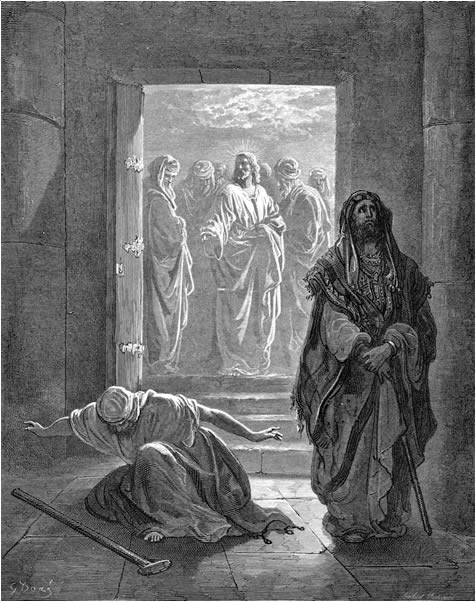
Print by Gustave Doré illustrating the parable of the rich man and Lazarus, from the Gospel of Luke
  1. Give up everything they have
  2. Hate their families
  3. Take up their cross

Why these three things?

Because Jesus has not come to reform the present age. He has come to bring it to an end. His coming is the beginning of the end of the present age. On the cross, it is not only our sins which are put to death, but the present age as a whole is buried in the tomb with him. As we learn from Colossians, it is on the cross, not in a future battle, that he defeats the enemies of God:

 “And having disarmed the powers and authorities, he made a public spectacle of them, triumphing over them by the cross” (Colossians 2:15).

That’s confusing to us, because it seems like the world is still continuing on its way. But Scripture says that the only reason God keeps the present age from ending immediately is so that his offer of mercy to his defeated enemies—which Scripture calls “the gospel”—can be proclaimed to and received by them.

When we as Christ’s defeated enemies accept that offer of mercy, we do so by entering into Christ’s death and new-creation life through his baptism. In doing so, we are cut off from this present age and grafted into Christ. From that point on, we are dead to the world—and that’s no mere metaphor. Everything we need comes from him, and the present age cannot provide anything we need. In fact, if we accept what the present age provides, we will be “choked by life’s worries, riches and pleasures” (Luke 8:14).

 What are the things that the present age provides to which we are still clinging? It’s that familiar list of three things we’ve been noting:

  1. Our flesh-and-blood family
  2. Our money and possessions
  3. Our self-fulfillment

These three things give us a “share” in the present age. In clinging to them, we ultimately end up being choked by them. This is why in order to follow Christ on the Exodus out of the present age into the Kingdom of God, we must leave these idols behind. Instead, we must cling to the three things that take their place in the Kingdom of God:

  1. Becoming members of Christ’s family instead of clinging to our flesh-and-blood family
  2. Becoming depending on Christ for day-to-day support instead of depending on our money and possessions
  3. Taking up the cross instead of looking for self-fulfillment

 Jesus tells us it is not possible to live in two kingdoms at the same time. This would be like having two masters. We’ll always hate the one and love the other. And the one we will love is the age that includes our flesh-and-blood family, our money and possessions, and our self-fulfillment. Jesus says this is why so few people enter his kingdom.

“No one can serve two masters. Either you will hate the one and love the other, or you will be devoted to the one and despise the other. You cannot serve both God and money.” (Luke 16:13)

 Many Christians today reject Jesus’ plan and replace it with their own. They claim that Jesus’ kingdom is his call to reform the present age, not follow him on an exodus out of it. They claim that Jesus wants us to:

  1. Reform our families through Christian values
  2. Use our money to do good things for God
  3. Help people to find Christian self-fulfillment

 Thus, instead of entering the Kingdom of God, people prefer to live in a Christianized form of the present age. This is because they have more of a share in the present age than they realize.

 It is in this context that Jesus tells the story of The Rich Man and Lazarus:

“There was a rich man who was dressed in purple and fine linen and lived in luxury every day. At his gate was laid a beggar named Lazarus, covered with sores and longing to eat what fell from the rich man’s table. Even the dogs came and licked his sores. The time came when the beggar died and the angels carried him to Abraham’s side. The rich man also died and was buried. In Hades, where he was in torment, he looked up and saw Abraham far away, with Lazarus by his side. So he called to him, ‘Father Abraham, have pity on me and send Lazarus to dip the tip of his finger in water and cool my tongue, because I am in agony in this fire.’ But Abraham replied, ‘Son, remember that in your lifetime you received your good things, while Lazarus received bad things, but now he is comforted here and you are in agony. And besides all this, between us and you a great chasm has been set in place, so that those who want to go from here to you cannot, nor can anyone cross over from there to us.’ He answered, ‘Then I beg you, father, send Lazarus to my family, for I have five brothers. Let him warn them, so that they will not also come to this place of torment.’ Abraham replied, ‘They have Moses and the Prophets; let them listen to them.’ ‘No, father Abraham,’ he said, ‘but if someone from the dead goes to them, they will repent.’ He said to him, ‘If they do not listen to Moses and the Prophets, they will not be convinced even if someone rises from the dead.’” (Luke 16:19-31)

When we Christians hear this parable, the problem and the solution seem very clear to us. We think that the problem is that the rich man was selfish and greedy and should have helped Lazarus by giving him food, money, or medical care but did not, so he was sent to hell—apparently because it was a sign that he did not repent. If he had repented, we think, he would have been more generous.

But, interestingly, Abraham does not say that the rich man is in hell because he was selfish and greedy and did not help Lazarus. Abraham’s explanation is this: “Son, remember that in your lifetime you received your good things, while Lazarus received bad things, but now he is comforted here and you are in agony.”

This is very different from how we have been taught to think about salvation and damnation. We think that salvation is when we repent of doing things wrong and ask Christ into our hearts and damnation is what happens when we don’t do that. But Abraham says simply that the rich man is in hell because he already received all his good things during his life time.

The problem is not with Abraham’s explanation but with our wrong way of thinking about salvation and damnation. Our thinking is too small. We are so self-focused that we only think about confessing and repenting of our own individual sins. But Scripture is clear that the message of Jesus and the apostles is much bigger and much deeper than the sin in our own hearts:

“Grace and peace to you from God our Father and the Lord Jesus Christ, who gave himself for our sins to rescue us from the present evil age, according to the will of our God and Father, to whom be glory for ever and ever. Amen.” (Galatians 1:3-5)

Notice here that Paul didn’t say that Christ died for our sins simply so he could forgive us. Paul says Christ died for our sins in order to rescue us from the present evil age. In other words, the problem is not only our hearts. The problem is the whole present age. We are like fish that are swimming in a filthy fish tank. The filthy fish tank is the present age. Fish become diseased from being in that filthy water all the time. If the only thing that Christ did was to forgive your sins, that would be like being a clean fish in a dirty tank. You would not be a clean fish for very long!

But that does not mean that the fish is okay and only the filthy fish tank is the problem. The tank is filthy and the fish is filthy, too. This is why salvation is always presented in the New Testament as a two part solution:

  1. Christ gives himself for our sins
  2. Christ rescues us from the present evil age

Just as Paul preached that message to the Galatians, Peter preached it in Acts 2 at Pentecost:

“Peter replied, “Repent and be baptized, every one of you, in the name of Jesus Christ for the forgiveness of your sins. And you will receive the gift of the Holy Spirit. The promise is for you and your children and for all who are far off—for all whom the Lord our God will call.” With many other words he warned them; and he pleaded with them,“Save yourselves from this corrupt generation.” (Acts 2:38-40)

Or to put it in the words we’ve been using as we’ve been studying Luke, give up your “share” in this present generation. Or to use Paul’s words from Colossians 3:3, we have died to this present age. We no longer receive anything from this present age to sustain us. Instead, we are already living in and being sustained by the kingdom of God. 

There are two amazing truths here that we Christians rarely realize.

The first truth: The Kingdom of God is present now.

Both the present age and the kingdom of God are now present. The Kingdom of God cannot be seen with our eyes, but it is fully present to us by faith. It is more real than the present age, which according to Scripture has already begun to fall apart. The Kingdom of not something we enter after we die or when Christ returns. Christ’s whole message is for us to enter into the Kingdom and live in it today by believing in Christ and being baptized into his death.

In doing so: 

  1. Christ’s family becomes our family
  2. Christ supports us with his riches
  3. It is no longer we who live, but Christ

The second amazing truth is this: Christ came not only to deal with our sins, but to bring the Kingdom—and to bring us into it.

That is why we don’t say, “Christ went to Jerusalem to die for my sins.” That’s only half the truth. Christ came not only to forgive the fish but to replace the fish tank! Most of the time when Christians read in the Bible about a “new creation”, they wrongly think that the Bible is talking about them individually being changed into little “new creations”. But when the Bible talks about a new creation, it means a new creation: A new heavens and a new earth. A new kingdom. A new king.

These days, Christians don’t realize or understand that Christ brings a new kingdom for us to live in and be sustained by today. They wrongly think that Christ’s plan is to work through Christians to reform the present age. They are like fish who think that the maker of the fish tank is going to clean up the tank through them! They talk about the present situation as a “battle” that Christ helps them “win” by giving them strength and wisdom and all the resources that are needed to Christianize the present age. They look at their “share” in the present age—their family, their money, their possessions—and they think, “God wants me to use these things to improve the present age.” This is why they get involved in politics. They believe that the problem is the wrong use of money and power and the weakening of the family. They believe the solution is the right use of money and power and the strengthening of the family.

But Jesus defines neither the problem nor the solution in these terms.

Jesus talks about two problems:

  1. Our evil hearts
  2. The present evil age

Jesus himself solves both of these problems on the cross. It is not that he fixes our hearts in order to use us to reform the present evil age. He brings to us new hearts and a new age: the kingdom of God, established permanently in his blood. He calls us to enter the kingdom today by being baptized into his death.

Think about it like this: We Christians don’t actually die when we die physically. Scripture says that we actually die when we are baptized. We don’t enter the Kingdom of God after our physical death. We enter it when we are baptized into his death.

Many Christians respond to the gospel of the kingdom like this: “So you’re saying we should do nothing and just go to the mountains and pray while the world falls apart?”

But Christians who respond like this do not know the Scriptures. In Acts, we see neither Christians who try to fix the present evil age by Christianizing the “resources” of this age—money, possessions, flesh-and-blood families, and self-interest.

In the Book of Acts, what we see is Christians being moved from their birth family into Christ’s family, which is called the church. We see them giving up their possessions in order to care for each other. We see them being sustained on a day-to-day basis by Christ. We see them no longer focusing on their self-fulfillment and safety and happiness but instead laying down their lives for each other and for their enemies.

To use the language of our fish tank example, Christ does not work through the fish to fix the fish tank. But he also doesn’t remove his fish from the tank. Instead, his fish are transformed into new creatures, just like a tadpole becomes a frog. Frogs can still live in the tank, but they don’t rely on anything in the tank at all. They don’t breathe the water. They don’t eat the food. There is a gigantic world outside the fish tank, and the frogs rely on that world for everything they need. But they don’t leave the fish tank behind. They actually stay there and testify to the fish, “Your purpose isn’t to be a fish. It’s not even to be a clean fish. Your purpose isn’t to live in a clean tank. Your purpose is to be a new kind of creature. And the One who created us made a gigantic world outside this fish tank, and I am supported by that world today.” In other words, the purpose of the frog is to point beyond the fish and the fish tank and testify to how the Creator made us to live today in a much greater kingdom.

With all this in mind, we can understand the parable of the Rich Man and Lazarus.

The Rich Man’s share was entirely in this present age. He was completely sustained and satisfied by the things of this age. He had no share in the Kingdom at all. The problem is not that he was greedy and selfish. All of us in this present age are greedy and selfish! The present age is itself an age of greed and selfishness. The greedy and selfish succeed in this present age.

That’s why the solution is not for the rich man to be more generous to Lazarus by giving him food, or money, or access to the hospital. The solution, according to Abraham, is to listen to the words of Moses and the prophets, which testify to the mission and ministry of Jesus Christ and the kingdom of God that he brings. If the rich man had listened to Moses and the prophets, then he would have seen the evil of his heart and the evil of the present age. He would have done what Jesus commanded the Pharisees and the teachers of the Law to do back in Luke 14: 13: He would have invited Lazarus, not his flesh-and-blood brothers, to his daily banquets:

“But when you give a banquet, invite the poor, the crippled, the lame, the blind” (Luke 14:13)

Jesus isn’t talking here about giving charity to poor people. Jesus is talking about us receiving his family as our family. He is talking about us giving up our own possessions so that we become stewards of Jesus’ possessions. And the most precious possession Jesus has is the cross. The cross is what cuts us off from the present evil age. The cross is what cuts us off from our self-love. The cross cuts out our evil hearts and replaces them with Christ’s own heart. The cross is how we are set free to love the outcasts as our family and our enemies as ourselves. “So if you have not been trustworthy in handling worldly wealth, who will trust you with true riches?” (Luke 16:11). 

Lazarus, on the other hand, had no “share” in the present age. The present age did not sustain him in any way. That doesn’t mean that he had a good heart, though. Remember: In order for us to be saved, Christ has to deal with two problems. He has to save us from our sins, and he has to deliver us from the present evil age. So how did Lazarus end up in Abraham’s side if he didn’t repent?

Here we need to remember the truth we studied two weeks ago: Repentance is not a work we do. It is a gift God gives to us. Repentance and forgiveness are equally gifts from God.

And repentance does not mean “realizing I did bad things and feeling bad about it”. Repentance means “realizing my complete dependence upon God for salvation and my complete inability to save myself”. It means knowing that I contribute absolutely nothing to Christ’s saving work except my need. It means that he opens his arms and I fall into them.

That is why Jesus says in Luke 6:20:

“Looking at his disciples, he said: “Blessed are you who are poor, for yours is the kingdom of God” (Luke 6:20).

The poor are blessed because the present evil age does not even try to sustain such people. Jesus is the only one opening his arms to them. Jesus opened his arms and Lazarus fell into them.

That is exactly what repentance looks like: Jesus opens his arms, and we fall into them. He gives us his heart to replace our evil hearts. He gives us his kingdom to replace this present evil age. And he gives us his family to receive us into his kingdom..

Blessed are we, for ours is the kingdom of God! 

Posted in Bible, Bible Study | Tagged , , , , , , , , , , , , , , | Leave a comment

This man welcomes sinners and eats with them!

Luke 15:1-10 is part of the portion of Luke which began in Luke 9:51 where Jesus has set his face towards Jerusalem and is on the way there to continue to fulfill Isaiah 61 as he preached in Luke 4. Jesus is the true Lord and this journey is the final Exodus, to which the first Exodus—the one out of Egypt –points and in which it is fulfilled .

By Alexandre Bida – https://archive.org/details/christinartstory00egglrich/page/164/mode/2up?view=theater, Public Domain, https://commons.wikimedia.org/w/index.php?curid=121008582

In the first Exodus, what happens to the Israelites who mutter in the wilderness? They died in the wilderness. Likewise, the “muttering” of the Pharisees and teachers of the Law throughout Jesus’ journey to Jerusalem are very serious. Their accusations against Jesus—that he works on the Sabbath (through his healings) and that he welcomes and eats with sinners—are punishable by death, according to the Law.

So how does Jesus respond to these serious accusations? By telling a parable:

“Suppose one of you has a hundred sheep and loses one of them. Doesn’t he leave the ninety-nine in the open country and go after the lost sheep until he finds it? And when he finds it, he joyfully puts it on his shoulders and goes home. Then he calls his friends and neighbors together and says, ‘Rejoice with me; I have found my lost sheep.’ I tell you that in the same way there will be more rejoicing in heaven over one sinner who repents than over ninety-nine righteous persons who do not need to repent. “Or suppose a woman has ten silver coins and loses one. Doesn’t she light a lamp, sweep the house and search carefully until she finds it? And when she finds it, she calls her friends and neighbors together and says, ‘Rejoice with me; I have found my lost coin.’ In the same way, I tell you, there is rejoicing in the presence of the angels of God over one sinner who repents.” ” (Luke 15:4-7)

The main point of Jesus’ parable, as he notes, is that there is rejoicing over repentant sinners. But, interestingly, the sheep and the coin don’t seem to repent. They don’t seem to do anything except be lost and then be found. All of the action is done by the shepherd and the woman.

This is the reason why the Pharisees and the teachers of the law mutter: The tax collectors and sinners didn’t go through the proper steps and procedures outlined in the Law for repentance. All they did was be found by Jesus and follow him. So it means that they are still sinners.

The Pharisees and the teachers of the law know what the scripture says about sinners, especially the Psalms, which says that sinners will be punished. If the tax collectors and sinners repented, wouldn’t the Pharisees and the teachers of the law repent?

No! We know that because when John the Baptist came, tax collectors and sinners repented, but the Pharisees and teachers of the law did not rejoice.

“(All the people, even the tax collectors, when they heard Jesus’ words, acknowledged that God’s way was right, because they had been baptized by John. But the Pharisees and the experts in the law rejected God’s purpose for themselves, because they had not been baptized by John.) Jesus went on to say, “To what, then, can I compare the people of this generation? What are they like? They are like children sitting in the marketplace and calling out to each other: “‘We played the pipe for you, and you did not dance; we sang a dirge, and you did not cry.’ For John the Baptist came neither eating bread nor drinking wine, and you say, ‘He has a demon.’ The Son of Man came eating and drinking, and you say, ‘Here is a glutton and a drunkard, a friend of tax collectors and sinners.’ But wisdom is proved right by all her children.” (Luke 7:29-35)

This is the point which Jesus makes in the parable of the prodigal son in Luke 15. When the second brother returns home, the first brother did not rejoice and feast with the rest of the father’s house. So the Pharisees and teachers of the law exclude themselves from the Kingdom through their failure to rejoice over the Lord’s work of saving sinners.

But aren’t the Pharisees and teachers of the law the 99 righteous sheep who did not need to repent?

With that question, we come to the heart of the parable. To understand Jesus’ answer, we need to hear from a former Pharisee: Paul the Apostle. He writes this about himself:

“circumcised on the eighth day, of the people of Israel, of the tribe of Benjamin, a Hebrew of Hebrews; in regard to the law, a Pharisee; as for zeal, persecuting the church; as for righteousness based on the law, faultless.” (Philippians 3:5-6)

Paul was one of the 99 righteous who did not need to repent. He was “blameless” according to the law. He was in right relationship to the Law, so he had no reason to repent. But he was not in right relationship with God and others.

The Pharisees and teachers of the law in Luke 15 are in the same position. There have no need to repent according to the law. But, says Jesus, there is no rejoicing in heaven over such people. That is because Jesus did not come to bring people into right relationship with the law.

What the Pharisees and the teachers of the Law could not see—and what many of us Christians today cannot see—is that Scripture talks about two completely different kinds of righteousness and two completely different kinds of sin. Paul describes the two different kinds of righteousness like this in Philippians 3:9: One he calls “a righteousness of my own that comes from the Law”, and the other he calls “the righteousness that comes from God and is by faith”.

And what of the two different kinds of sin? We can distinguish these by calling them “lowercase-‘s’ sins” and “uppercase ‘S’ Sin”. Lowercase-s sins are individual infractions against the law. They are often spoken of in the plural, like in the Lord’s Prayer when we say, “Forgive us our sins.” When the Pharisees and teachers of the law call people “sinners”, they are referring to people who have committed such sins and have not repented of them. Calling them “lowercase-‘s’ sins “ doesn’t mean they are “small sins”. It means all sinful actions we do—including big sins like murder, sexual sin, lying, and stealing.

Uppercase “S” Sin refers to Sin as a power—the power that holds all human beings in slavery. Paul writes about “Capital-S Sin” in Romans 5:12:

“Sin entered the world through one man, and death through sin, and in this way death came to all men, because all sinned.”

Sin and sins are related. We are enslaved to Sin and so, as a result, we commit sins. The temple and John’s baptism could deal with sins, but the were powerless against Sin. Against Sin, we are completely helpless…like lost sheep or a lost coin. This is why Jesus uses word like “lost”, “sick” or “indebted” to describe sinners. When Jesus uses these words, he is talking about Sin.

If you are really lost, someone has to find you. If you are really sick, someone has to heal you. If you are really in debt, someone has to pay for you. On our own, we can repent of sins, even non-Christians do that if they have a strong conscience. But Sin goes way deeper than conscience.

Our conscience cannot feel Sin, and we are not even aware of it. and faith are opposites: “Capital-S Sin” is rebellion against God, while faith is trust in God. Paul says it like this in Romans 14:23:

“everything that does not come from faith is sin” (Romans 14:23)

Faith, forgiveness, and repentence are Sin-overcoming gifts that can only come to us from God as we hear his voice:

“Consequently, faith comes from hearing the message, and the message is heard through the word about Christ.” (Romans 10:17).

Faith cannot come to us through an explanation of the gospel or through general encouragements about God’s existence or God’s love for us. Faith can only come from the proclamation of the gospel itself. Only the gospel itself is God’s own word and voice.

When angels are rejoicing in heaven, are they rejoicing because someone made a good decision to repent? Are they saying, “Hey, good job, sinner, you made a good choice!”

No! They are rejoicing because Jesus has sought, found, and granted repentance to one more sinner. That is something only he can do.

The Church really needs to recover this proper understanding of two kinds of sin and two kinds of righteousness. Because we do not understand these difference, we do not understand our role in the world and have become like the Pharisees and teachers of the law.

How?

The Lord calls us to address the Lowercase-s sins of our fellow believers, but not the Lowercase-s sins of the world.

“What business is it of mine to judge those outside the church? Are you not to judge those inside? God will judge those outside. “Expel the wicked person from among you.” (1 Corinthians 5:12-13).

This is why the church is never shown in the New Testament as protesting and trying to change the laws of the world. Addressing Lowercase-s without first addressing and overcoming Capital-S Sin means that we do not understand sin, righteousness, the Lord, or his gospel at all.

When we speak to the world, the Lord only authorizes us to address Capital-S Sin. We do that through the only message he has authorized us to share in the world: the gospel. It is through the gospel that the Lord reveals that he is the friend of Capital-S sinners. It is through the gospel that He addresses Capital-S sinners as lost, sick, and deeply in debt to Sin. It is through the gospel that he sets Capital-S Sinners free from the law of sin and death.

But, today, the church is completely focused on judging and condemning the lowercase-s sins of the world. It is always out there protesting sinful laws and trying to change them. In this, we are imitating the Pharisees and the teachers of the law, not the Lord. The Lord has one purpose for coming to the world, and it is not to uphold Christian values:

“For the Son of Man came to seek and to save the lost.” (Luke 19:10)

Posted in Bible | Tagged , , , , , , , , , , , , , , | Leave a comment

When you give a banquet…

But when you give a banquet, invite the poor, the crippled, the lame, the blind, and you will be blessed. Although they cannot repay you, you will be repaid at the resurrection of the righteous.” (Luke 14:13-14)

In Luke 14:1-6, Jesus heals another person on the Sabbath. This is the third time which Jesus has healed on the Sabbath in Luke. Each time, the religious leaders who witness Jesus’ miracle harden their hearts. The first time, they complained to each other. The second time, the synagogue leader complained to the congregation. And, this time “they remained silent” (Luke 14:4).

We can see the root of the conflict in Luke 15:2:

But the Pharisees and the teachers of the law muttered, ‘This man welcomes sinners and eats with them.’ (Luke 15:2).

The root of the conflict is about how God works. We know that God works through Jesus and that everything that Jesus does is the work of God because Jesus is God. But the religious leaders do not acknowledge Jesus as God. They call him, “This man”.

In Luke 14, it says that the religious leaders were “watching him carefully” (Luke 14:2). If the religious leaders had not hardened their hearts, they would recognize that Jesus is doing things that only God can do.

Like the man who had his eyes opened in John 9:32, they would have seen that “Nobody has ever heard of opening the eyes of a man born blind.” As Jesus said, “Believe me when I say that I am in the Father and the Father is in me; or at least believe on the evidence of the works themselves.” (John 14:11).

When Jesus speaks, he generally quotes or refers to scripture. But he doesn’t say, “In Isaiah 16, it says…” because, being God, the word is his word. And, when Jesus quotes the word, he generally applied the part of the scripture about God to Himself.

He also applies the Messianic scriptures to himself, such as when he began his preaching ministry in Luke 4, quoting Isaiah 61:1 and saying, “Today this Scripture has been fulfilled in your hearing.”

In the scripture from today, Jesus asked the religious leaders, “Which of you, having a son or an ox that has fallen into a well on a Sabbath day, will not immediately pull him out?” (Luke 14:5). By doing this, he is not just trying to advocate for the right of human beings to heal people on the Sabbath. He is doing so as God.

Jesus is saying the same thing here as he says in Matthew 7:9-11:

Which of you, if your son asks for bread, will give him a stone? Or if he asks for a fish, will give him a snake? If you, then, though you are evil, know how to give good gifts to your children, how much more will your Father in heaven give good gifts to those who ask him!

Luke 14 is not about advocating the right to heal on a rest day. It is about Jesus being God and the religious leaders trying to prevent that from happening.

After this healing, Jesus tells a parable.

Now he told a parable to those who were invited, when he noticed how they chose the places of honor, saying to them, “When you are invited by someone to a wedding feast, do not sit down in a place of honor, lest someone more distinguished than you be invited by him, and he who invited you both will come and say to you, ‘Give your place to this person,’ and then you will begin with shame to take the lowest place. But when you are invited, go and sit in the lowest place, so that when your host comes he may say to you, ‘Friend, move up higher.’ Then you will be honored in the presence of all who sit at table with you. For everyone who exalts himself will be humbled, and he who humbles himself will be exalted.” (Luke 14:7-11)

The important phrase here is “when your host comes” (Luke 14:10). Jesus is not just giving important advice about being humble here. He is quoting Proverbs 25:6-7, which the religious leaders would undoubtedly know.

Do not exalt yourself in the king’s presence, and do not claim a place among his great men; it is better for him to say to you, “Come up here,” than for him to humiliate you before his nobles. (Proverbs 25:6-7).

Jesus is the king. He is warning the religious leaders not to exalt themselves in his presence. He is telling them that he himself will humble them on the day of Jesus’ own great banquet, which he then tells them about in the following passage.

It may be difficult for us to understanding these things. But we need to read the scripture as the full revelation of who Jesus is and what Jesus does. When we look at Isaiah 58, we can see how Jesus fulfills the scripture.

Is not this the kind of fasting I have chosen: to loose the chains of injustice and untie the cords of the yoke, to set the oppressed free and break every yoke? Is it not to share your food with the hungry and to provide the poor wanderer with shelter—when you see the naked, to clothe them, and not to turn away from your own flesh and blood? (Isaiah 58:6-7)

If you keep your feet from breaking the Sabbath and from doing as you please on my holy day, if you call the Sabbath a delight and the Lord’s holy day honorable, and if you honor it by not going your own way and not doing as you please or speaking idle words,”(Isaiah 58:13)

A large part of Jesus’ ministry is keeping the Sabbath the way that he, as God, wants it to be kept. Jesus is not saying, “Don’t be too legalistic. Make sure to leave time for rest and fun with your family.” And Jesus never tells us, “Look forward to heaven, where you can meet your deceased relatives and pets and have fun playing golf and dancing” as if the point of the afterlife is to live out the best parts of our current life without all the parts we don’t like.

In fact, Jesus tells us that the Sabbath is not about having fun with our family and friends. He tells us, “When you give a dinner or a banquet, do not invite your friends or your brothers[b] or your relatives or rich neighbors” (Luke 14:12). And, inasmuch as the Sabbath is a small picture which God gave to Israel to know what life will be like in the kingdom, life after death will not be about having fun with our family and friends forever. In the kingdom, we will sit across the table from the “the poor and crippled and blind and lame”. And the reason we will do this in the kingdom is because it is the way we spent our sabbaths.

Our thinking about the Sabbath and heaven is more similar to the religious leaders than it is to Jesus. Jesus’ complaint about the religious leaders is not that they are too legalistic, but that their behavior looks outwardly holy, but is primarily for their own benefit.

We may protest, “No, I’m different. The religious leaders were just being absolutely mean and trying to stop people from being healed on the Sabbath”. But the religious leaders had a good reason for why they tried to oppose Jesus’ healing. They believed that the reason why Israel was struggling in Jesus’ day is because the people of Israel were living in ways that were no different from the rest of the world. They believed that, in order to get God to act on their behalf, they had to get serious about being different from the world. The Pharisees especially felt that keeping the Sabbath day is one of the main ways that they could be different from the rest of the world.

As modern Christians, we have the same wrong thinking. We think that, the more we fast, the more worship services we attend, and the more we show God that we are serious about our faith that God will work on our behalf. We may even want to show God that we are serious that, when we are sick on Sunday, we pray, fast, and go to a lot of worship services on Sunday and focus on getting healed on the next day, hoping that God will heal us as a result of what we have done. We believe that God has good gifts to give, but is not giving them to us yet because we have not been serious about them yet.

In all religions, we human beings are the subjects of the verbs. We do something and then God responds to us. Either he blesses us because we are serious about him. Or he punishes us because we are not serious about him. That is how we expect and want God to work.

But Jesus shows us that God, not human beings, is the subject of the verbs. On the Sabbath, God is the actor, not human beings. Likewise, in the kingdom, God is the actor. He brings gifts. He brings his presence. He brings his forgiveness. He brings healing. He brings food. He brings is not because we have been good, not because we have been serious about him, but because he is good. For us as human beings, the question is “Will we receive the gifts that he brings?”

In the parable of the wedding banquet in Luke 14, we learn that most human beings reject the gifts God seeks to give us because we do not like the way he runs his banquet. He calls us out of our human flesh and blood relationships and friendships and into his family. His family is composed of the people who are of no value in the present age. In fact, associating with these people (the poor, the handicapped, the lame, the blind, the outcast, the prisoners) will lower our status in the present age. But he says that they are his family. If we want Jesus, we have to accept his family as our family even more than our flesh and blood family.

Posted in Bible, Bible Study, Reading the Bible | Tagged , , , , , , , , | Leave a comment