
How to Pray…and Sing…For God’s Visitation

Part III of our Series on Visiting and Remembering
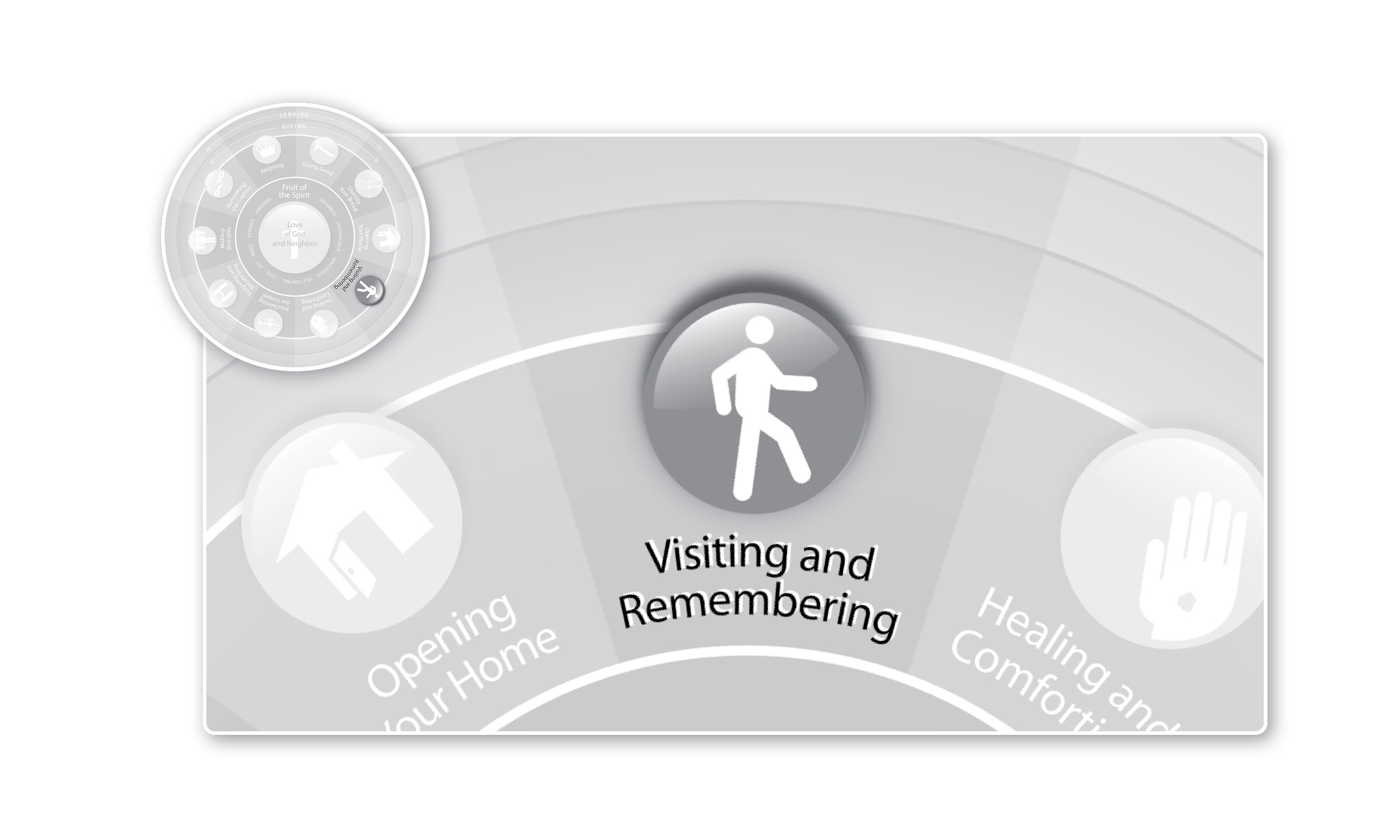
There’s something important about this Work of Mercy of Visiting and Remembering and it relates specifically to salvation. When we became Christians, it wasn’t a choice we made to accept a general or standing offer. According to Scripture, we received a personal visitation from God:

Behold, I stand at the door and knock. If anyone hears my voice and opens the door, I will come in to him and eat with him, and he with me. (Rev 3:20)

He came, and—by his grace—you hosted him. And in his visit he raised you up from the dead:

1And you were dead in the trespasses and sins 2in which you once walked, following the course of this world, following the prince of the power of the air, the spirit that is now at work in the sons of disobedience— 3among whom we all once lived in the passions of our flesh, carrying out the desires of the body and the mind, and were by nature children of wrath, like the rest of mankind.

4But God, being rich in mercy, because of the great love with which he loved us, 5even when we were dead in our trespasses, made us alive together with Christ—by grace you have been saved— 6and raised us up with him and seated us with him in the heavenly places in Christ Jesus, 7so that in the coming ages he might show the immeasurable riches of his grace in kindness toward us in Christ Jesus. (Eph 2:1-7)

Sum it up and say: God visited you. And now that you are incorporated into his body, he dwells in you and you dwell in him…and he continues his visit—his personal inspection, his seeing you with his own eyes—today.

Note his humility in the following scripture in terms of his description of his own role of being among us:

For where two or three are gathered in my name, there am I among them (Matt 18:20).

So when we pray, we don’t just pray for endurance or help or the power to forgive. We pray for him to visit us—to be among us—to abide with us. And that prayer is the basis of Abide With Me, the song that .W church members recently learned and which I commend to you as well.  Rather than read it only, go here and start the video. Then, come back here and follow along!

Abide with me; fast falls the eventide;
The darkness deepens; Lord with me abide.
When other helpers fail and comforts flee,
Help of the helpless, O abide with me.
 
Swift to its close ebbs out life’s little day;
Earth’s joys grow dim; its glories pass away;
Change and decay in all around I see;
O Thou who changest not, abide with me.
 
Not a brief glance I beg, a passing word;
But as Thou dwell’st with Thy disciples, Lord,
Familiar, condescending, patient, free.
Come not to sojourn, but abide with me.
 
Come not in terrors, as the King of kings,
But kind and good, with healing in Thy wings,
Tears for all woes, a heart for every plea—
Come, Friend of sinners, and thus bide with me.
 
Thou on my head in early youth didst smile;
And, though rebellious and perverse meanwhile,
Thou hast not left me, oft as I left Thee,
On to the close, O Lord, abide with me.
 
I need Thy presence every passing hour.
What but Thy grace can foil the tempter’s power?
Who, like Thyself, my guide and stay can be?
Through cloud and sunshine, Lord, abide with me.
 
I fear no foe, with Thee at hand to bless;
Ills have no weight, and tears no bitterness.
Where is death’s sting? Where, grave, thy victory?
I triumph still, if Thou abide with me.
 
Hold Thou Thy cross before my closing eyes;
Shine through the gloom and point me to the skies.
Heaven’s morning breaks, and earth’s vain shadows flee;
In life, in death, O Lord, abide with me.

What other hymns or worship songs come to mind that relate to God Visiting and Remembering us?

Posted in Uncategorized | Tagged , , , , , , | 2 Comments

How to Not Miss the Visitation of Christ

Part II of our Series on Visiting and Remembering

God visits us; through, with, and in the form of his servants. That’s what we learned at the conclusion of our last post.

That’s the truth conveyed in the book of Exodus:

1Now Moses was keeping the flock of his father-in-law, Jethro, the priest of Midian, and he led his flock to the west side of the wilderness and came to Horeb, the mountain of God. 2And the angel of the LORD appeared to him in a flame of fire out of the midst of a bush. He looked, and behold, the bush was burning, yet it was not consumed.

3And Moses said, “I will turn aside to see this great sight, why the bush is not burned.” 4When the LORD saw that he turned aside to see, God called to him out of the bush, “Moses, Moses!” And he said, “Here I am.” 5Then he said, “Do not come near; take your sandals off your feet, for the place on which you are standing is holy ground.” 6And he said, “I am the God of your father, the God of Abraham, the God of Isaac, and the God of Jacob.” And Moses hid his face, for he was afraid to look at God.

7Then the LORD said, “I have surely seen the affliction of my people who are in Egypt and have heard their cry because of their taskmasters. I know their sufferings, 8and I have come down to deliver them out of the hand of the Egyptians and to bring them up out of that land to a good and broad land, a land flowing with milk and honey, to the place of the Canaanites, the Hittites, the Amorites, the Perizzites, the Hivites, and the Jebusites.

9And now, behold,the cry of the people of Israel has come to me, and I have also seen the oppression with which the Egyptians oppress them. 10Come, I will send you to Pharaoh that you may bring my people, the children of Israel, out of Egypt.” (Exodus 3:1–10)

In Jesus, God visits his beloved children physically, personally:

9The true light, which enlightens everyone, was coming into the world. 10He was in the world, and the world was made through him, yet the world did not know him. 11He came to his own, and his own people did not receive him. 12But to all who did receive him, who believed in his name, he gave the right to become children of God, 13who were born, not of blood nor of the will of the flesh nor of the will of man, but of God.

14And the Word became flesh and dwelt among us, and we have seen his glory, glory as of the only Son from the Father, full of grace and truth. (John 1:9-14)

In Christ, God looks at us through actual human eyes, touches us with actual human hands. It is the event to which all previous visitations point. Unfortunately, we humans usually miss his visitation. Note how Jesus describes this as he visits Jerusalem:

And when he drew near and saw [Jerusalem], he wept over it, saying, “Would that you, even you, had known on this day the things that make for peace! But now they are hidden from your eyes. For the days will come upon you, when your enemies will set up a barricade around you and surround you and hem you in on every side and tear you down to the ground, you and your children within you. And they will not leave one stone upon another in you, because you did not know the time of your visitation.(Luke 19:41–44, ESV, emphasis mine)

This is reminiscent what we talked about earlier this month: Stay awake! Be ready! The Lord shows up in the way you least expect him to…and yet he’s told you exactly in what form he’s going to visit: the stranger, the naked, the imprisoned. There is no reason for us to not know the time of his visitation as long as we remember and treasure his word.

How do you balance helping the Lord when he shows up as the stranger, naked or imprisoned while not enabling others in their sin?

Posted in Uncategorized | Tagged , , , , , , , | 2 Comments

The Intimacy of God’s Visitation to Us

Part I of our Series on Visiting and Remembering

Visitation is hospitality gone mobile. It’s more than just a social call or a brief chatty check-in. The word signifies something big:

God showing up where before there was no one; life showing up where before there was nothing; deep care where before there was neglect; correction where before there was open sin.

“Visit” in the Hebrew, paqad, means “to personally inspect and pay close attention to.” Think of a general inspecting troops in the field and then stopping to talk with one particular soldier.

Amazingly, visitation is even more intimate than that!

In the New Testament, “visit” is typically the Greek episkeptomai, meaning “to examine with the eyes.” This is not about showing up to shoot the breeze or make small talk. John Wesley called it “close conversation.”

As author Amy L. Sherman notes, in the Bible visitation means something even more than inspection. God visits human beings who are soul-sick and languishing in the prison of sin, widowed and orphaned by the father of lies.

In I Samuel 2:21, God “visits” barren Hannah—and the result is that she is enabled to have five children. You’ll recall that God had graciously given Hannah the gift of a son, Samuel, whom she dedicated back to the Lord. God has more that he wants to do for barren Hannah, and so He “visits” her and she conceives new life.

The visitation of God imparts life!   

Scripture portrays God visiting human beings in distress who cry out to him. As we’ll talk about later on this month, when God calls us to visit those in prison, we can look to him as the perfect example: he made the first prison visit ever recorded in the Bible. He looks in on the wrongly-accused Joseph and imparts to him the gifts of friendship-love and favor:

And Joseph’s master took him and put him into the prison, the place where the king’s prisoners were confined, and he was there in prison. But the LORD was with Joseph and showed him steadfast love and gave him favor in the sight of the keeper of the prison. (Genesis 39:20–21, ESV)

At the close of his life, Joseph prophesizes that the God who remembered him and visited him in prison will surely not fail to remember and visit his children in Egypt – a remarkable event given the understanding of the day that gods were restricted to their own geographic domain. This God, however, will cross any domain to lead his children to the home he has prepared for them. Joseph is so certain of God’s character that he forces his children to swear an oath based upon the visitation coming to pass:

And Joseph said to his brethren, I am going to die. But God will surely visit you and bring you out of this land to the land He swore to Abraham, to Isaac, and to Jacob [to give you].

And Joseph took an oath from the sons of Israel, saying, God will surely visit you, and you will carry up my bones from here. (Genesis 50:24–25, ESV)

And so God does. A few generations after Joseph’s prophesy, the Israelites are ground down into slavery. God hears their cries and resolves to show them heartfelt care, commissioning Moses. That’s an important principle that we’ll be developing this month.

God visits – through, with, and in the form of – his servants.

How have you experienced the visitation of God through others?

Posted in Uncategorized | Tagged , , , , , | 3 Comments

