Voice of the Martyrs Korea announced the release today of a major new book on the earliest Korean church history, Professor Choi Sung Il’s The First Korean Bible and its Relation to the Protestant Origins in Korea: John Ross and the Korean Protestant Church.
Voice of the Martyrs Korea Representative Dr. Hyun Sook Foley, Professor Sung Il Choi and CEO Pastor Eric Foley announce the release of Professor Choi’s Il’s The First Korean Bible and its Relation to the Protestant Origins in Korea: John Ross and the Korean Protestant Church.
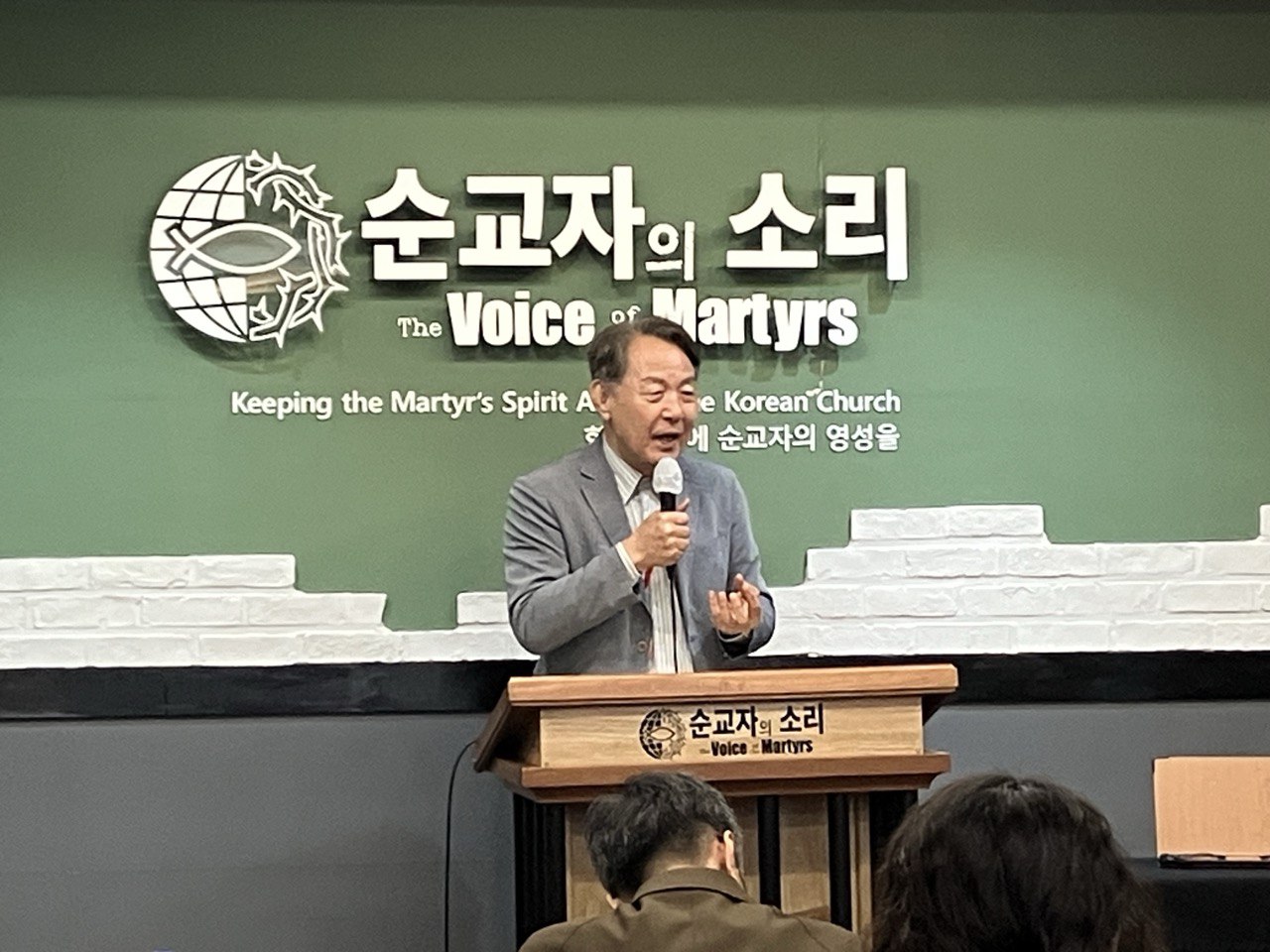
The release was announced at a press conference held at the Voice of the Martyrs Korea’s Jeongneung office Tuesday. The author, Prof. Choi Sung Il, the Professor of Theology of Mission at Hanshin Seminary, as well as Voice of the Martyrs Korea Representative Dr Hyun Sook Foley and CEO Pastor Eric Foley addressed reporters.
“Before the first Western missionaries set foot in Korea, a network of untrained indigenous Koreans had already spread the gospel widely throughout the country and converted many Koreans to Protestant Christianity,” said Representative Foley. “Their successful strategy, unique in Christian history, relied on their covert personal distribution of thousands of copies the first vernacular translation of the Bible into Korean. That translation was created by the Koreans under the direction of a Scottish missionary who was himself an untrained Bible translator. This book recounts in detail the story of those Christians and that missionary, John Ross. Missionary Ross is widely honored as the father of the Korean church despite spending almost no time in Korea and despite his conception of the Christian life and faith being significantly different from that of the Western missionaries who would reject his translation, his missionary methods, and even his own offers to help them, despite the unparalleled success of Ross and his indigenous Korean partners.”
Voice of the Martyrs Korea Representative Dr. Hyun Sook Foley and CEO Pastor Eric Foley address reporters at a press conference announcing the release of Professor Choi Sung Il’s The First Korean Bible and its Relation to the Protestant Origins in Korea: John Ross and the Korean Protestant Church.
“Voice of the Martyrs Korea is proud to publish Prof. Choi’s groundbreaking work in both Korean and English,” said Voice of the Martyrs Korea CEO Pastor Eric Foley. “The book is more than just a well-written and fascinating history of the earliest Korean church. It is a reminder of the cutting-edge church planting and Bible translation strategies that characterized the Korean church’s birth—strategies that the church around the world and in Korea need to re-learn today. It is a book telling the true story of how God always uses the least of those among us to do his greatest work. It is the story of how God’s work is often overlooked, rejected, or set aside in favor of more impressive human methods—even by God’s own people. The story of John Ross and the earliest Korean Christians is still being lived out among underground North Korean Christians today. I pray John Ross’ fatherhood of the Korean church—the unique spiritual heritage he and his indigenous Korean partners imparted to it—will likewise be renewed and revitalized in the South Korean and Korean diaspora church through Professor Choi’s powerful book.”
The author, Professor Choi Sung Il
The First Korean Bible and its Relation to the Protestant Origins in Korea: John Ross and the Korean Protestant Church is available through Voice of the Martyrs Korea for 15,000 KRW. Individuals interested in purchasing the book can call VOM at 02-2065-0703 or go to www.vomkorea.com/en/shop. Voice of the Martyrs Korea will also make it available (in English) on Amazon this summer.
An original musical and dance performance recounting the true story of the translation and transmission of the Bible to Korea through Scottish missionary John Ross and his Korean co-workers debuted last week at More Love Church in Suwon.
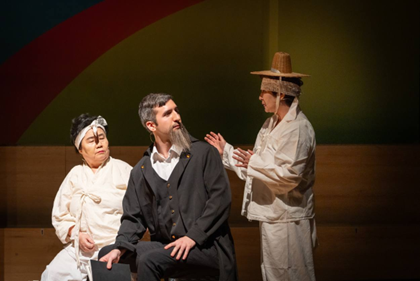
A scene from the debut performance of the John Ross Bible Historical Drama at More Love Church in Suwon last week. Voice of the Martyrs Korea North Korean Ministry Team Leader Pastor Trevor Foley portraying Missionary John Ross is shown here with students from the ministry’s Underground University missionary training school, who performed in the event.
The “John Ross Bible Historical Drama”, written by Voice of the Martyrs Korea Representative Dr Hyun Sook Foley, was performed by North Korean defector students enrolled in the ministry’s Underground University North Korean missionary training program, as well as by Representative Foley, Voice of the Martyrs Korea CEO Pastor Eric Foley, and North Korean Ministries Team Leader Pastor Trevor Foley.
According to Representative Foley, the drama was twenty years in the making.
“In the mid-2000s, Voice of the Martyrs Korea, which believed that North Korean defectors flooding into South Korea could play an important role in North Korean missions, started Underground University to train North Korean defectors in the ways of North Korean underground believers and to reach North Koreans with the gospel wherever they are found around the world,” said Representative Foley. “While running the school, I discovered that first-generation North Korean defectors (average age over 60 years old) were the main characters of North Korean ministry.”
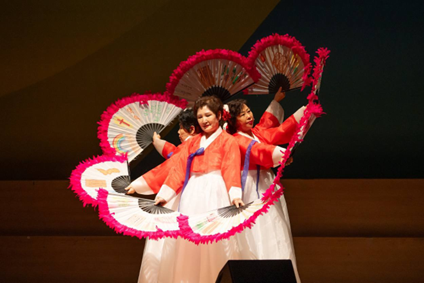
North Korean defector students at Voice of the Martyrs Korea’s Underground University missionary training program perform a special version of the traditional Korean fan dance at the debut performance of the John Ross Bible Historical Drama at More Love Church in Suwon last week.
Starting in early 2023, Representative Foley, a professional Korean dancer and clinical counselor, began including Bible dance therapy in the Underground University curriculum.
“There are two goals for our Bible dance therapy curriculum,” said Representative Foley. “Our first goal was to teach our students the miraculous true story of their North Korean ancestors, who were the ones the Lord used along with Missionary John Ross to bring the word of God to Korea. The second was to use Korean dance and drama to help them express their inner feelings and experience healing for the traumas they had experienced in their lives and in their journeys to South Korea.”
Representative Foley said the students gained pride as they learned about their ancestors, while also experiencing a sense of stability and peace in their hearts through the Bible dance therapy. “Their passion for evangelism toward fellow North Koreans was also amplified,” she said.
More Love Church in Suwon invited the group for their debut performance, scheduling it immediately after their Wednesday morning service at which Pastor Foley and Representative Foley preached. In addition to the church’s own members, about a hundred other guests attended the performance at the invitation of Voice of the Martyrs Korea.
More Love Church Associate Pastor Ji Sang Hoon, who coordinated the group’s performance at the church, said he was impressed.
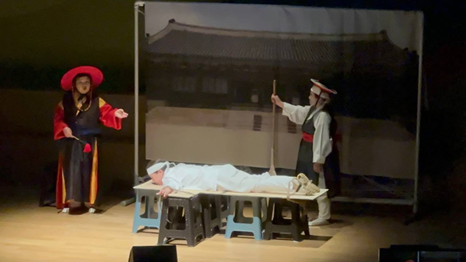
Voice of the Martyrs Korea Representative Dr. Hyun Foley as early Korean Christian Paik Hong Jun, is interrogated by North Korean defector students at the ministry’s Underground University as part of the debut performance of the John Ross Bible Historical Drama last week at More Love Church in Suwon
“I think that the John Ross Bible historical drama does a great job of conveying the historical story of John Ross and the Joseon merchants’ translation of the Bible without leaving out the essential points,” said Pastor Ji. “The Korean people who participated in the John Ross Bible translation were not Christians at first, and in some ways, they were people who would not have received any social attention. However, I really liked how Missionary John Ross expressed in detail through this performance how he paid great attention to each and every one of them, persevering and motivating them until the end of the book of life.”
Pastor Ji said he was most impressed by the North Korean defector performers, who played historical figures including Seo Sang Yoon, Lee Eung Chan, and Lee Sung Ha, in addition to singing and performing versions of the Korean traditional fan dance and three drum dance created especially for the drama. There is also a performance in which the confession of a North Korean defector about the translation of the Bible is scored to the traditional “Jindo Arirang” folk song and expressed using Korean traditional percussion instruments.
“The North Korean defector students in their 60s and 70s did it like professional theater actors, even though it must not have been easy for them to memorize and direct so many lines in such a short period of time,” Pastor Ji said.
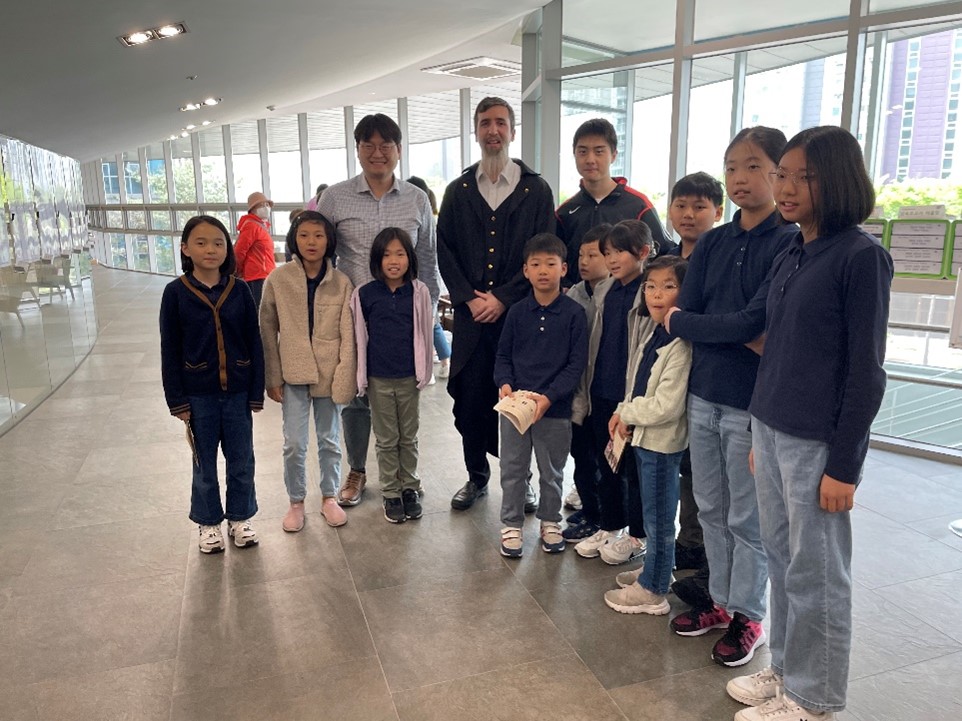
Also in attendance were students from The Light School, a Christian alternative school in Yongin. The students had been studying Missionary John Ross and early Korean Christians when they heard that Voice of the Martyrs Korea would be performing the drama near the school.
Missionary John Ross, played by Voice of the Martyrs North Korean Ministry Team Leader Pastor Trevor Foley, poses with students and faculty from The Light Christian School in Yongin at the debut performance of the John Ross Bible Historical Drama
“Through John Ross Bible Historical Drama, I have been very grateful to see how God’s Word has changed people who are mere treasures into God’s people who risk their lives to preach the Bible,” said Pastor Go Byeong-ik, the pastor in charge of the school. “I was impressed by the historical facts through the play, and the acting of the North Korean defector teachers was very good and interesting. In particular, I was surprised that Pastor Trevor Foley, who played the role of John Ross, spoke Korean so well.” Pastor Go says the Light School receives the Voice of the Martyrs Korea monthly newsletter and uses it to guide students’ prayer requests for Christians in persecuted countries, as well as to support VOMK’s annual sending of more than 40,000 Bibles per year into North Korea.
Representative Foley says Voice of the Martyrs Korea plans to continue performances of the John Ross Bible Historical Drama throughout the remainder of 2024. Churches interested in hosting the performance can contact the ministry at 02-2065-0703 for more information.
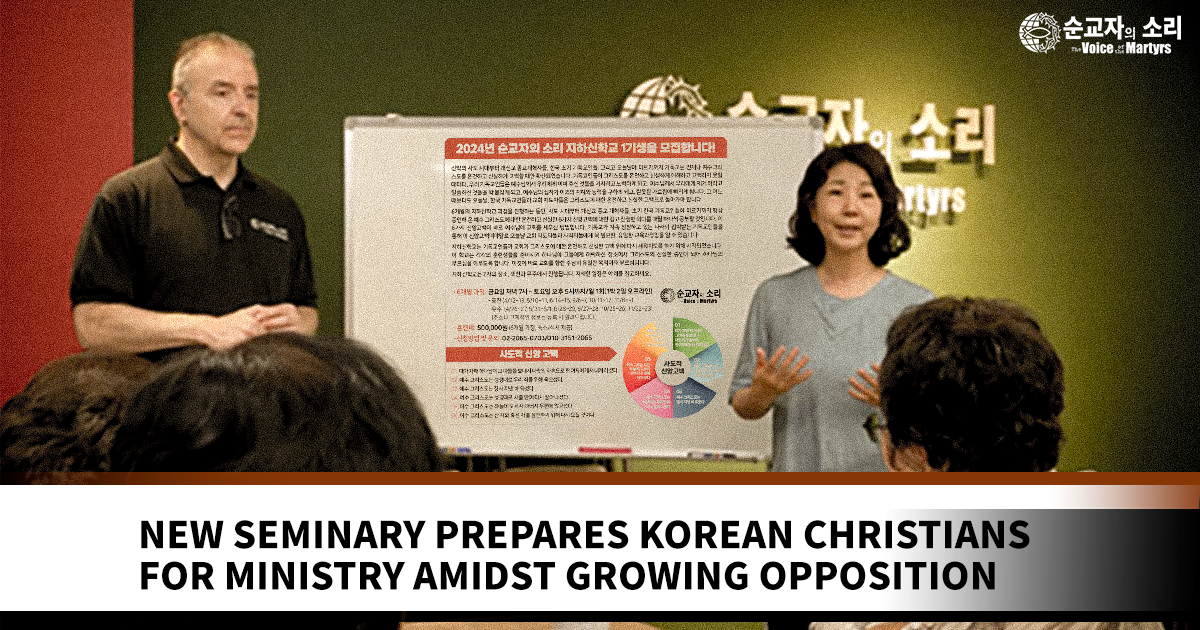
A new seminary opens in Korea this month, but don’t expect a ribbon cutting ceremony or an open house.
“Underground Seminary”, a new Korean seminary operated by persecution ministry Voice of the Martyrs Korea, is designed to train Korean Christians how to lead the church in settings of growing opposition to the Christian faith in Korea.
“The seminaries currently in operation in South Korea provide little to no training for their students in how to operate in environments increasingly hostile to the church,” says Pastor Eric Foley, CEO of Voice of the Martyrs Korea. “Underground Seminary brings to Korean Christians the training used to prepare leaders in the more than 70 countries around the world where Christianity is restricted or even outlawed.”










 Do the Word