Do Forgiveness And Feelings Go Together?

Pastor Tim Dillmuth says that forgiving based on our feelings is a faulty way to practice Scriptural forgiveness.  He says that sometimes our feelings cooperate with forgiveness, but more often they do not.  This may happen in cases where you have been greatly hurt or among family members . . . like brother and sister!

If you would like to hear more sermons on Forgiving and Reconciling, visit the VOM Korea Podcast Page!

Posted in Forgiving and Reconciling, Works of Mercy | Tagged , | 2 Comments

One Of The Best Books On Suffering And Persecution As Essential Parts Of The Christian Life

ISCSYou might expect North Korean defectors more than others to understand the “high cost” of following Jesus, but surprisingly many of them are as naïve as we are.

Many NK defectors in our Underground University program became Christians after escaping from NK. This means that a good majority of their Christian experience has taken place in South Korea. And since coming to South Korea, they have received an apartment and a sizeable amount of money from the government. They are also able to get an extra monthly stipend from many SK churches simply for attending. They experience “freedom of religion” in a similar way to how we experience it in the US. And this is of course mixed in with things like access to television, technology, and well-stocked grocery stores . . . AKA the good life! (Not really the good life, but hopefully you get my point – more on that here)

Thus, when I read Luke 14:28-33 with them last Saturday, many of them were a little concerned that Jesus said it would cost us everything to follow him. And to be honest . . . I was just as concerned as they were!

Luke 14:33 says, “So therefore, any one of you who does not renounce all that he has cannot be my disciple.”

I love how Pastor Brian Steele of Christ the King Community Church described it. He said,

Jesus was not a crooked salesman. And because of this he probably lost potential followers who wouldn’t pay the price he was asking.

A good Scriptural theology of Christian suffering and persecution is largely absent from many cultures like South Korea and the United States, where Christians tend to have material wealth and enjoy a reasonable amount of success and comfort. As a result, we tend to twist the Scriptures and replace the Jesus of the New Testament with our own creation. A 2010 article in Canada’s National Post put it this way,

Santa is the perfect deity for our day; he’s a god-man who is eternal, omnipotent, omniscient and omnipresent, who judges and reward good and bad behaviour. He is a vehicle of undeserved love, forgiveness and grace . . .

But what about Jesus?

The sweet infant sleeping on the hay . . . grows up to be the man who angers local religious authorities, is betrayed, abandoned and handed over for torture by disappointed friends, and dies a traitor’s cruel death.

Following Santa seems much more appealing than following Jesus . . . doesn’t it?

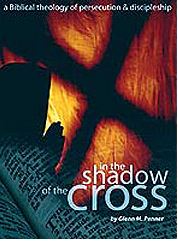
Although our culture makes it difficult to understand, the Bible is clear that being a disciple of Jesus isn’t easy, and that it always involves suffering. One of the best resources that I’ve found on the topic is Glenn Penner’s book, In the Shadow of the Cross.  In the beginning of the book, Glenn Penner quotes Dietrich Bonhoeffer:

Discipleship means allegiance to the suffering Christ, and it is therefore not at all surprising that Christians should be called upon to suffer.

The simple truth is that if you are truly following Christ you will be called to suffer, you will be called to carry your cross, and you will be called to give up everything. It’s not an “optional extra” that only certain Christians are called to endure. That’s why I’m recommending Penner’s book to you, why we use this book to teach our Underground University students, and why we broadcast the contents for Christians in both China and North Korea.

Posted in Making Disciples, North Korea, persecution, Uncategorized | Tagged , , , | Leave a comment

North Korean Defectors’ Angry Response To The North Korean Government’s Angry Response To The US State Department’s Angry Report (And Why None Of This Is Helpful)

In Underground University class this past weekend Dr. Foley and I showed our students the video released by the North Korean government this week refuting the U.S. State Department’s allegations this week of egregious violations of religious freedom in North Korea.

The video is in Korean, but you don’t have to understand Korean to catch the gist of it. The video shows the newly renovated Chilgol Church, one of the four state church buildings (two Protestant, one Catholic, one Russian Orthodox) operated by the North Korean government. If you understand Korean, you’ll be able to hear the North Korean reporter explain that North Korean Christians have been afraid to worship openly because of U.S. bombing of North Korean church buildings during the Korean War. There’s also the “truer-than-he-knows” statement from Chilgol Church minister Baek Bong Il that

Our esteemed Premier [Kim Il Sung] taught us what Christians should believe, thus setting new ground for our religious lives.

The video is characteristically outlandish, and, predictably and understandably, raised considerable ire among our Underground University students. “We need to record a video in response, exposing these lies!” shouted one usually timid UU student, rising to her feet and slicing the air with emphatic gestures. “Complain to our pastors!” shouted another. “Denounce Baek Bong Il!” called a third.

But scripture is decidedly obtuse when it comes to dealing with our enemies. Consider a representative sampling:

For our struggle is not against flesh and blood, but against the rulers, against the authorities, against the powers of this dark world and against the spiritual forces of evil in the heavenly realms (Ephesians 6:12, NIV).

But I say unto you, Love your enemies, bless them that curse you, do good to them that hate you, and pray for them which despitefully use you, and persecute you (Matthew 5:44, KJV).


“Do what is beautiful to the one who hates you” is how the Aramaic Bible translates it.

Some of my colleagues tell me it is hard enough to get the people in their own country to even be aware of or pay attention to Christian persecution in other countries. True, sadly. But my colleagues and I also know that Hebrews 13:3 doesn’t stop at our raising awareness of atrocities committed against Christians. We know that scripturally it is not enough to simply change our Facebook icons to identify with Christians in Mosul. It may start there, but if it does not end with us returning blessings for cursings and doing what is beautiful to the ones who hate us, then we have prematurely aborted our trip down the rabbit hole.

As Martin Luther King, Jr., Mahatma Gandhi, and Cho Man-Sik knew, following Jesus in loving our enemies does not mean avoiding mention of their sins while enjoying a warm communion repast and pleasant Bible study (more on that next week), but it is safe to say that if we loved our friends the way many Christians love their enemies, most of our friends would rather we not love them.

That’s why at Underground University we are asking the students: What would it mean scripturally to bless Baek Bong Il? What would it look like to do what is beautiful to Chilgol Church without our being in league with it? How do we raise awareness of atrocities and identify with our suffering North Korean Christian brothers and sisters not only without demonizing their persecutors but with loving them the way we love ourselves?

For that, there is only one Facebook symbol.

Cross-FS


Posted in Bible, Doing Good, Forgiving and Reconciling, North Korea, persecution | Tagged , , , , , , , | 1 Comment