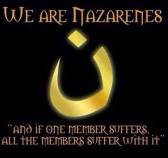
 I was tagged earlier this week in a Facebook picture entitled “We Are Nazarenes.” The post shows the now well-known symbol used to mark the homes of Christians in Mosul, along with the caption (from 1 Corinthians 12:26), “And if one member suffers, all the members suffer with it.”
While I am usually not a fan of being tagged in Facebook posts (since this typically sets off an avalanche of subsequent notifications from people commenting on a post which I did not generate in the first place and with which I may not agree), in this case the tag did a good work in me, for which I am grateful. I am grateful also to our American sister ministry, Voice of the Martyrs/US, for challenging me through their i-am-n campaign in the very same way. Both campaigns have caused me to have to ask myself:
If I really am N, what then does that mean?
For myself, I have no difficulty feeling genuinely connected to the Christians of Mosul (or, perhaps more accurately, the Christians formerly of Mosul). Given our work with the underground Christians of North Korea, such a feeling of kinship arises quite naturally.
Rather, the challenge for me is how these campaigns have forced me to take a closer look at what response the Scripture calls for in circumstances like this one. If I am N, in other words, I want to be a good one.
In this regard, the oft-cited Hebrews 13:3 is as notable for what it does not say as for what it does. Here is how it reads in the NIV:
Continue to remember those in prison as if you were together with them in prison, and those who are mistreated as if you yourselves were suffering.
What is being commanded is not entirely clear or explicit. What are we to do when we “remember”? And what does it mean to remember “as if” we were the ones suffering?
Typically we believers interpret the admonition to mean something like:
- Pray for
- Sympathize with
- Call attention to
- Use our freedom to help out
I do not doubt that every one of these things is true in this case and the other cases we encounter with persecuted Christians. Perhaps for me because of my background with North Korean work, these are the parts of the “We are Nazarenes”/”I am N” identification that come quite readily to me.
But one suspects that if the goal of the writer of Hebrews was only to have us pray for, sympathize with, call attention to, and help out prisoners, he would have simply said so. There are exact constructions in Scripture for each of these phrases, and in fact each phrase and its related call to action are commended to believers over and over again. Christianity 101, you might say.
However, the key words in this passage–typically translated “remember” and “as if you were together with them in prison”–have few if any parallels in the rest of Scripture.
In other words, the author is commending something that is very unique and hard to express in any other way. He is asking us not only to do the things listed above but also to do something more because of our identification with those who suffer. What is it?
One interpretive tool that is seldom employed in relation to this verse is contextual analysis. In other words, what was the author talking about prior to this verse? Can that context give us any insight into how he intends us to understand these unique words and phrases?
Here is what immediately precedes Hebrews 13:3, again in the NIV:
Keep on loving one another as brothers and sisters. Do not forget to show hospitality to strangers, for by so doing some people have shown hospitality to angels without knowing it.
The subject at hand in Hebrews 13 is loving other Christians. That is straightforward enough. But interestingly, as the chapter unfolds we see that the author of Hebrews is at least as concerned about the why as he is the how.
For example, the author of Hebrews tells us that we are to show hospitality to strangers. Why? Because there is often more to strangers than meets the eye. Throughout the Scripture we are given plenty of reasons for being hospitable. We should be hospitable because we were once strangers and aliens. We should be hospitable because we want others to be hospitable to us. We should be hospitable because we are to be like our Father in heaven, who is hospitable.
But of all the reasons to be hospitable, the author of Hebrews highlights a very unusual one: Because angels are out and about, and we may be entertaining them unaware–or, worse, slamming our doors in their faces without knowing it.
Thus, Hebrews 13:2 sets a fascinating context for Hebrews 13:3. What if there were more to prisoners of the faith than meets the eye?
The context for Hebrews 13:3, in other words, is not simply combating indifference. The author of Hebrews is not merely saying, “It is easy to forget about prisoners. Let’s not do that.” That’s absolutely true as far as it goes, of course. But as I travel around the world speaking about North Korean underground believers, I find that we Christians generally don’t shrug off the sufferings of other believers. When we learn about their difficulties we seem to have a natural inclination to feel bad for them. And not only to feel bad–I also find that we Christians generally want to help out suffering Christians, praying for them, if not also giving money and spreading the word in an effort to somehow alleviate their suffering.
All good. But the author of Hebrews takes it one step deeper. Just as he gives us a very unusual reason for opening our homes to strangers (i.e., because there is more to strangers than meets the eye), he likewise provides us a very unusual way to think about prisoners. He leads us to ask: Could there be more to prisoners than meets the eye?
The Wycliffe translation captures this quite well when it begins Hebrews 13:3 with this admonition:
Think ye on bound men, as ye were together bound
The admonition, in other words, is not just “Do not forget the prisoners.” It is “Look carefully into this matter of Christians imprisoned for their faith.” Why?
Here, Wycliffe again does us a favor. As opposed to the more commonly appearing “as if,” Wycliffe (correctly, I would contend) drops the “if.” The meaning then becomes, “Look carefully into this matter of Christians imprisoned for their faith. Though it may not appear this way to the eye, you are bound together with them.”
The second half of the verse, which is too often taken to be simply a restatement for emphasis of the first half, actually delivers the punch line. Charles Williams is one of many translators (including Weymouth, Norlie, Lamsa, Goodspeed, and the New English Bible) who captures this well when he renders this:
…since you, too, are liable to similar physical punishment.
Put it all together and it comes out like this:
Look carefully into this matter of Christians imprisoned for their faith. Though it may not appear this way to the eye, you are bound together with them since you, too, are liable to similar physical punishment.
This is a far more challenging rendering of the verse than we may typically contemplate, and one that has a number of obvious parallels in the rest of Scripture, including Jesus’ own words in Luke 23:26-31:
As the soldiers led him away, they seized Simon from Cyrene, who was on his way in from the country, and put the cross on him and made him carry it behind Jesus. A large number of people followed him, including women who mourned and wailed for him. Jesus turned and said to them, “Daughters of Jerusalem, do not weep for me; weep for yourselves and for your children. For the time will come when you will say, ‘Blessed are the childless women, the wombs that never bore and the breasts that never nursed!’ Then
“‘they will say to the mountains, “Fall on us!”
and to the hills, “Cover us!”’
For if people do these things when the tree is green, what will happen when it is dry?”
“Why do you think what is happening to me is unrelated to what will soon happen to you?” This is the question Jesus puts to those who are following him and mourning him. In the same way, the author of Hebrews challenges his readers, “Why do you regard prisoners as distinct from you and their circumstances and fate as distinct from your own? The punishment they are experiencing will not be foreign to you for much longer.”
How might this change the way we remember (i.e., think on, carefully look into) the situation facing the Christians of Mosul?
What if, as we mourned the Christians of Mosul and followed their plight on the news, Jesus turned to us and said,
“Christians in the ‘free’ world, do not weep for the Christians of Mosul; weep for yourselves and for your children. For the time will come when you will say, ‘Blessed are the Christians who were warned before they were evicted, given the chance to escape before they were put to death!’
This does not in any way absolve us of prayers, tears, and advocacy on their behalf. After all, Jesus wasn’t shooing the women away. He was calling them to think even more deeply. And when we think even more deeply and scripturally we begin to recognize that prisoners of faith are not an aberration to be remedied by our advocacy and relieved by our gifts, as much as those actions are important. No, prisoners of faith are a regular and permanent feature of Christianity–a reminder until he comes again of the difficulties Christ promised would be attendant to all who follow him. We really are Nazarenes, in a way deeper than we can imagine.
And interestingly, Nazarenes and other persecuted Christians are in their harrowing situations for the same reason he was in that situation: Because it turns out that Christianity really is a threat to Islam, a threat to the existing world order, and a threat to many aspects of the “American way of life” as well. Even if we generally mind our own business and carry out the commands of Christ in small and faithful ways that would seem to hurt no one, we should not be surprised when our countrymen turn on us as well one day, just as the countrymen of the Christians of Mosul are turning on them now. Trouble, says Jesus, is what you have in store when you follow me.
If this is true, then how are we to respond today to the situation facing the Christians in Mosul? Pray, yes. Give, yes. Advocate, yes. Cry, yes. But something more, deeper, and costlier is called for here than only our tears, our advocacy, and our material aid, and–yes–our Facebook posts.
What is called for is a decision to voluntarily take up the cross in our own nation and neighborhood, while the wood is still green.
If you wonder what that would look like in your own life, you are not alone. I am renewing my own quest for an answer. Fortunately the author of Hebrews actually goes on to explain in detail to us some of the consequences of identifying with the Nazarene (and the Nazarenes) that we are likely to encounter. He says this identification will impact every dimension of our existence, from our marriages (13:4) to our Christmas wish lists (13:5) to our diets (13:9) to the people with whom we voluntarily associate (and “friend” on Facebook) and the places we frequent (13:13). But I’ll let you read those verses for yourself.
Just don’t say I didn’t warn you.









 Do the Word