
Dur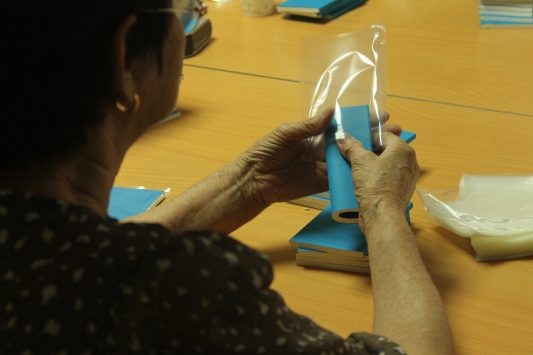 ing the summer, our balloon rooms are always a bustling place. People from around the world work elbow to elbow. Small, blue bibles are stacked on each table. Some people sing hymns. Others share scriptures. Some muse to one another about how surreal it is to hold the same Bible that a North Korean will be holding only hours later.
One of these volunteers thoughtfully thumbed through a blue Bible.
“You know,” she said. “Bibles are great. But I think we should send something else in the balloons, too. Something the North Korean people really need.”
This volunteer was not the first person to have this thought. Why do we send Bibles in our balloons? Why not food or clothes or sanitary napkins? After all, North Koreans need food, clothes, and sanitary napkins so much more than they need the Bible.
Another volunteer immediately joined the conversation. “Human beings need God more than anything!”
These words are easy to say, but their meaning is very difficult to understand. Each day, thousands of North Korean citizens die from starvation. The government systematically starves these individuals due to their suspicious or rebellious behavior.
Many people in North Korea suffer in the monsoon season because they do not have rain boots or raincoats. Some are stricken by horrid cases of trench foot. People from North Korea say (only half-jokingly) that they would sell their wives for a pair of rain boots.
Women in the more rural areas of North Korea often do not have access to sanitary napkins. They must use cloths, instead. During the winter, these women risk hypothermia to wash these cloths in the frigid water.
Without any of these items, a person in North Korea can die. Claiming that the Bible is more important than any of these necessities is not a glib matter. It is a very serious one. But I believe that it is the correct claim. Let me tell you why.
Food, clothes, and sanitary napkins that are sent into North Korea will—very likely—be confiscated by the North Korean government. North Korean citizens are required to report balloons to the authorities. Not reporting a balloon is a punishable offence. Out of fear, the North Korean citizens will almost always report these balloons to the authorities. After all, punishment in North Korea is not only restricted to the individual criminal. Families (and sometimes even extended families) are punished as well.
The simplest solution, one might argue, is for the group of North Koreans who find the balloon to all agree not to report it. But, as the case of the Prisoner’s Dilemma illustrates, this solution is not always a feasible one. The night after finding the balloon, each of the group members will lose sleep. Each will worry that the other group members have reported the balloon. Each will worry that they have put their families in danger by refusing to alert the authorities. As the old North Korean adage goes, “whenever two or three are gathered together, one of them is a spy.”
The reason why the North Korean people need food, clothes, and sanitary napkins is not because their government is too poor to provide these items. It is because the North Korean government uses starvation, nakedness, and unsanitary conditions as a tactic to strengthen their government. The strength of the North Korean government is relative to the strength of the Juche ideology. Anyone who threatens the Juche ideology is an enemy of the state. These people are left hungry, naked, and filthy.
Those who support and adhere to the Juche ideology are nourished, clothed, and well-provided for. They live in cities of relative wealth and prosperity. They are able to afford items like televisions, cars, and computers. But even these people live in fear. One word to an official about how they do not adhere to the Juche ideology can land them in a concentration camp. Providing food, clothes, and sanitary napkins to the North Korean people is important. North Korean people need all of these items. (Our ministry actually does provide them through a more effective method in our “Ministry Pack” ministry.) But what North Korean people need most is a new system. They need a system which will feed the hungry, clothe the naked, and lift up the fallen.
The Bible introduces the North Korean people to this system.
Our Bible includes 46 different stories from the Bible. In every one of these stories, God shows his care, compassion, and trustworthiness to human beings. In every one of these stories, God instructs human beings to follow his example. God’s love is not a static love. It is a love that changes every person that it touches. This love has eliminated slavery, created worker’s unions, and built homeless shelters. This love is the only instrument powerful enough to transform North Korea.
While North Koreans do need food, clothing, and sanitary napkins, we can say with confidence that North Koreans really do need the Bible more than anything else.
Written by Margaret Foley . . . VOM Korea’s newest staff member!







 Do the Word