
Luke 15:1-10 is part of the portion of Luke which began in Luke 9:51 where Jesus has set his face towards Jerusalem and is on the way there to continue to fulfill Isaiah 61 as he preached in Luke 4. Jesus is the true Lord and this journey is the final Exodus, to which the first Exodus—the one out of Egypt –points and in which it is fulfilled .
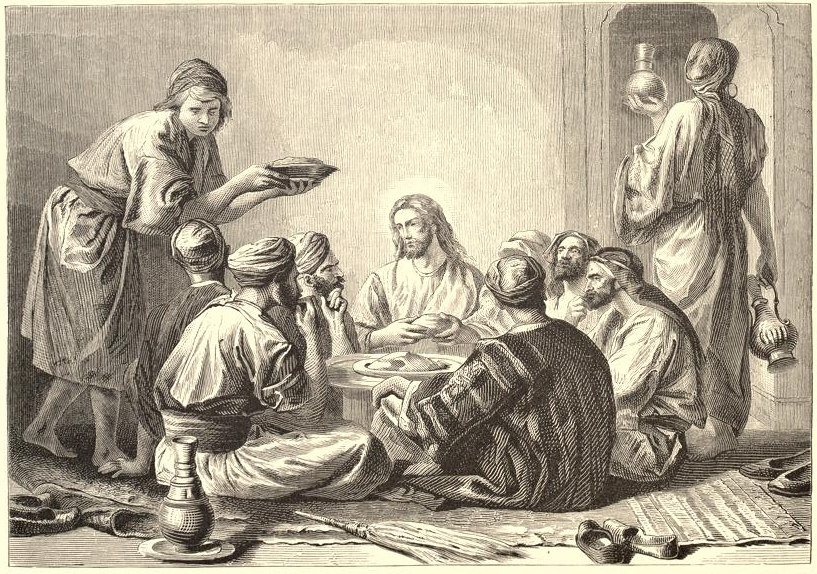
In the first Exodus, what happens to the Israelites who mutter in the wilderness? They died in the wilderness. Likewise, the “muttering” of the Pharisees and teachers of the Law throughout Jesus’ journey to Jerusalem are very serious. Their accusations against Jesus—that he works on the Sabbath (through his healings) and that he welcomes and eats with sinners—are punishable by death, according to the Law.
So how does Jesus respond to these serious accusations? By telling a parable:
“Suppose one of you has a hundred sheep and loses one of them. Doesn’t he leave the ninety-nine in the open country and go after the lost sheep until he finds it? And when he finds it, he joyfully puts it on his shoulders and goes home. Then he calls his friends and neighbors together and says, ‘Rejoice with me; I have found my lost sheep.’ I tell you that in the same way there will be more rejoicing in heaven over one sinner who repents than over ninety-nine righteous persons who do not need to repent. “Or suppose a woman has ten silver coins and loses one. Doesn’t she light a lamp, sweep the house and search carefully until she finds it? And when she finds it, she calls her friends and neighbors together and says, ‘Rejoice with me; I have found my lost coin.’ In the same way, I tell you, there is rejoicing in the presence of the angels of God over one sinner who repents.” ” (Luke 15:4-7)
The main point of Jesus’ parable, as he notes, is that there is rejoicing over repentant sinners. But, interestingly, the sheep and the coin don’t seem to repent. They don’t seem to do anything except be lost and then be found. All of the action is done by the shepherd and the woman.
This is the reason why the Pharisees and the teachers of the law mutter: The tax collectors and sinners didn’t go through the proper steps and procedures outlined in the Law for repentance. All they did was be found by Jesus and follow him. So it means that they are still sinners.
The Pharisees and the teachers of the law know what the scripture says about sinners, especially the Psalms, which says that sinners will be punished. If the tax collectors and sinners repented, wouldn’t the Pharisees and the teachers of the law repent?
No! We know that because when John the Baptist came, tax collectors and sinners repented, but the Pharisees and teachers of the law did not rejoice.
“(All the people, even the tax collectors, when they heard Jesus’ words, acknowledged that God’s way was right, because they had been baptized by John. But the Pharisees and the experts in the law rejected God’s purpose for themselves, because they had not been baptized by John.) Jesus went on to say, “To what, then, can I compare the people of this generation? What are they like? They are like children sitting in the marketplace and calling out to each other: “‘We played the pipe for you, and you did not dance; we sang a dirge, and you did not cry.’ For John the Baptist came neither eating bread nor drinking wine, and you say, ‘He has a demon.’ The Son of Man came eating and drinking, and you say, ‘Here is a glutton and a drunkard, a friend of tax collectors and sinners.’ But wisdom is proved right by all her children.” (Luke 7:29-35)
This is the point which Jesus makes in the parable of the prodigal son in Luke 15. When the second brother returns home, the first brother did not rejoice and feast with the rest of the father’s house. So the Pharisees and teachers of the law exclude themselves from the Kingdom through their failure to rejoice over the Lord’s work of saving sinners.
But aren’t the Pharisees and teachers of the law the 99 righteous sheep who did not need to repent?
With that question, we come to the heart of the parable. To understand Jesus’ answer, we need to hear from a former Pharisee: Paul the Apostle. He writes this about himself:
“circumcised on the eighth day, of the people of Israel, of the tribe of Benjamin, a Hebrew of Hebrews; in regard to the law, a Pharisee; as for zeal, persecuting the church; as for righteousness based on the law, faultless.” (Philippians 3:5-6)
Paul was one of the 99 righteous who did not need to repent. He was “blameless” according to the law. He was in right relationship to the Law, so he had no reason to repent. But he was not in right relationship with God and others.
The Pharisees and teachers of the law in Luke 15 are in the same position. There have no need to repent according to the law. But, says Jesus, there is no rejoicing in heaven over such people. That is because Jesus did not come to bring people into right relationship with the law.
What the Pharisees and the teachers of the Law could not see—and what many of us Christians today cannot see—is that Scripture talks about two completely different kinds of righteousness and two completely different kinds of sin. Paul describes the two different kinds of righteousness like this in Philippians 3:9: One he calls “a righteousness of my own that comes from the Law”, and the other he calls “the righteousness that comes from God and is by faith”.
And what of the two different kinds of sin? We can distinguish these by calling them “lowercase-‘s’ sins” and “uppercase ‘S’ Sin”. Lowercase-s sins are individual infractions against the law. They are often spoken of in the plural, like in the Lord’s Prayer when we say, “Forgive us our sins.” When the Pharisees and teachers of the law call people “sinners”, they are referring to people who have committed such sins and have not repented of them. Calling them “lowercase-‘s’ sins “ doesn’t mean they are “small sins”. It means all sinful actions we do—including big sins like murder, sexual sin, lying, and stealing.
Uppercase “S” Sin refers to Sin as a power—the power that holds all human beings in slavery. Paul writes about “Capital-S Sin” in Romans 5:12:
“Sin entered the world through one man, and death through sin, and in this way death came to all men, because all sinned.”
Sin and sins are related. We are enslaved to Sin and so, as a result, we commit sins. The temple and John’s baptism could deal with sins, but the were powerless against Sin. Against Sin, we are completely helpless…like lost sheep or a lost coin. This is why Jesus uses word like “lost”, “sick” or “indebted” to describe sinners. When Jesus uses these words, he is talking about Sin.
If you are really lost, someone has to find you. If you are really sick, someone has to heal you. If you are really in debt, someone has to pay for you. On our own, we can repent of sins, even non-Christians do that if they have a strong conscience. But Sin goes way deeper than conscience.
Our conscience cannot feel Sin, and we are not even aware of it. and faith are opposites: “Capital-S Sin” is rebellion against God, while faith is trust in God. Paul says it like this in Romans 14:23:
“everything that does not come from faith is sin” (Romans 14:23)
Faith, forgiveness, and repentence are Sin-overcoming gifts that can only come to us from God as we hear his voice:
“Consequently, faith comes from hearing the message, and the message is heard through the word about Christ.” (Romans 10:17).
Faith cannot come to us through an explanation of the gospel or through general encouragements about God’s existence or God’s love for us. Faith can only come from the proclamation of the gospel itself. Only the gospel itself is God’s own word and voice.
When angels are rejoicing in heaven, are they rejoicing because someone made a good decision to repent? Are they saying, “Hey, good job, sinner, you made a good choice!”
No! They are rejoicing because Jesus has sought, found, and granted repentance to one more sinner. That is something only he can do.
The Church really needs to recover this proper understanding of two kinds of sin and two kinds of righteousness. Because we do not understand these difference, we do not understand our role in the world and have become like the Pharisees and teachers of the law.
How?
The Lord calls us to address the Lowercase-s sins of our fellow believers, but not the Lowercase-s sins of the world.
“What business is it of mine to judge those outside the church? Are you not to judge those inside? God will judge those outside. “Expel the wicked person from among you.” (1 Corinthians 5:12-13).
This is why the church is never shown in the New Testament as protesting and trying to change the laws of the world. Addressing Lowercase-s without first addressing and overcoming Capital-S Sin means that we do not understand sin, righteousness, the Lord, or his gospel at all.
When we speak to the world, the Lord only authorizes us to address Capital-S Sin. We do that through the only message he has authorized us to share in the world: the gospel. It is through the gospel that the Lord reveals that he is the friend of Capital-S sinners. It is through the gospel that He addresses Capital-S sinners as lost, sick, and deeply in debt to Sin. It is through the gospel that he sets Capital-S Sinners free from the law of sin and death.
But, today, the church is completely focused on judging and condemning the lowercase-s sins of the world. It is always out there protesting sinful laws and trying to change them. In this, we are imitating the Pharisees and the teachers of the law, not the Lord. The Lord has one purpose for coming to the world, and it is not to uphold Christian values:
“For the Son of Man came to seek and to save the lost.” (Luke 19:10)







 Do the Word